

The strongest brand awareness marketing objectives are the ones you can measure against a starting point. Five cover most campaigns: recognition and recall, reach and share of voice, credibility through earned media, branded search and direct traffic, and an engaged audience on channels you own. Pick recall if you are a newer brand in a defined market. Pick share of voice if louder competitors crowd your category. Pick earned media if trust is your barrier. Pick branded search if you want proof in your analytics. Pick owned-channel engagement if your leaders are the face of the business.
Most businesses start a campaign with a vague wish to "get our name out there". That wish cannot be measured, so it cannot be budgeted, defended in a boardroom or judged a success. You end up reporting likes and hoping.
This article gives you five objectives for brand awareness, the KPIs that track each one, and a practical way to reach it. It then shows you how to turn the objectives into SMART goals and build a campaign around them. Purple Word Box is a South African PR and communication agency that helps businesses with PR strategy, media relations, press releases, media pitches and content placements.
1. Increase brand recognition and recall
Recognition and recall are the foundation objective. You want more of your target market to know your brand exists and to link it with the right category. Every other objective on this list depends on it, because buyers cannot shortlist a business they cannot remember.
What it means
Awareness comes in two strengths. Aided recall is when someone says yes to "Have you heard of this brand?" after seeing your name. Unaided recall is when they name your brand without a prompt when asked about a category, such as "Which payroll providers can you think of?" Unaided recall is harder to win and worth far more.
Set this objective when you are new, entering a new market or launching a new offering. It also suits a brand that is well known by the wrong people, because recognition among your actual buyers is what counts.
You cannot be chosen if you cannot be recalled.
How to measure it
Run a short survey of your target audience, not your friends or staff. A sample of 100 to 150 people gives a usable baseline if you ask the same questions each time. A free tool such as Google Forms is enough to collect the answers. Track these KPIs:
- Aided recall percentage
- Unaided recall percentage
- Category association, meaning the share who link your brand with the service you want to be known for
- Source of awareness, from a simple "How did you first hear of us?" question
How to reach it
Repeat the same name, message and visual identity in the places your buyers already spend time. Recall comes from consistent, repeated exposure, so spreading a small budget across eight channels works worse than doing two or three well. Choose channels by where your buyers read and listen, such as trade publications, LinkedIn or industry events.
Write one sentence that says what you do and for whom. Use it on your website, in press releases, on LinkedIn and on event signage. A message that changes with every channel is forgotten as fast as it is read.
2. Grow reach and share of voice
This objective is about how many of the right people see your brand and how much of the category conversation you own. Choose it when competitors are louder than you or when you are entering a crowded category.

What it means
Three terms get mixed up. Reach is the number of unique people who saw you at least once. Impressions count every view, including repeats. Frequency is impressions divided by reach, or how often the average person saw you.
Share of voice is your mentions divided by all mentions of you and your competitors in the category, multiplied by 100. If your category earns 200 media mentions in a quarter and 20 are yours, your share of voice is 10%.
Reach tells you how many people saw you, and share of voice tells you whether you are winning the category.
How to measure it
Platform reports such as LinkedIn analytics give you reach and impressions for your posts and ads. For share of voice, pick three or four direct competitors and count mentions of each in news and trade coverage over the same period. Google Alerts can collect these mentions for free, and a paid monitoring tool saves time when you track more brands.
Report reach as a share of your target audience where you can. Ten thousand impressions from people who will never buy from you is a vanity figure, not progress.
How to reach it
Narrow your targeting before you widen your budget. Aim paid placements at specific job titles or industries. Then add earned coverage and speaking slots to reach the same people for free. A frequency of one means people saw you once and moved on, while repeated sightings in the same publications are what build familiarity.
3. Build credibility through earned media
Here the objective is to be known and also believed. Coverage chosen by a journalist carries more trust than anything you buy, so earned media is the strongest route to credible awareness. It suits B2B firms, professional services and any business where buyers worry about risk.

What it means
Awareness without trust rarely turns into enquiries. When a respected publication quotes your expert or covers your story, a third party vouches for you. That is why PR belongs in an awareness plan and not only in crisis response.
Purple Word Box helped TreasuryONE gain mainstream media recognition in its market. That kind of move, from a respected specialist to a name the general business press uses, is what this objective aims for.
Earned coverage borrows the trust of the publication that runs it.
How to measure it
Count what you can verify and judge what you cannot. Useful KPIs include:
- Number of placements in publications your buyers read
- Share of coverage that carries your key messages
- Sentiment of coverage (positive, neutral or negative)
- Spokesperson quotes and interviews secured
- Website visits that come from coverage
A hundred mentions in outlets nobody in your market reads are worth less than five in the right titles, so weight quality above volume.
How to reach it
Find the stories that already exist in your business, such as a customer result, a market insight or an expert opinion. Package them as a press release or a thought leadership article, and pitch each to the journalist who covers that topic. Our PR and media relations service follows this route, from PR strategy to media pitches and placements. Media training also helps, because a prepared spokesperson turns one interview into repeat invitations.
4. Lift branded search and direct traffic
This objective turns awareness into numbers in your analytics. When more people know you, more of them type your name into Google or go straight to your website. It suits you if you need to show results to a manager who wants proof beyond impressions.
What it means
Branded search is any search that contains your company or product name. Direct traffic is visits where the person typed your address or used a bookmark. Both come from people who already know you, so growth in either is a strong sign that awareness is working.
Read direct traffic with care. It also includes visits whose source could not be identified, such as links shared in private messages. Look at the trend over months instead of treating one month as exact.
Branded search is awareness that people acted on.
How to measure it
Open Google Search Console and filter the performance report for queries that contain your brand name, including common misspellings. Track the impressions and clicks over time. In your analytics, watch the direct channel and the number of new users. Google Trends lets you compare interest in your name against competitors.
How to reach it
Make your name easy to search for. Put the full brand name and website address in every press release, LinkedIn post, event banner and speaker slide. When a journalist, podcast host or event audience hears your name, they need to know what to type next. Compare month against month, since the lift follows your activity rather than appearing on the same day.
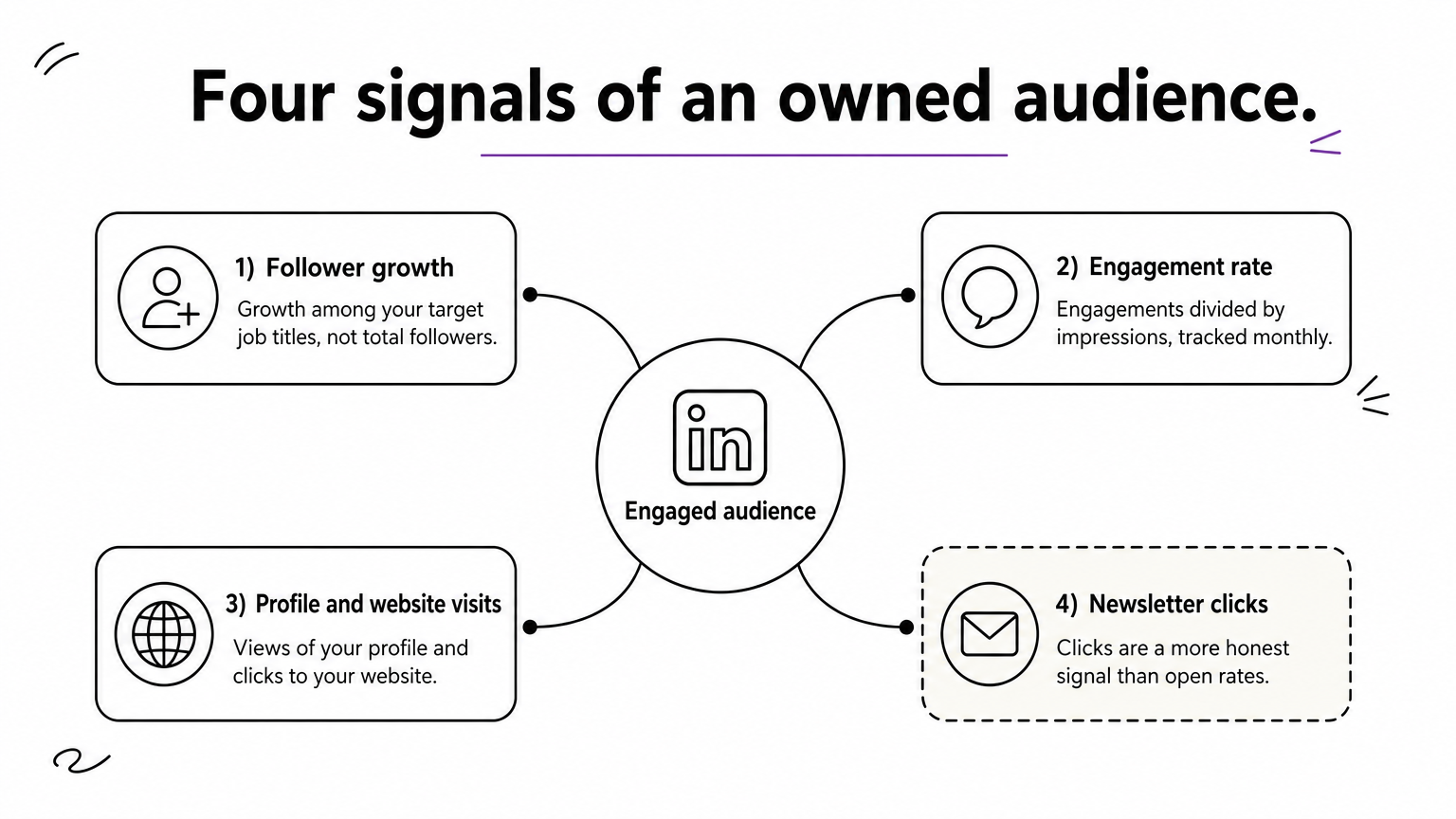
5. Grow an engaged audience on owned channels
Here you build an audience you own: LinkedIn followers, newsletter subscribers and returning website visitors. These people chose to hear from you, so you do not pay again to reach them. Choose this objective when your leaders are the public face of the business or when your sales cycle is long.
What it means
Engagement shows that people are paying attention and not scrolling past. A smaller audience of the right buyers that comments, clicks and replies is worth more than a large one that ignores you. For many B2B companies, LinkedIn is the main channel, and a leader with a clear point of view often becomes the brand’s most recognisable voice.
An audience you own keeps working after the campaign budget ends.
How to measure it
Pick a few indicators and track them monthly:
- Follower growth among your target job titles, not total followers
- Engagement rate, which is engagements divided by impressions
- Profile views and visits to your website from LinkedIn
- Newsletter subscribers and the clicks they make
Treat newsletter open rates with caution, because privacy features on email apps distort them. Clicks are a more honest signal.
How to reach it
Post consistently and say something specific. Share what you know about your market, answer the questions customers ask, and reply to comments within a day. Our Social & Profile service covers profile building, thought leadership posts and LinkedIn management for leaders and businesses that want this done well. Give your audience one reason to subscribe, such as a monthly note on your industry, and then deliver it on schedule.
How to turn these objectives into SMART goals
An objective is the direction, and a goal is the numbered target that proves you reached it. To set brand awareness goals, take each objective, record a baseline, then write a target that is specific, measurable, achievable, relevant and time-bound. Choose two or three objectives for one campaign, never all five.
Start with a baseline
Measure where you stand before you spend anything. Run the recall survey, count last quarter’s media mentions, and export your branded search clicks and LinkedIn engagement rate. Without a baseline you cannot tell growth from noise, and any later number is meaningless.
Write each goal in SMART form
A weak goal says "increase brand recognition". A SMART goal says: "Raise aided recall among finance managers at mid-sized companies from 12% to 18% within six months, measured by the same 150-person survey." On 150 respondents, that is 18 people today and 27 people at the target. It names the audience, the number, the method and the deadline.
A goal without a baseline and a deadline is only a wish.
Match each objective to a KPI
Use the table as a starting point. The targets are examples, so replace them with your own baseline and capacity.
| Objective | KPI | Where to find it | Example six-month target |
|---|---|---|---|
| Recognition and recall | Aided recall | Survey of 150 target buyers | 12% to 18% |
| Reach and share of voice | Share of voice | Media mention count against competitors | 10% to 15% |
| Credibility | Placements in target publications | Media monitoring | 1 to 3 per quarter |
| Branded search | Monthly branded clicks | Google Search Console | 400 to 520 (up 30%) |
| Engaged audience | LinkedIn engagement rate | LinkedIn analytics | 2% to 3.5% |
Build the campaign around two or three objectives
Your brand awareness campaign strategy should follow from the objectives you pick. A new brand might combine recall and credibility, using press coverage and consistent messaging. An established firm that wants to be heard above competitors might pair share of voice with an engaged audience. Review your KPIs monthly, repeat the survey each quarter, and drop tactics that do not move a number.
Start with two objectives and a baseline
Brand awareness becomes manageable when you stop chasing it as one vague outcome. Recognition and recall, reach and share of voice, credibility, branded search, and an engaged audience each have a KPI, a way to measure and a way to reach them. Pick two that fit your market, take a baseline, and write each as a SMART goal with a deadline.
If you want a senior PR practitioner to help turn those objectives into earned media coverage, a clear message and a steady online presence, talk to Purple Word Box about your brand awareness plan.