
Brand visibility vs brand awareness comes down to exposure versus memory. Brand visibility is how often and where your target audience can see your brand: in search results, on LinkedIn, in the press, at events. Brand awareness is how well those people recognize your brand, remember it, and know what you do. Visibility is something you create through placement. Awareness is something that forms in other people’s minds.
At Purple Word Box, we see this split in PR work all the time. A media placement gives a client visibility on the day it runs. Whether it builds awareness depends on whether readers remember the name and understand what the business stands for. Many South African businesses measure the first and assume they are getting the second.
This article explains why the difference matters, how to measure each one, and how to improve both without wasting budget. It ends with a worked example for a mid-sized business, so you can see how the pieces fit together.
Why brand visibility vs brand awareness matters
The two terms matter because they call for different fixes. If you treat a memory problem as an exposure problem, you buy more reach and nothing changes. If you treat an exposure problem as a memory problem, you polish your message for an audience that never sees it.
Visibility is exposure, awareness is memory
Visibility answers the question "Can people see us?" Awareness answers "Do people know us?" The first is about frequency and placement. The second is about recognition, recall, and understanding. The table below sets the two side by side.
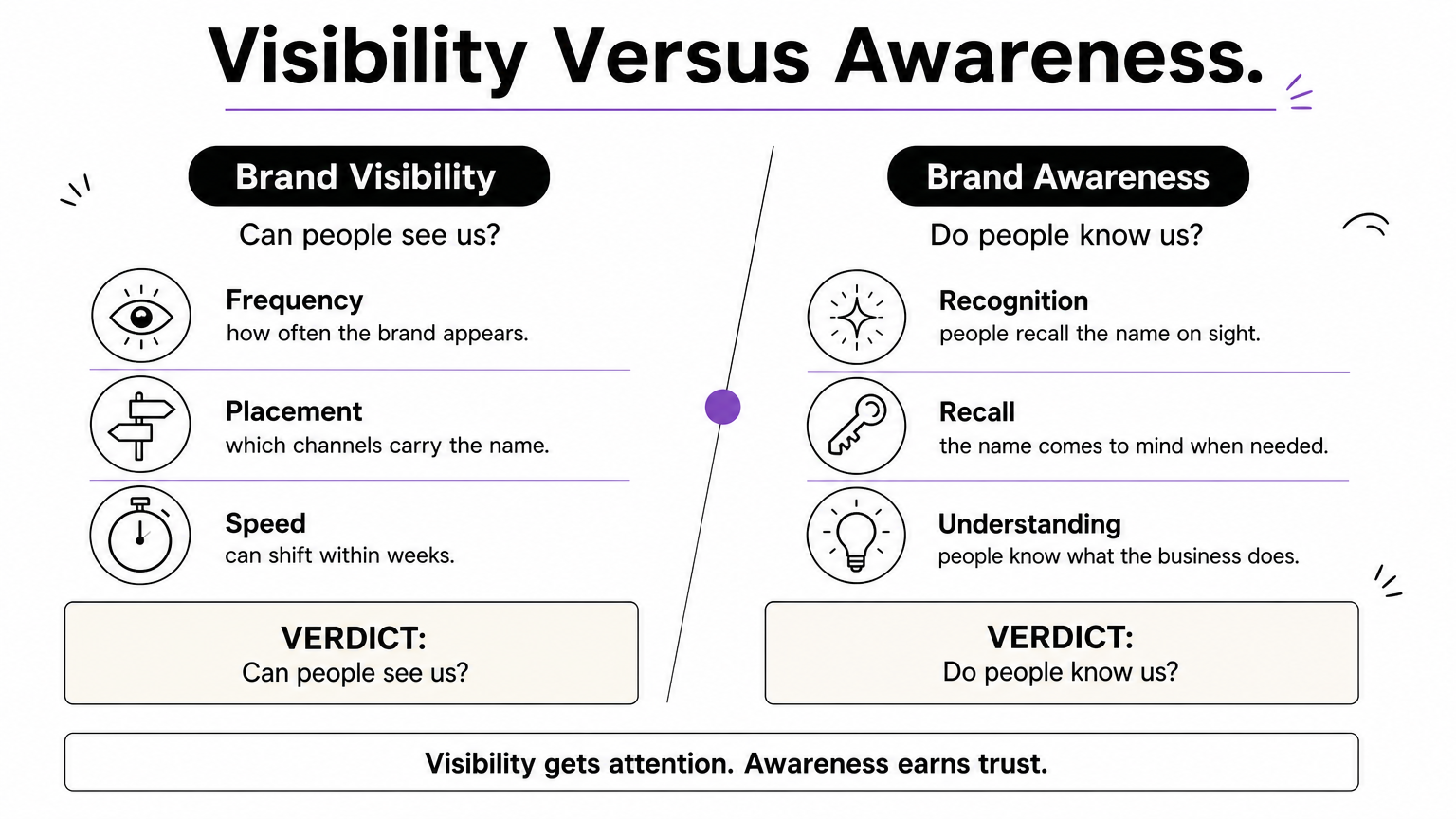
| Brand visibility | Brand awareness | |
|---|---|---|
| Core question | Where and how often is your brand seen? | What do people remember and understand about it? |
| What it describes | Exposure | Familiarity |
| Where it lives | Channels: search, media, social, events | The audience’s mind |
| How fast it moves | Can change within weeks of a campaign | Builds over months and years |
| Main risk | Being seen by the wrong people, or too rarely | Being recognized but misunderstood |
What goes wrong when one is missing
High visibility with low awareness looks busy but leaves no trace. Your ads run, your posts get impressions, and a journalist quotes your CEO. Yet when a buyer needs your service, your name does not come to mind. This usually happens when the message changes from channel to channel, so nothing repeats long enough to stick.
High awareness with low visibility is the opposite problem. People know you, but only those who already do business with you or heard about you years ago. You do not show up when new buyers search, scroll, or read the trade press. Your reputation ages while competitors fill the gap.
Visibility without awareness is noise, and awareness without visibility is a fading memory.
How the two feed each other
Visibility comes first in the sequence. People cannot remember a brand they have never seen. But repeated exposure does not guarantee memory, which is why awareness needs a clear, consistent message on top of it.
Once awareness exists, it improves visibility in return. People search for your name, click your results more readily, and share your content. Journalists also respond faster to a name they already recognize. So the two form a loop, and your job is to keep both halves turning.
How to measure brand visibility and brand awareness
Measure visibility with channel data that counts exposure, and measure awareness with surveys and behavior signals that show memory. Visibility is easy to count. Awareness takes more effort to track, but it is the number that tells you whether your work is sticking.
Visibility metrics you can track today
These numbers show how often your brand appears. Most of them come free from tools you already use.
- Search impressions: how often your site appears in Google results. Google Search Console reports this for free.
- Reach and impressions on social: LinkedIn and other platforms show how many people saw your posts.
- Media mentions: the number of articles, podcasts, and broadcasts that name your brand or spokespeople, plus the quality of those outlets.
- Share of voice: your mentions as a percentage of total mentions across you and your closest competitors.
- Ad viewability and frequency: for paid campaigns, how often real people saw the ad and how many times.
Awareness metrics that show memory
Awareness needs questions or behavior signals, because exposure alone cannot prove anyone remembered you. Four measures do most of the work.
- Unaided awareness: ask your audience to name brands in your category without prompts. Being named first shows top-of-mind awareness.
- Aided awareness: show a list of brands and ask which ones people recognize.
- Branded search: the volume of searches for your company or product name. Google Trends lets you compare this over time.
- Direct traffic and mentions: visitors who type your address straight in, and people who name you without being asked.
A short survey of 5 to 10 questions, sent to your customer list and a relevant audience, is enough to get a baseline. Repeat it once or twice a year with the same wording so the results can be compared.
Read the two together
The real insight comes from comparing both sets of numbers. If impressions and mentions climb but branded search stays flat, you have visibility without awareness. If branded search is healthy but impressions are falling, your reputation is running on old momentum.
Track exposure and memory side by side, because either one alone can mislead you.
A simple quarterly review works well. Record your visibility numbers, run or refresh your survey, and note which campaigns ran. After a few quarters, you can see which activities moved both measures and which only moved one.
How to improve brand visibility
Improve brand visibility by showing up consistently in the places your buyers already look, and by choosing channels where you can appear repeatedly rather than once. Frequency matters as much as reach. One big appearance fades fast, while steady presence builds up.
Earn placements in the media your buyers read
Media coverage is one of the strongest visibility sources because it comes with third-party credibility. Start by listing the business titles, trade publications, podcasts, and newsletters your customers actually read. Then give journalists something worth using: a clear opinion, local data, or a spokesperson who can explain a topic plainly. Targeted media pitches beat mass press releases, because editors respond to relevance.
Make your own channels work harder
Your website, LinkedIn page, and the profiles of your leaders are visibility assets you control. Post on a regular schedule, not in bursts. Put your spokespeople forward, since people follow people more readily than company pages. Write content around the questions buyers type into Google, so your pages appear in search when they are looking.
Add paid reach and events where they fit
Paid ads and sponsorships can extend visibility quickly, but they stop working the moment the budget stops. Use them to amplify what already works, such as promoting a well-received article to a defined audience. Events add visibility in person, and they give you material to repeat afterwards in media outreach and on social channels.
How to build brand awareness
Build brand awareness by making your brand easy to recognize and easy to explain, then repeating the same message until it sticks. Awareness grows from consistency and clarity, not from volume alone. It usually takes months of steady effort, and for many brands, years.
Start with one clear sentence
If a stranger cannot repeat what you do after seeing you, your awareness work will leak. Write one plain sentence that says who you serve and what problem you solve. Then test it on a few customers. Every post, pitch, and website headline should support that same idea.
Keep your identity and message consistent
Use the same logo, colors, fonts, and tone everywhere, from your invoices to your LinkedIn banner. Choose two or three core messages and repeat them across channels. People often need to meet a message several times before it registers. Changing the wording each time resets that process. Consistency is what converts exposure into recall.

Prove what you say
Awareness is more than recognition. It includes knowing what you are good at. Back your claims with evidence: expert commentary, practical advice, client results you have permission to share, and honest answers to common questions. Over time, thought leadership teaches your audience what to associate with your name. That association is what makes them think of you when the need arises.
Recognition tells people you exist. Understanding tells them why to choose you.
A worked example: putting both to work
Picture a mid-sized Johannesburg software company that sells payroll tools to small businesses. This is a hypothetical example, but the pattern is common. The company runs steady LinkedIn posts and gets the odd trade article. Its impressions look healthy, yet few prospects mention it when asked which payroll tools they know.
Diagnose before you spend
The company compares its numbers and finds the gap. Search impressions and social reach are decent, but branded search is flat, and a short survey shows low unaided awareness. That points to visibility without awareness. The posts are being seen, but each one pushes a different idea, so nothing is remembered.
Fix the memory problem first
The team picks one core message about simple payroll compliance for small businesses. It then rewrites its website headline, LinkedIn banner, and pitch lines to match. Its founder starts writing one commentary piece each month for relevant business media on the same theme.
Visibility work continues, but now every appearance repeats the same idea. After two or three quarters, the team reruns the survey with the same questions. If unaided awareness and branded search rise together with impressions, the strategy is working. If not, it adjusts the message or the channels and tests again.
Where to start
Brand visibility is about being seen, and brand awareness is about being remembered. You need both, in that order, and you should measure both so you know which one is holding you back. Pick one clear message, repeat it where your buyers look, and check your results every quarter.
If you want senior-level help turning media coverage and content into recognition that lasts, talk to Purple Word Box about your brand visibility goals. We will tell you honestly where your gaps are and what to do about them.