

PR agency pricing is what a public relations firm charges for strategy, media outreach and content. It usually takes one of three forms: a monthly retainer, an hourly rate or a fixed project fee. Published benchmarks put most retainers between $3,000 and $15,000 a month. Hourly rates run from about $75 to $500 or more, and project fees typically start around $5,000 and climb with the size of the campaign. Where you land depends on scope, the media you target and the seniority of the people doing the work.
If you are asking how much a PR agency costs, a single average will not help you. What helps is knowing what each fee model includes, what pushes a quote up or down and how to compare proposals fairly. This article covers all of that, in order: why pricing matters before you sign, how the fee models work, what drives the cost, how to budget and compare quotes, and what to expect as a small or mid-sized South African business.
Purple Word Box is a South African PR and communication agency led by Maria Joubert, so the advice leans toward what growing local businesses can sensibly buy. Most published benchmarks are in US dollars, so read them as a guide to structure and proportion, not as a rand quote.
Why PR agency pricing matters before you hire
PR agency pricing matters because a PR fee pays for time, access and judgment, not a product with a shelf price. Two quotes for "PR" can describe completely different work, and the lowest number often hides the thinnest scope.

Why one quote rarely matches another
Public relations has no standard unit of sale. One agency counts press releases, another counts hours and a third sells a programme of media relations, content and reporting. So the answer to "how much does a PR agency cost" is always a range, because the work behind the fee changes from proposal to proposal.
Consider two hypothetical quotes. Agency A charges a lower monthly fee but leaves out media monitoring, reporting and event support. Agency B charges more and includes all three. Once you add the extras, Agency B may be the cheaper option, and you only see that if you compare scope before price.
What a wrong budget costs you
An underfunded budget is the most common mistake. PR works slowly. First placements typically appear within four to eight weeks, and real editorial momentum takes three to six months. If your budget covers only two months of activity, you pay for the groundwork and never see it compound.
Overspending is the mirror problem. Paying for senior international media outreach makes little sense if your buyers read two trade titles and follow a handful of LinkedIn voices. The size of your PR fee should follow the audience you need to reach.
A PR budget is right when it matches the audience you need to reach, not the biggest media name you can imagine.
What a quote tells you about the agency
A proposal shows how an agency works before you ever meet the team. Look for three signals:
- Who does the work: a senior practitioner or a junior layer behind a senior name.
- How specific the deliverables are: named outputs and reporting, or phrases like "ongoing PR support".
- What the agency promises: realistic effort, or outcomes it cannot control, such as guaranteed coverage.
Specific scope protects you, and vague scope protects the agency. Treat the level of detail in a quote as part of its price.
PR agency rates and fees by pricing model
PR agencies charge in three main ways: a monthly retainer, an hourly rate or a fixed project fee. Retainers dominate, and benchmarks for 2026 put most of them between $3,000 and $15,000 a month, with wide variation by agency size.
Monthly retainers
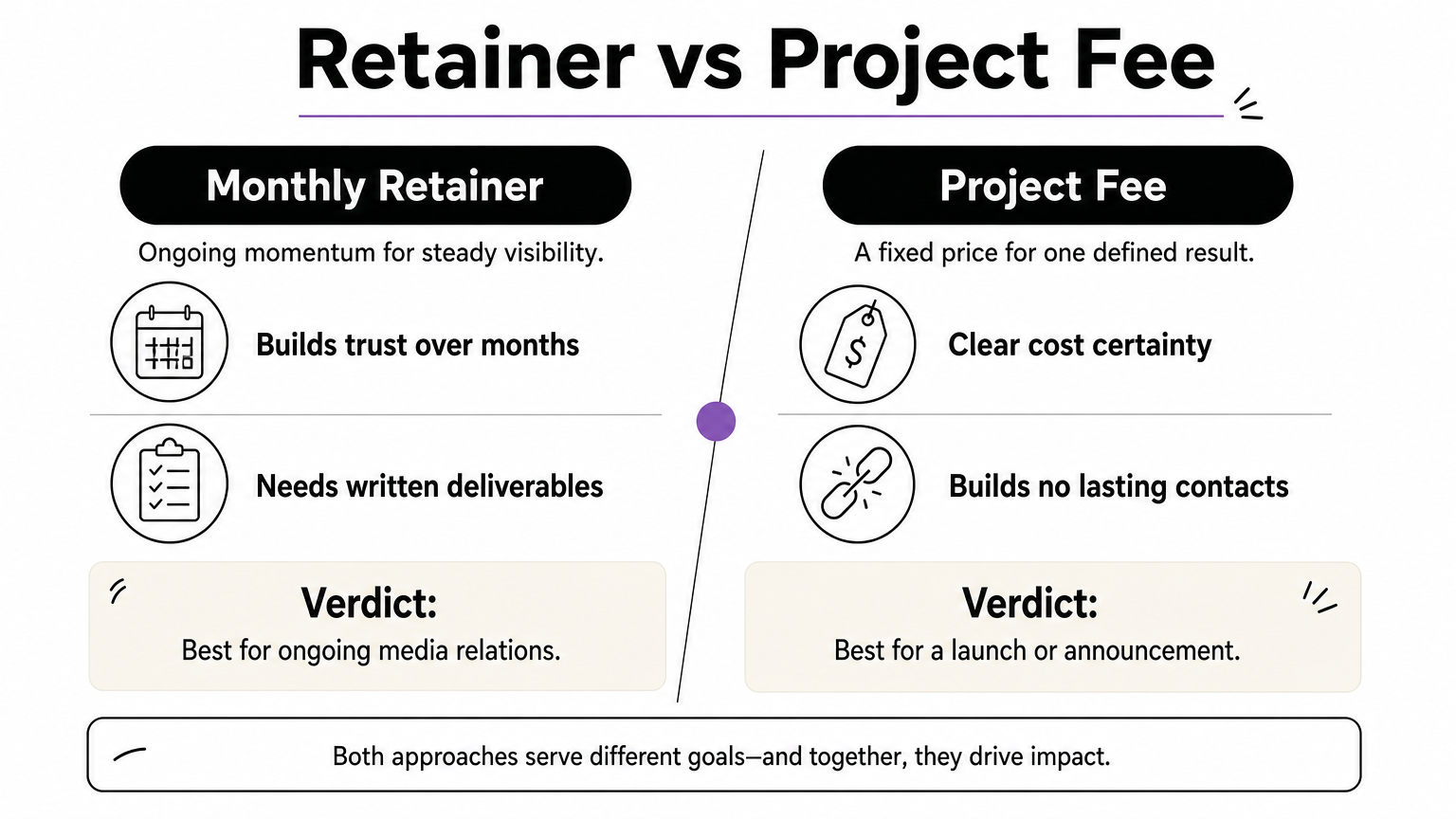
A retainer is a fixed monthly fee for an agreed scope. That scope usually covers strategy, media pitching, press release writing, journalist outreach, monitoring and a monthly report. Retainers dominate because PR compounds over time. Journalists learn to trust a source, and a consistent story builds on itself month after month.
The risk is passivity. Make sure the agreement lists specific deliverables, not just hours, so you can judge each month whether you received what you paid for.
Hourly rates
Hourly fees generally fall between $75 and $250 at the lower end and $150 to $500 or more for senior consultants. Hourly work suits crisis advice, media training and one-off strategy sessions. Many agencies limit it to existing clients or special cases.
It is a poor fit for ongoing media relations. Open-ended hours are hard to budget, and the incentive shifts from results to time spent.
Project fees
A project fee is a fixed price for a defined job, such as a product launch, funding announcement, event or awards entry. Typical ranges start around $5,000 and reach about $25,000. Larger multi-market campaigns can climb well past $50,000.
Projects give you cost certainty, but they build no lasting infrastructure. Journalists who covered your launch are not automatically available for your next story.
Pay-per-placement offers
Some providers charge only when coverage appears. Be cautious. Editors, not agencies, decide what gets published, so a guarantee of placements usually signals low-tier outlets or paid coverage presented as editorial. Treat it as a warning about method, not a pricing innovation.
Benchmark ranges side by side
The figures below combine the ranges that published pricing guides report. They are indicative, not quotes.
| Pricing model | Typical range (USD unless noted) | Best suited to |
|---|---|---|
| Freelance PR retainer | $500–$2,000 per month | Early-stage firms with one market |
| Boutique agency retainer | About $2,000–$7,000 per month | Growing companies in a defined niche |
| Mid-size agency retainer | $5,000–$15,000 per month | Established firms using several channels |
| Large or global agency retainer | $15,000–$50,000+ per month | Enterprise, multi-market and crisis cover |
| UK small-business retainer | £1,000–£4,000 per month | Small firms with a focused scope |
| Hourly consulting | $75–$500+ per hour | Strategy, media training, crisis advice |
| Project fee | $5,000–$25,000, more for large campaigns | Launches, announcements, events |
Retainers buy momentum, projects buy a result, and hourly rates buy advice.
What drives PR agency cost
PR agency cost is driven by four things: how much work the scope contains, how hard the target media is to reach, how specialised your industry is and how many costs sit outside the fee. Knowing these lets you predict why a quote is high or low.
Scope and volume of activity
A retainer covering one press release a month costs far less than one covering proactive story development, thought-leadership articles, event support and monitoring. Volume matters, but fit matters more. Ask whether the activity level matches what your business actually needs to say, not only what your budget allows.
Media tier and geography
Placing stories in leading national or international titles takes senior contacts built over years, and agencies price that access. Each extra market adds cost, because each needs its own journalist relationships. One published estimate puts an additional market at roughly $2,000 to $5,000 a month, though it varies by agency.
For most South African small and mid-sized businesses, the smart target is trade and business media where your buyers actually read. That is cheaper to reach and often more valuable per placement.
Industry and seniority
Regulated or technical sectors such as finance, healthcare, legal and technology need people who understand the subject and the compliance limits. Specialist knowledge commands a premium, and it saves budget, because a team unfamiliar with your sector pitches poorly framed stories.
Seniority works the same way. A fee that buys a senior practitioner’s own time costs more per hour than one that passes work to juniors. It also tends to reach results faster.
Costs outside the fee
Many proposals leave certain items out of the monthly figure. Ask whether any of these are charged separately:
- Influencer or spokesperson fees
- Event venue, production, photography and video
- Paid distribution or media buying
- Travel and translation
- Crisis response outside normal hours, which often carries extra hourly fees
A lower monthly fee is not cheaper if the items you need are billed on top of it.
How to budget for and compare PR agency quotes
To budget for PR, define the outcome first, set a range you can sustain for at least three to six months and then compare quotes on deliverables rather than totals. That order keeps price from steering the decision.

A five-step budgeting process
- Name the outcome. Examples: coverage in two trade titles, a stronger founder profile on LinkedIn, or media attention for an event.
- Pick the model. Use a retainer for ongoing visibility, a project for a launch and hourly support for advice.
- Set a sustainable range. Plan for at least three to six months, since results take time to build.
- Request written scope. Ask each agency for deliverables, reporting frequency and exclusions.
- Compare the cost per deliverable. Divide the fee by what you actually receive, not by what the proposal promises.
A brief to send every agency
A short, identical brief makes quotes comparable. Copy and adapt this:
We are a [industry] business in [city/region].
Goal for the next [3/6] months: [outcome].
Target audience and media: [titles, platforms].
Budget range: [amount per month or per project].
Please quote in rand, stating whether VAT is included, and list:
- Deliverables per month
- Who will do the work
- Reporting frequency and format
- What is excluded or billed separately
- Notice period and contract length
Questions and red flags
Beyond the brief, ask who will be on your account day to day and whether you can see coverage from a comparable client. Ask how success is measured in 90 days. Agencies confident in their method answer these plainly.
Walk away when you see a guarantee of specific placements, pricing built only on the number of press releases, no mention of journalist relationships or a contract with no exit clause. A 30-day notice period on either side is a reasonable standard.
Compare PR agency fees by what you receive each month, not by the number at the bottom of the page.
What small and mid-sized South African businesses should expect
Small and mid-sized South African businesses should expect to scope PR agency pricing against a focused goal, start with a limited engagement and scale once results show. Most benchmarks come from larger markets, so use them to understand structure and then ask PR agencies in South Africa for local quotes.
Reading dollar benchmarks in rand
Guides publish figures in dollars, pounds and other currencies, and rand values move with the exchange rate. Convert at the current rate, then use the result as a rough direction only. Local agency size, market depth and the media you target will shift the real figure.
When you collect quotes, ask for rand pricing and confirm whether VAT is included. This keeps proposals comparable and avoids a surprise on the first invoice.
Start focused, then scale
A smaller business rarely needs a full programme on day one. A sensible start is a three to six month engagement around one goal, such as press releases and targeted pitches to the trade titles your buyers read. Review the coverage, the website traffic and the social engagement it produced, then decide whether to widen the scope.
At Purple Word Box, that kind of scope is built around PR strategy, media relations, press releases and content, with direct access to a senior practitioner. That means you pay for hands-on guidance, not a layered account structure.
Agency or in-house hire
A full-time PR hire carries salary, benefits and tools, and still has to build journalist relationships from scratch. An agency gives you access to an experienced practitioner and existing media contacts without the fixed employee cost. In-house makes more sense when you have constant communications work and the budget to support a team. For most growing businesses, an agency or a senior consultant on retainer is the more flexible option.
For most growing businesses, the cheapest route to credible media coverage is a focused agency scope, not a new full-time hire.
Setting a PR budget you can defend
PR agency pricing is easier to read once you see it as payment for scope, access and seniority. Retainers fund steady momentum, projects fund a single result and hourly rates fund advice. The fee itself matters less than what it includes, who does the work and what sits outside it.
Define your outcome first. Then choose a model, set a range you can sustain for several months and send each agency the same brief. Compare deliverables, not totals, and walk away from guaranteed placements or vague scope.
If you want a clear, honest scope for your own situation, talk to Purple Word Box about your PR budget. You will get straightforward advice from a senior practitioner, and you will know what you are paying for before you commit.