

You keep hearing the term thrown around in board meetings and marketing decks, but nobody quite explains it in plain terms. Media relations is the practice of building and managing relationships with journalists, editors, and newsrooms so your business gets covered accurately and fairly when it matters. It is not advertising, and it is not sending out a press release and hoping for the best.
If you are asking what media relations actually means, here is the short answer: it is the strategic link between your company and the media that decides how, when, and whether your story gets told. Done well, it shapes corporate communication, protects your reputation during a crisis, and puts your leadership in front of the right audience through earned, credible coverage rather than paid placement.
In this article, we unpack the media relations definition properly, look at the core objectives of media relations in a business setting, and show how it fits into a broader PR strategy. We also touch on what a media relations report should include, so you can measure whether your efforts are actually working.
Why media relations matters for your business
South African business owners often ask why they should bother with media relations when they could just run a Facebook ad or boost a LinkedIn post. The answer comes down to trust. When a journalist writes about your company, readers assume the coverage passed some form of scrutiny. When you post an ad, readers know you paid for it and discount it accordingly. That distinction is the whole reason media relations in corporate communication carries more weight than any campaign budget alone.

Credibility that advertising can’t buy
Think about the last time you decided to trust a new supplier or service provider. Chances are you didn’t rely on their own marketing copy. You looked for a mention in a trade publication, a quote in a news article, or a segment on a business radio show. That third-party validation is exactly what strong media relations delivers. A well-placed feature in outlets like Business Day, Moneyweb, or a respected industry title does more for your credibility than a year of paid banners, because a journalist chose to tell your story on its merits.
Earned coverage works because someone else is vouching for you, and that trust can’t be purchased.
We’ve seen this play out directly with clients, as our client testimonials and references show. TreasuryONE needed to be recognized as a serious voice in South African corporate treasury management, not just another financial services vendor shouting into the void. Consistent, well-targeted media relations got their spokespeople quoted in the right business press, building the kind of industry authority that ad spend simply cannot replicate.
Media relations protects you when things go wrong
Every business eventually faces a moment it didn’t plan for: a product recall, a data breach, a leadership scandal, or a public complaint that goes viral. This is where the relationships you’ve built with journalists over time either save your reputation or leave you exposed. Companies with no media relations history often get one shot at a comment before a story runs with someone else’s version of events. Companies with an established media relations function get a phone call first, a chance to respond, and sometimes the opportunity to shape the angle before it goes to print.
Approaching a crisis without existing journalist relationships is like trying to make a new friend during an emergency. It rarely goes well. That’s why crisis communication should never be a standalone plan bolted onto your business at the last minute. It works best as an extension of media relations you’ve already invested in, so when reporters call, they already know your name, your spokesperson, and your track record for straight answers.
Visibility with the audience that actually decides your business outcomes
Not all visibility is equal. A viral TikTok might get you likes, but it rarely gets you in front of procurement managers, investors, or B2B decision-makers. Media relations targets the outlets those audiences actually read: financial press, trade publications, sector-specific newsletters, and business broadcast segments. This is particularly relevant for South African companies competing for enterprise contracts or investor attention, where a mention in a credible business publication carries more decision-making weight than a large but generic social following.
Cost efficiency compared to paid advertising
Here’s a comparison that tends to surprise business owners who’ve never budgeted for PR before:
| Factor | Paid Advertising | Media Relations |
|---|---|---|
| Perceived credibility | Low to moderate | High |
| Cost per placement | Fixed, ongoing spend | Retainer or project-based, no media fee |
| Longevity | Ends when budget ends | Coverage lives online indefinitely |
| Message control | Full control | Shared with journalist’s editorial judgment |
| Audience trust | Skeptical | Higher trust due to third-party endorsement |
The trade-off is real. You give up some control over exact wording in exchange for a credibility boost you can’t buy outright. For most small and mid-sized South African businesses, that trade is worth making, especially when budgets are tight and every rand needs to work harder than a single ad flight ever could.
It builds the profile of your leadership, not just your logo
Journalists don’t quote logos, they quote people. One of the most overlooked benefits of media relations is what it does for the individual reputation of your founders, executives, and spokespeople. Regular, well-handled media interactions turn a CEO into a recognised industry commentator rather than an anonymous name on a company website. That personal thought leadership compounds over time: the more a spokesperson appears in credible outlets, the more journalists come looking for their opinion on breaking industry news, which creates a self-reinforcing cycle of visibility, and it pairs naturally with building a strong social profile for your leaders.
This matters because buyers, investors, and even future employees increasingly research the people behind a business, not just the business itself. A leader who shows up confidently and consistently in the media signals stability and expertise, two things that are hard to fake and even harder to build through advertising alone.
What happens if you skip it
Skipping media relations doesn’t mean nothing happens. It means someone else controls your narrative by default, whether that’s a competitor getting the coverage you wanted, a disgruntled customer setting the tone on social media, or silence that leaves your business invisible when a journalist needs an expert quote for a story in your exact industry. In a market like South Africa’s, where trust in business is hard-won and easily lost, that gap tends to get filled by whoever is loudest, not whoever deserves it most.
Understanding why media relations matters is one thing. Knowing how to actually build a working strategy, get quoted consistently, and measure whether it’s paying off is another. If you’re weighing up whether to bring in senior-level support for this, Purple Word Box’s PR and media relations support is built around exactly this kind of practical, hands-on guidance for South African businesses.
How media relations fits into corporate communication
Corporate communication covers everything a company says to the outside world, from investor updates to internal memos to the words on your careers page. Media relations is one function inside that larger system, the part responsible for how your business shows up in the press. Confusing the two leads to messy strategy: businesses either treat media relations as the whole of their communication effort, or they bolt it on as an afterthought once marketing and legal have already decided what can and can’t be said. Neither approach works, because media relations only functions well when it’s coordinated with the rest of your communication activity, including marketing communication, not run in isolation.
Understanding where it sits helps clarify what it can and can’t do. Corporate communication typically includes several distinct functions, each with its own audience and goals:
| Function | Primary audience | Main goal |
|---|---|---|
| Media relations | Journalists, editors, newsrooms | Earned coverage and third-party credibility |
| Marketing communication | Customers, prospects | Awareness and demand generation |
| Investor relations | Shareholders, analysts | Financial confidence and compliance |
| Internal communication | Employees | Alignment and culture |
| Public affairs | Regulators, government | Policy influence and compliance |
Grasping this table matters because each row uses a different tone, a different channel, and often a different spokesperson, yet all six rows need to say roughly the same thing about the business.
Media relations needs a consistent message to work
Journalists talk to each other, and they definitely compare notes with customers, analysts, and employees who might contradict your official line. If your marketing team is promising rapid growth while your investor relations disclosures mention caution, a good financial journalist will spot the gap immediately. That’s why message consistency across every corporate communication function isn’t a nice-to-have, it’s the thing that keeps a media relations program from unraveling the first time a reporter cross-checks your claims against another source.
A journalist only needs to catch you contradicting yourself once to stop trusting anything you say afterward.
Getting this right means media relations can’t be run by a junior staffer with no visibility into what the rest of the business is announcing. Whoever handles your press inquiries needs a seat close enough to leadership to know what’s coming before a journalist asks about it.
Where media relations reports within the business
Structure varies by company size, but in most South African businesses that take this seriously, media relations reports either directly to the CEO or sits inside a broader marketing and communications function with a direct line to leadership when it matters. Smaller businesses often outsource the function entirely to a PR practitioner or agency who works closely with the founder or spokesperson, which is common practice and often more effective than hiring a junior in-house generalist stretched across five different communication tasks, provided you know what to check before signing an agency contract.
Separating media relations from a marketing department that only thinks in campaigns and clicks avoids a specific failure mode: marketing teams sometimes push messaging that reads well in an ad but falls apart under a journalist’s questions. Media relations in corporate communication works best when the person managing journalist relationships understands both the news cycle and the business well enough to push back on messaging that won’t survive scrutiny.
Why the distinction matters for smaller businesses
Smaller South African businesses often can’t afford five separate communication specialists, so one person or one agency ends up wearing multiple hats, which is part of the boutique versus large agency trade-off. That’s fine in practice, as long as the person understands that a media pitch and a marketing email require different instincts.
How to build a media relations strategy step by step
Many South African business owners who are deciding whether to handle PR in-house or hire an agency try media relations backwards. They write a press release first and figure out the strategy later, if at all. That order guarantees weak results. A working media relations strategy starts with clarity on why you’re doing this at all, because the objectives of media relations for a company launching a new product look nothing like the objectives for a company managing reputational fallout. Get the objective wrong at the start and every pitch that follows will miss the mark, whether you run the plan yourself or work with one of the best South African PR agencies.
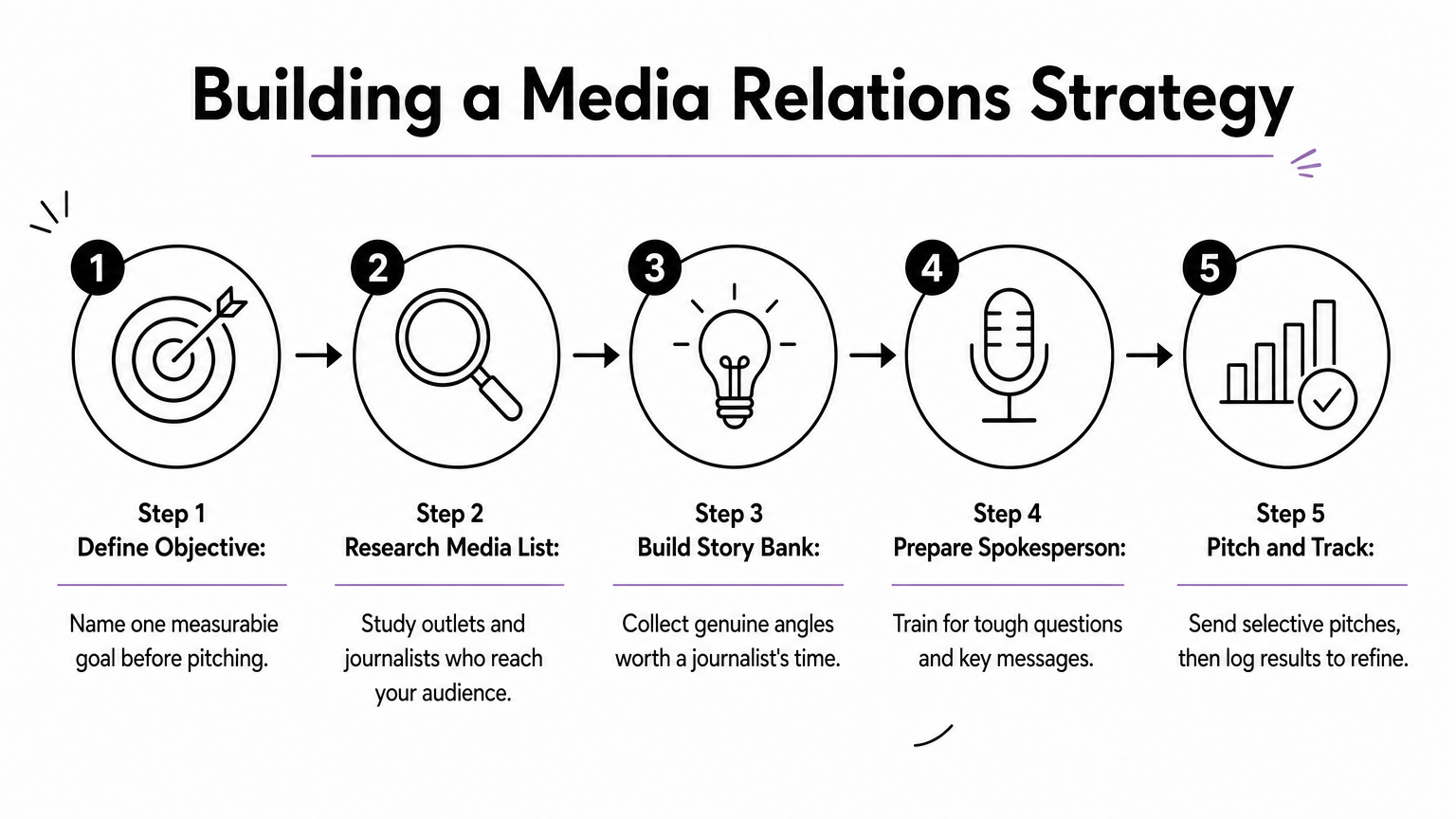
Step 1: Define your objective before you write anything
Objectives should be specific enough to measure, not vague hopes for "more visibility." A business raising capital might aim for coverage in financial press that reassures investors. A business launching a product might aim for trade press reviews that build buyer confidence. Common objectives worth naming upfront include:
- Building industry authority for a spokesperson or founder
- Supporting a product or service launch with earned credibility
- Managing reputation during or after a crisis
- Attracting investor or partner attention through financial press
- Correcting a public misconception about the business
A media relations strategy without a named objective is just a list of journalist email addresses.
Write the objective down in one sentence and test every activity against it. If a pitch doesn’t serve that sentence, it doesn’t belong in the plan.
Step 2: Research your target media list properly
Once you know the objective, work backwards to the outlets that reach the audience who needs to see that message. Media list research means reading the publications you want coverage in, not just scraping a list of contact emails from a database. Note which journalists at Business Day, Moneyweb, or your relevant trade title actually cover your sector, and read three of their recent pieces before you ever email them. A pitch that references their own reporting lands very differently than a generic template blast to fifty names.
Step 3: Build a message and story bank
Journalists reject most pitches because they read like advertising with a byline attached. Before pitching anything, build a small bank of genuine story angles: a data point unique to your business, a trend you’re seeing in your industry, or a customer result worth sharing. Each angle should answer one blunt question honestly: why would a busy journalist care about this today? If you can’t answer that, the pitch isn’t ready yet.
Step 4: Prepare your spokesperson
A great pitch that lands a great journalist is wasted if your spokesperson freezes on the call or gives answers that sound like a brochure. Media training for executives and spokespeople should cover likely questions, three or four key messages the person can repeat naturally in different phrasings, and practice handling a tough or unexpected question without going silent. This matters even more in a crisis, where a shaky answer can do more damage than saying nothing at all.
Step 5: Pitch selectively and follow through
Send fewer pitches to better-matched journalists rather than mass emails to an entire media list. Timing matters too: pitching around a relevant news hook, an industry report, or a seasonal moment increases your odds of a response far more than pitching on a random Tuesday. Once a journalist responds, follow through fast. Missed deadlines or slow replies burn relationships you’ll want to use again next quarter.
Step 6: Track results and refine
Every strategy needs a feedback loop. Log which pitches got coverage, which journalists responded, and which angles fell flat. Over a few cycles, patterns emerge that tell you which outlets are worth your time and which story types your industry’s press actually wants. This tracking becomes the raw material for the media relations report we cover further down, and it’s what separates a strategy that improves over time from one that repeats the same mediocre results every quarter.
A strategy built this way takes longer to set up than firing off a generic release, but it’s the difference between occasional lucky coverage and a media relations function that reliably delivers when your business needs it most.
Key media relations activities and tools
Once your strategy is in place, day-to-day media relations comes down to a handful of recurring activities, each supported by specific tools. Knowing what these are, and when to use them, keeps your PR function from becoming a vague catch-all task nobody quite owns. Media relations activities range from writing to monitoring to relationship management, and skipping any one of them tends to show up later as gaps in coverage or missed opportunities.

Press releases and media pitches
Press releases remain useful, but only for genuine news: a funding round, a leadership appointment, a product launch, or a regulatory milestone. Press releases written for routine updates get ignored by journalists who receive dozens a day and can spot padding instantly. Media pitches work differently. A pitch is a short, direct email that offers a specific journalist a specific story, tailored to what they already cover. Where a release broadcasts news to everyone, a media pitch targets one person with a reason the story matters to their readers right now.
A press release announces. A pitch persuades. Most businesses only know how to do the first.
Good pitches are short, usually under 150 words, lead with the news value rather than the company name, and end with a clear offer: an interview, data, or a spokesperson available for comment.
Media kits and background materials
A media kit saves time on both sides of the relationship. It typically includes a company backgrounder, executive bios, high-resolution logos and headshots, and recent coverage links, all packaged so a journalist working on deadline doesn’t have to chase basic facts. Businesses that skip this step often lose coverage simply because a reporter couldn’t get a usable photo or an accurate title in time for their deadline. Keeping a media kit current, updated whenever a spokesperson changes or a company fact shifts, is a small task that prevents an entirely avoidable failure.
Media monitoring and tracking tools
You can’t manage what you don’t track, and media relations without monitoring means flying blind on whether your coverage is landing, spreading, or being ignored. Monitoring tools scan news sites, broadcast transcripts, and social mentions for your brand name, spokesperson names, and key competitors, alerting you when coverage appears.
| Tool type | What it does | Best for |
|---|---|---|
| Media monitoring platforms | Tracks brand mentions across news, print, and broadcast | Measuring reach and sentiment |
| Google Alerts | Free email alerts for keyword mentions online | Budget-conscious basic tracking |
| Journalist databases | Contact details and beat information for reporters | Building and refining media lists |
| Social listening tools | Tracks mentions and sentiment across social platforms | Spotting reputational issues early |
| CRM or spreadsheet logs | Records pitch history and journalist interactions | Managing ongoing relationships |
Smaller businesses in South Africa can get surprisingly far with Google Alerts and a well-maintained spreadsheet before investing in paid monitoring software. What matters more than the tool itself is the discipline of checking it regularly and logging what you find.
Building and maintaining a media contact database
Every pitch you send should draw from a living database of journalist names, beats, past interactions, and preferences, not a static list bought once and never updated. Journalists move between outlets, change beats, or leave the industry entirely, and pitching a reporter who left their publication eighteen months ago signals that you haven’t done basic homework. Media contact management works best as an ongoing habit: a quick note after every interaction, whether it led to coverage or not, builds a record that makes your next pitch sharper than the last.
Taken together, these activities and tools form the operational backbone of media relations. None of them work particularly well in isolation. A perfect pitch sent to an outdated contact fails just as often as accurate monitoring data that nobody acts on. The businesses that see consistent coverage are the ones that treat these as a connected system, reviewed and refined every quarter rather than assembled once and left to run on autopilot.
How to measure media relations and report on results
Most businesses can tell you how many press releases went out last quarter. Few can tell you what that coverage actually did for the business. A proper media relations report closes that gap by connecting pitches and placements to outcomes leadership actually cares about, whether that’s investor confidence, sales inquiries, or reputation recovery after a rough news cycle. Without this step, media relations looks like an expense with no return, even when it’s working.
What a good media relations report actually includes
Skip the report that’s just a folder of press clippings with no context. A report that earns its place on a leadership agenda covers a specific set of elements, ideally reviewed on a consistent schedule so trends become visible over time:
- Coverage secured: outlet name, journalist, date, and a link to the piece
- Reach and audience: estimated readership, viewership, or listenership per placement
- Tone and sentiment: whether coverage was positive, neutral, or negative
- Message pull-through: did the coverage include your key messages or just a passing mention
- Share of voice: how your coverage compares to named competitors over the same period
- Pitch-to-placement ratio: how many pitches went out versus how many resulted in coverage
Building this into a repeatable template means every quarter’s report looks the same shape, which makes it far easier for a busy executive to spot a decline or an improvement at a glance.
Metrics that matter more than clip count
Counting clippings feels productive, but a stack of small mentions in irrelevant outlets tells you far less than three well-placed features in the publications your buyers actually read. Media relations metrics worth tracking go beyond volume:
| Metric | Why it matters | Weak alternative |
|---|---|---|
| Quality of outlet | Signals credibility with the right audience | Total mention count |
| Message pull-through | Confirms your framing survived editing | Presence of company name only |
| Journalist relationship depth | Predicts future coverage likelihood | One-off pitch success rate |
| Sentiment trend over time | Flags reputation shifts early | Single-article sentiment |
| Website or inquiry uplift after coverage | Ties PR to business impact | Social share counts alone |
Running these numbers against your stated objective, the one you wrote down at the start of your strategy, is what separates a real evaluation from vanity metrics dressed up as proof of success.
Turning coverage into board-level insight
Executives rarely want a spreadsheet of every mention. They want a short narrative: what happened, why it matters, and what you’re doing differently next quarter. Translate raw data into two or three sentences per objective, for example noting that trade press coverage rose alongside a jump in qualified sales inquiries, or that a spokesperson’s media appearances correlated with a measurable lift in LinkedIn follower growth. This is also where a media relations report earns its keep for objectives of media relations tied to reputation management, since sentiment trends over several months tell you far more about recovery than any single article ever could.
Quarterly reviews work well for most South African businesses, though a fast-moving crisis or product launch warrants weekly tracking until things stabilise. Whatever cadence you choose, consistency matters more than frequency, since a report that only appears when coverage looks good tends to lose credibility with leadership fast.
Reporting honestly, even when the numbers are flat
Quiet quarters happen, and the temptation to pad a report with irrelevant mentions or inflated reach estimates is real. Resist it. Honest reporting, including the pitches that went nowhere and the outlets that never responded, builds trust with the people funding your PR budget and gives you a real basis for adjusting strategy next quarter. Yielding better results starts with an accurate picture of where you actually stand, not a flattering one.
Building media relationships that last
Good media relations comes down to a simple habit: treat journalists as people you’re building a long-term relationship with, not a list you email when you need something. The media relations meaning we’ve unpacked here, earned trust, consistent messaging, honest reporting, only works if you keep showing up between the big announcements, not just when you need a favor.
Start small if you need to. Pick one objective, research three journalists who genuinely cover your space, and pitch one real story this month. Momentum builds from there, and so does the credibility no ad budget can buy.
If you’d rather have someone who’s done this for clients like TreasuryONE, Otinga.io, Wise Move or Sophos guide you through it, start a conversation with Purple Word Box and let’s build a media relations approach that actually works for your business.