

You’ve heard the term thrown around in board meetings or seen it in a competitor’s press release, but you still can’t quite explain what a PR agency actually does when someone asks. That gap matters, because hiring the wrong kind of support, or none at all, often means your business stays invisible while competitors land media coverage and build trust with the same audience you’re chasing.
Simply put, a PR agency is a team of communication specialists who manage how your business is seen and talked about, mainly through the media, but also across social platforms and public events. How a PR agency works in practice means building relationships with journalists, crafting your messaging, pitching stories, and protecting your reputation when things go wrong, all so your business earns coverage rather than pays for it.
In this article, we’ll unpack what PR agency teams actually deliver day to day, from press releases and media pitches to spokesperson training and event support. We’ll also look at how the process unfolds from first strategy session to published coverage, so you know exactly what to expect before you bring someone on board.
Why businesses invest in a PR agency
Most business owners already understand advertising. You pay for space, you control the message, and everyone knows it’s an ad. A PR agency works differently, and that difference is exactly why companies pay for it. What does a PR agency do that advertising can’t? It earns you third-party validation, the kind that comes from a journalist, industry publication, or respected commentator choosing to write about your business because it’s genuinely newsworthy, not because you bought the placement.
Building credibility that advertising can’t buy
Credibility is the real product here. When a customer sees your business quoted in a trade publication or your CEO interviewed on a business radio segment, they trust that far more than a banner ad. This trust compounds over time, shaping how customers, investors, and even potential employees perceive your brand before they’ve ever spoken to you directly.

Advertising tells people you’re good. PR gets someone else to say it for you.
Earning media coverage instead of paying for it
Here’s where what pr agency teams actually spend their time becomes clear: PR and media support means building and maintaining relationships with journalists and editors long before you need a favor. Those relationships are what get your story read instead of deleted. A cold pitch from an unknown company rarely gets a reply. A pitch from an agency a journalist already trusts, covering a story that fits their beat, has a real shot.
Businesses typically turn to a PR agency for a specific mix of outcomes:
- Visibility in relevant media that reaches decision-makers and customers, not just anyone scrolling past
- Third-party credibility that positioning statements and paid ads simply can’t replicate
- Consistent messaging across every spokesperson, platform, and campaign
- A steady flow of content for social channels, especially LinkedIn, where B2B audiences pay attention
- Crisis readiness, so a bad review or a public complaint doesn’t spiral into a reputation disaster
Managing reputation before a crisis hits
Many businesses only start asking what a PR agency does after something’s gone wrong. A negative news story, an angry customer thread, or a leadership scandal suddenly makes reputation feel urgent. Companies that already have a PR partner in place respond faster and more coherently because the messaging framework and media relationships already exist. Waiting until the crisis lands is the expensive way to learn this lesson.
Small and mid-sized South African businesses in particular benefit from this kind of preparation, since they often lack an in-house communications team, which raises the question of whether PR is something you can do yourself while still competing for the same media attention as larger, better-resourced competitors. Investing early means your business isn’t scrambling to explain itself for the first time under pressure, and it means the groundwork for mainstream recognition is already laid before you actually need it.
How a PR agency works, step by step
Understanding how a PR agency works takes the mystery out of the whole process. It isn’t a black box where you hand over a brief and hope for headlines. It’s a structured cycle of research, writing, pitching, and reporting that repeats month after month, refined as your business and its media relationships grow.
Discovery and strategy first
Every engagement starts with discovery. The agency needs to understand your business, your competitors, your audience, and what’s actually newsworthy about what you do before writing a single word. Strategic planning at this stage sets the targets: which journalists to approach, which publications matter, and what story angles will land.
Turning strategy into coverage
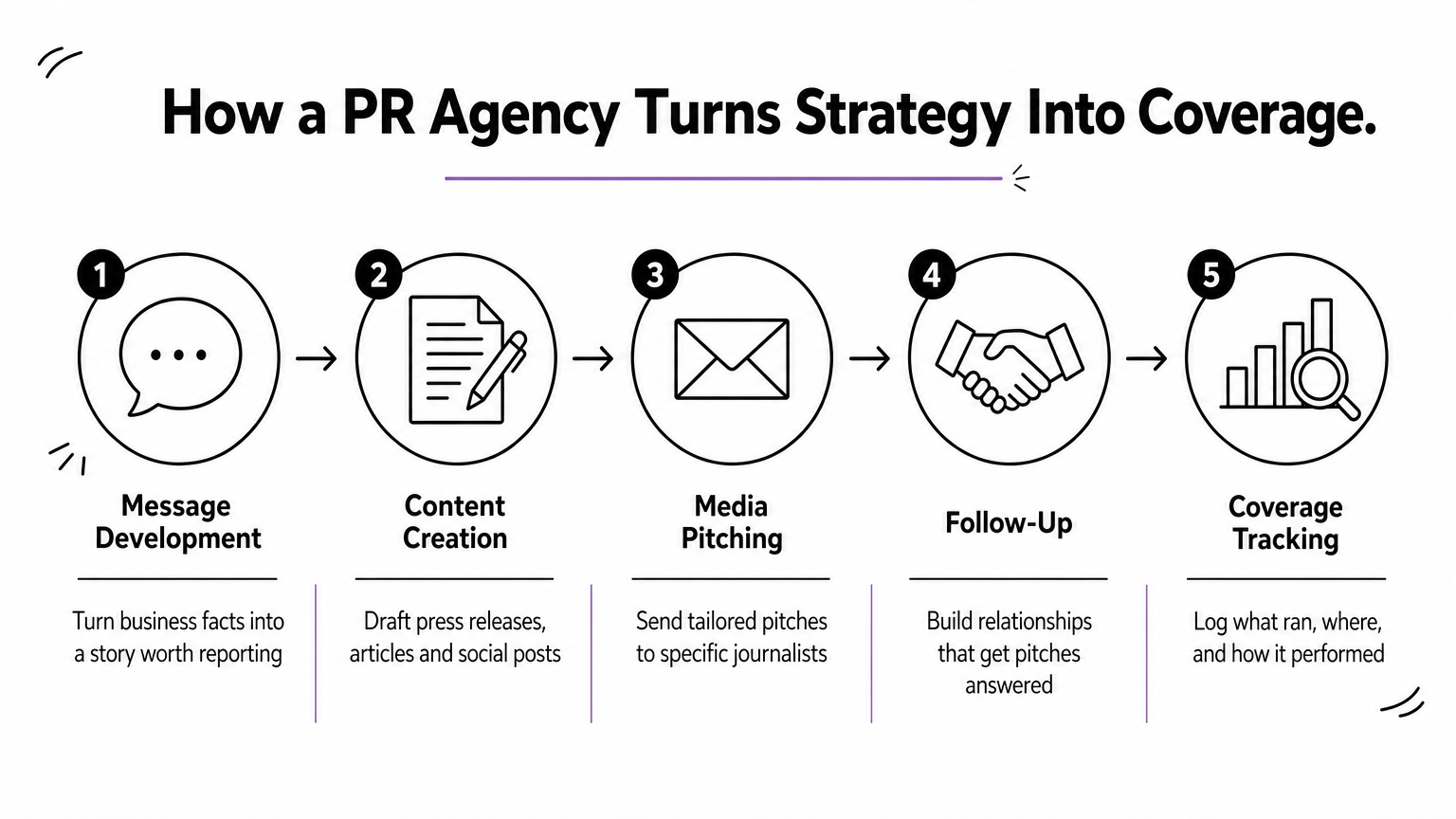
Once the strategy is set, the work becomes tactical. A typical cycle looks like this:
- Message development, turning your business facts into a story a journalist would actually want to run
- Content creation, drafting press releases, opinion pieces, and social posts that support the message
- Media pitching, sending tailored pitches to specific journalists, not mass blasts
- Follow-up and relationship building, the unglamorous work that gets your next pitch answered
- Coverage tracking, logging what ran, where, and how it performed
Good PR isn’t one big campaign. It’s a hundred small, consistent actions that compound into visibility.
Regular reporting closes the loop. A competent agency shows you exactly what coverage was earned, which outlets picked up the story, and how that compares to the previous month. Without this, you’re trusting a process you can’t verify.
Monthly retainers are the most common structure in South Africa, giving the agency time to build the journalist relationships that make pitching effective. Project-based work exists too, usually for a single launch or event, but it rarely delivers the compounding credibility that ongoing PR builds over a year of consistent, well-placed coverage.
Core services a PR agency provides
Ask five business owners what is a PR agency for, and you’ll get five different answers depending on what they’ve bought before. That’s because the range of PR services is broad, covering everything from a single press release to full spokesperson coaching. Knowing the range helps you scope what you actually need instead of paying for a package built for a different kind of business.
Media relations and press releases
Beyond the basics, this is the core of what most agencies do daily: how media relations works in practice is drafting press releases, pitching journalists, and securing coverage in outlets your customers actually read. A good release isn’t a company announcement dressed up in formal language, it’s a story angle a journalist can run with minimal rewriting.
A press release nobody wants to read isn’t PR, it’s just paperwork.
Content and profile building
Content work extends the same messaging across channels journalists never touch. This includes LinkedIn posts, opinion pieces, and social profile building for executives who want to be recognized as industry voices, not just company representatives.
Event support and reputation management
Events, interview preparation for spokespeople and crisis work round out the service list, often the parts businesses forget until they need them urgently.
| Service | What it covers |
|---|---|
| Media relations | Pitching, press releases, journalist relationships |
| Content strategy | Social posts, articles, messaging documents |
| Spokesperson support | Media training, interview prep, positioning |
| Event PR | Media invites, branded materials, on-site coordination |
| Reputation management | Crisis statements, response planning, monitoring |
Understanding what does PR agency do across this full list, from media briefings to PR events and round-tables, matters because most businesses only need two or three of these services at any given time. A PR strategy built around your actual goals, rather than a generic package, is what separates useful support from wasted retainer fees.
PR agency vs marketing agency: what’s the difference
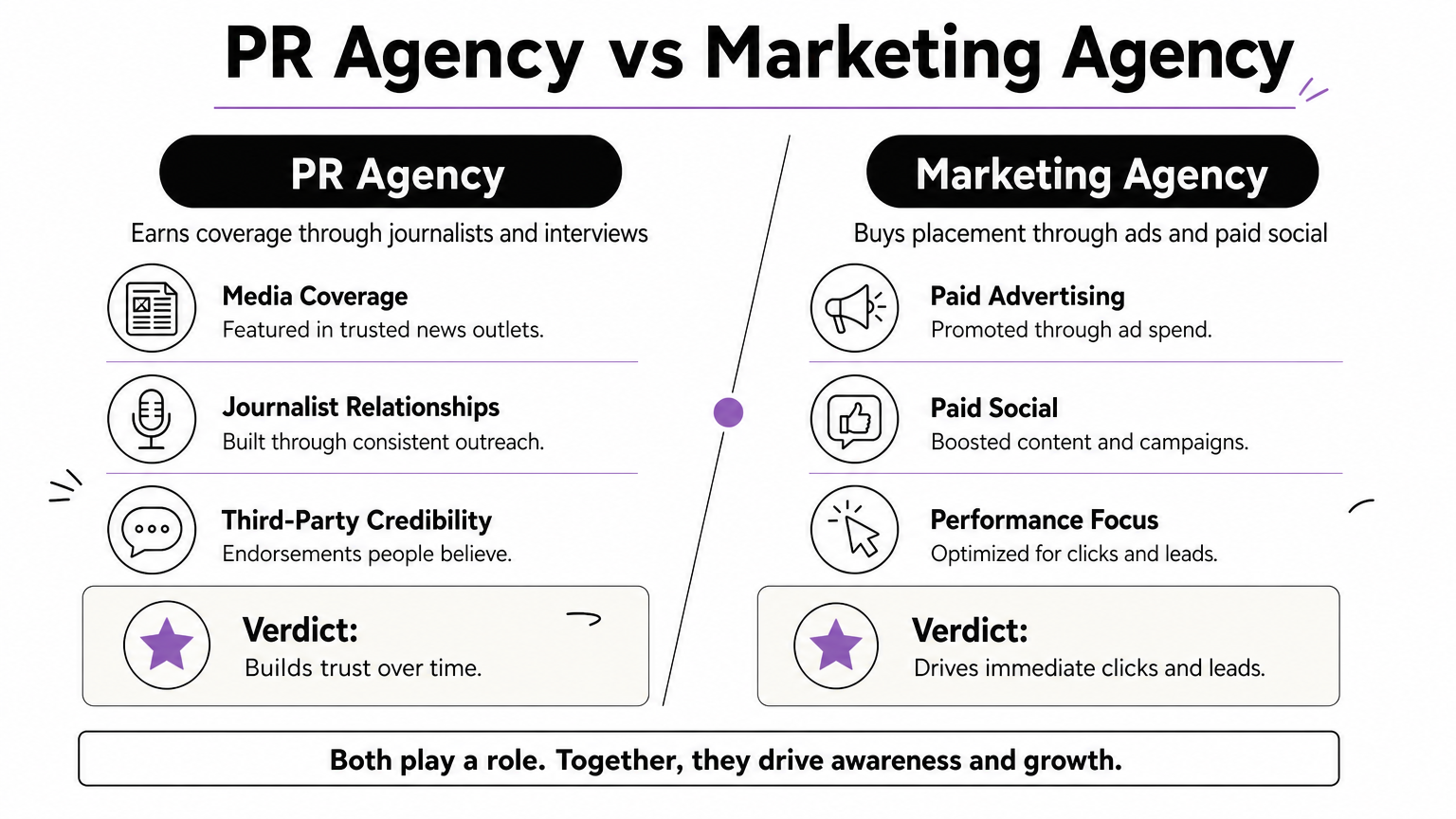
Confusion between these two is common, and it costs businesses money when they hire the wrong partner for the job. A marketing agency focuses on paid channels: adverts, sponsored posts, search campaigns, and content you control completely because you’re paying for the placement. A PR agency focuses on earned coverage: media stories, interviews, and mentions that happen because a journalist or influencer decided your story was worth telling, not because you bought space.
Different goals, different tools
Growth in sales is usually the marketing team’s scoreboard. Reputation and credibility are the PR team’s scoreboard, measured through coverage quality, share of voice, and how your brand is discussed rather than how many clicks an ad generated. This distinction matters most when a business tries to fix a trust problem with more advertising, which rarely works because audiences already discount ads as self-interested.
You can buy attention with marketing, but you have to earn trust with PR.
Where the two overlap
Separate as these disciplines are, they work best together. A PR agency lands a great feature in a business publication, and a marketing team amplifies it with paid boosting on LinkedIn. Overlap shows up clearly when you compare what each discipline actually controls:
| Aspect | PR agency | Marketing agency |
|---|---|---|
| Channel | Earned media, journalists | Paid ads, search, social |
| Control over message | Limited, journalist decides angle | Full control |
| Cost model | Retainer for relationships and time | Ad spend plus management fee |
| Main output | Coverage, interviews, reputation | Leads, clicks, conversions |
Though these two functions look separate on paper, the smartest South African businesses treat them as complementary rather than interchangeable. Companies that try to substitute one for the other usually end up either overspending on ads with no credibility behind them, or generating great coverage nobody sees because there’s no paid push behind it.
Choosing the right PR agency for your business
Finding the right partner starts with being honest about scale. In the choice between a boutique PR shop and a large network, a large agency with dozens of clients might land you a junior account manager who juggles fifteen other brands, while a smaller, senior-led practice gives you direct access to the person actually pitching journalists on your behalf. For most South African small and mid-sized businesses, that direct access matters more than a fancy office or a long client roster.
The size of the agency matters less than who actually answers your calls.
Questions worth asking before you sign
Getting a clear answer to a handful of direct questions tells you more than any pitch deck, and there are things worth checking before a retainer starts. Ask these before committing:
- Who exactly will manage my account day to day, and what’s their experience?
- Can you show examples of coverage you’ve secured for businesses my size?
- How do you measure and report results each month?
- What’s your process when a pitch gets ignored or a story falls flat?
- Do you handle crisis situations, and have you managed one before?
Red flags that signal a poor fit
Vague promises are the clearest warning sign. Agencies that guarantee specific headlines, quote inflated "reach" numbers without context, or can’t name a single journalist relationship in your industry usually can’t deliver the coverage they’re selling. Watch, too, for contracts that lock you in for a year with no clear reporting cadence, since accountability is what separates a working partnership from an expensive guess.
Experience in your specific sector counts for more than a polished website. A PR agency that understands your industry’s media landscape, the trade publications, the journalists who cover your space, and the story angles that actually land, will get you results faster than one starting from zero, which is why it pays to compare the top PR agencies to hire in South Africa. That’s the practical difference between paying for effort and paying for outcomes, and it’s worth interrogating closely before any contract gets signed.
Making PR work for your business
So, what is a PR agency, really? It’s a team that earns your business trust through media coverage, not one that buys visibility through ads. Understanding how a PR agency works, from discovery through pitching to reporting, means you walk into any agreement knowing exactly what you’re paying for and what results should look like. That knowledge alone puts you ahead of most businesses still confused about the difference between earned coverage and paid promotion.
Getting this right isn’t complicated, but it does require picking a partner who answers your questions directly, shows real journalist relationships, and treats your business as more than another retainer. South African companies that invest early in this kind of support build credibility long before a crisis forces the issue.
If you’re ready to stop guessing and start building real media relationships, talk to Purple Word Box about your PR and get straightforward, senior-level guidance built around your business.