

You’ve probably heard someone use "PR" and "media relations" as if they mean the same thing, and then wondered why your press release still hasn’t landed anywhere. This mix-up trips up a lot of South African business owners who want coverage but aren’t sure what part of the process actually gets journalists to say yes.
Here’s the short answer: media for public relations is one tool within a much bigger discipline. Public relations covers your entire reputation strategy, from messaging to stakeholder trust, while media relations is the specific practice of building journalist contacts and securing coverage. Understanding this relationship between media and public relations helps you set realistic expectations and spend your time where it actually moves the needle.
In this article, we’ll unpack how public relations vs media relations differ, where they overlap, and why treating media relations as a standalone tactic rather than part of a wider PR plan usually backfires. We work with South African businesses on exactly this distinction every day, and getting it right changes how you approach visibility, credibility, and the actual journalists you’re trying to reach.
Why media relations isn’t the same as public relations
Public relations is the whole conversation your business has with the world, not just the part that ends up in a newspaper. It includes how you position your brand, how you handle a crisis, what your executives say in interviews, how you talk to investors, and how you show up on social media. Public relations is a strategy discipline. It asks questions like: what do we want people to believe about us, and how do we get there consistently across every channel we touch. Media relations is one answer to that question, but it’s not the only one.

What media relations actually does
Media relations, by contrast, is the narrow, practical work of getting journalists and editors to pay attention to your business. It’s pitching a story to a Business Day reporter, sending a press release to a trade publication, or briefing a radio producer before an interview. Media relations lives inside PR, but it’s a specific set of activities: building contacts, writing pitches, managing interview requests, and following up when a journalist goes quiet. If PR is the strategy, media relations is one of the tactics you use to execute it. You can have excellent media relations and still have weak PR, because coverage without a coherent message doesn’t build the trust you’re actually after.
Media relations gets you coverage. Public relations decides whether that coverage actually builds trust.
Where the confusion usually starts
Confusion between the two terms usually starts because media coverage is the most visible, most shareable outcome of PR work. Your CEO sees a competitor quoted in Fin24 and assumes that’s what "doing PR" means. So the brief becomes "get us in the news" instead of "build our reputation, and use media coverage as one way to do it." This is exactly why the relationship between media and public relations trips up so many business owners in South Africa. They hire someone to "do PR" expecting a stream of press clippings, without first deciding what story they actually want told or who they’re trying to reach.
Here’s a simple way to see the difference in practice:
| Aspect | Public Relations | Media Relations |
|---|---|---|
| Scope | Full reputation and stakeholder strategy | Journalist and outlet relationships |
| Core question | What do we want people to believe? | Who will cover this story, and how? |
| Typical activities | Messaging, campaigns, stakeholder engagement, crisis management | Press releases, pitches, interviews, media lists |
| Success measure | Trust, credibility, long-term brand perception | Coverage secured, placements, journalist relationships |
| Timeframe | Ongoing, strategic | Often campaign-specific or reactive |
Once you see it laid out this way, it’s easier to spot where your own approach might be missing a piece. A lot of businesses have someone firing off press releases with no clear message strategy behind them, or they’ve built a beautiful brand narrative with nobody actually pitching it to journalists. Neither one works well alone.
Why business leaders conflate the two
Businesses often conflate public relations and media relations because both involve the word "media" somewhere in their vocabulary, and both are frequently handled by the same agency or the same person. That’s not wrong exactly. At Purple Word Box, our PR and communication services cover both, because they genuinely work better together. But handling both doesn’t mean they’re interchangeable. When a client asks for "media relations" specifically, they usually mean they want press coverage, interviews, or profile pieces. When they ask for "PR," what they often actually need is a broader look at messaging, positioning, and how their spokesperson communicates, of which media coverage is just one output.
Think of it like the difference between marketing and advertising. Marketing is the whole strategy behind how you attract and keep customers. Advertising is one channel you use to do that. Nobody would say marketing and advertising are the same thing, even though advertising is often the most visible piece of the marketing puzzle. Media relations public relations work the same way: media relations is visible and quotable, so it gets mistaken for the entire job, when really it’s a subset with a specific function.
Why the distinction actually matters for your business
Skipping this distinction costs you in two directions. If you focus only on media relations without a PR strategy behind it, you end up chasing coverage for coverage’s sake. You might land a mention in a business publication, but if the story doesn’t align with what you actually want your market to believe about you, that coverage does little for your credibility. We’ve seen companies get excited about a placement that technically ran their name, but said nothing useful about what they actually do or why anyone should trust them.
On the flip side, if you build a strong PR strategy but never invest in the media relations skill of actually pitching journalists, your best messaging sits in a document nobody outside your company ever reads. Media relations and publicity are the delivery mechanism, and that is why media matters so much to public relations. Without them, even a sharp, well-considered PR strategy stays invisible to the audiences who matter most, including potential customers, investors, and industry peers who form opinions based on what they see written about you by credible third parties, not just what you say about yourself.
Understanding both sides changes how you brief whoever handles your public relations media work, whether that’s an internal team, a freelancer, or an agency you’re about to sign with. Instead of saying "get us press coverage," you can say "here’s the reputation we’re building, here’s the message we want consistently reinforced, and media coverage is one of the ways we’ll get there." That single shift in how you frame the brief tends to produce far better results than treating media placements as the entire goal. It also sets realistic expectations: good media relations takes weeks of relationship building before a single placement lands, and it works best when it’s supporting a message you’ve already thought through, not scrambling to invent one after a journalist asks a hard question.
How to build media relations into your PR strategy
Once you’ve separated the two concepts, the next step is figuring out how media relations actually fits inside your wider PR plan rather than running alongside it as a separate project. Most businesses get this backwards. They start by asking who to pitch, before they’ve decided what story is worth pitching in the first place. Building media relations into your PR strategy means starting with your reputation goals and working outward to the journalists who can help you reach them, not the other way around.
Start with your reputation goals, not your press release
Before you write a single pitch, decide what you want your target audience to believe about your business in the next twelve months. Are you trying to be seen as the trusted expert in your industry, the disruptor challenging an outdated market, or the reliable local option customers can count on? This decision shapes every piece of media and public relations work that follows, including which journalists you approach and which stories you turn down. Skipping this step is why so many South African businesses end up with a folder of press clippings that don’t add up to a coherent reputation.
If you can’t explain what you want people to believe about your business, no journalist can either.
Match your message to the right media outlets
Once your message is clear, map it against the media landscape that actually reaches your audience. A fintech startup targeting investors needs a very different media list than a retail brand chasing consumer attention. This is where media relations pr work gets specific and practical rather than theoretical.
- Trade and industry publications for credibility with peers and decision-makers in your sector
- National business media like Business Day or Moneyweb for broader stakeholder and investor visibility
- Broadcast and radio for reach and spoken authority, particularly useful for raising a leader’s public profile
- Niche or regional outlets when your audience is geographically or demographically specific
- Podcasts and digital publications for longer-form positioning that print rarely allows
Picking two or three of these categories to focus on, rather than trying to appear everywhere at once, produces far better results. Journalists notice when a pitch is clearly tailored to their beat, and that noticing is what gets your emails opened instead of ignored.
Build relationships before you need them
Journalists respond to people they already know, or people whose previous pitches were relevant and well-timed. Waiting until you have news to reach out cold is the single biggest reason media relations efforts underperform. Instead, treat relationship building as an ongoing part of your PR calendar, not a scramble that only happens before a launch. Send a journalist a useful piece of industry data with no ask attached. Comment thoughtfully when they publish something relevant to your sector. Small, consistent gestures like this are what separate businesses with strong media relations in public relations from those still cold-emailing every reporter in their industry with the same generic release.
Regular, low-pressure contact does more for your long-term coverage odds than a perfectly written press release sent to a stranger.
Fit media relations into your broader PR calendar
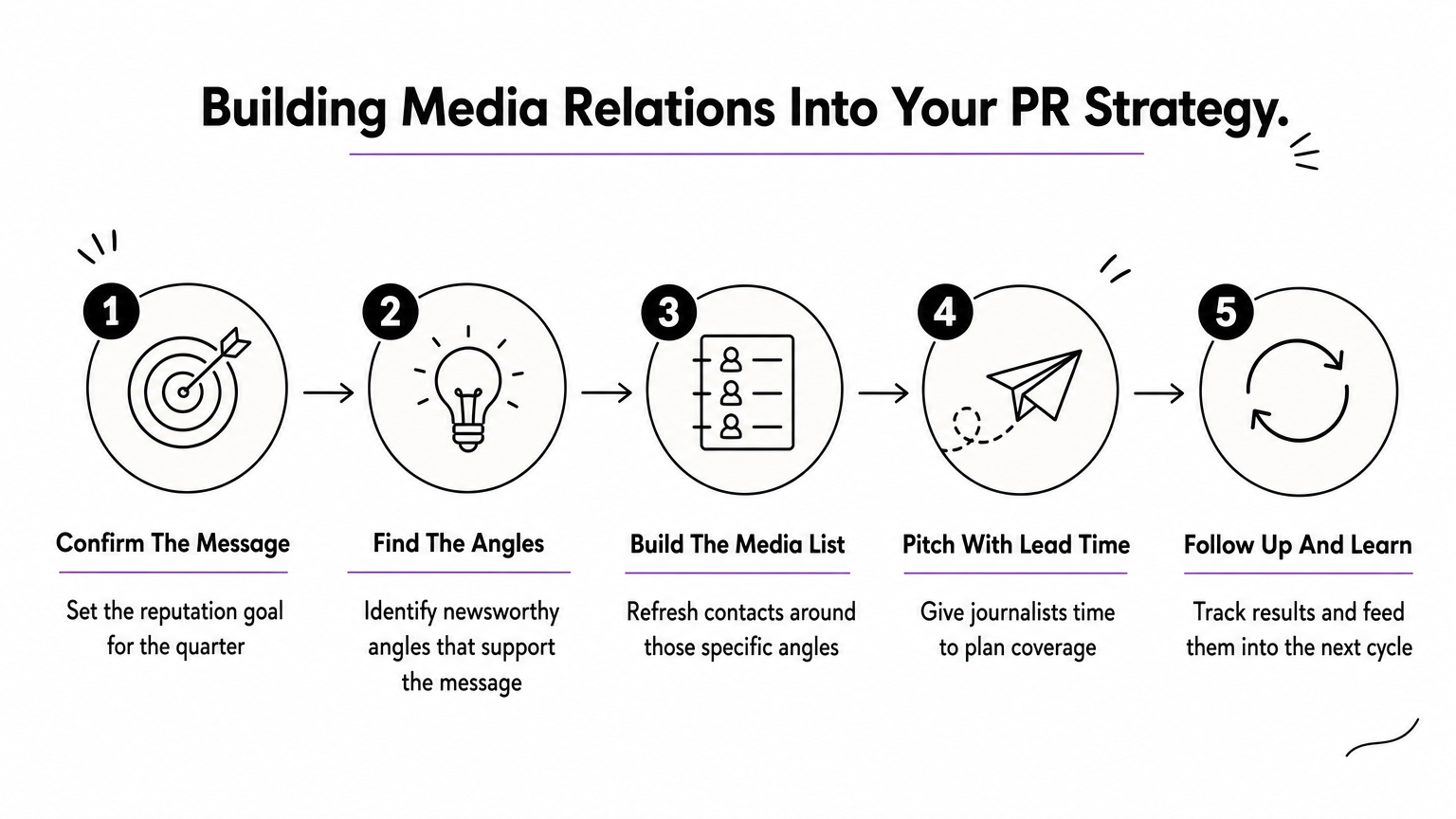
Media relations shouldn’t run on its own separate timeline disconnected from the rest of your PR activity. If you’re planning a product launch, a leadership change, or a campaign around a specific message, your media outreach needs to be timed against those moments, not tacked on afterward as an afterthought. Here’s a simple sequence that keeps the two aligned:
- Confirm the message and reputation goal for the quarter or campaign
- Identify two or three newsworthy angles that support that message
- Build or refresh your media list around those specific angles
- Pitch with enough lead time for journalists to plan coverage
- Follow up, track results, and feed what worked back into your next PR planning cycle
Getting this sequence right takes practice, and it’s exactly the kind of hands-on work we do with clients at Purple Word Box, building the PR strategy first and then handling the media relationships that bring it to life. Practical guidance from someone who’s already made the mistakes helps you skip the trial and error most businesses go through when they try to handle PR themselves.
Key media relations activities that support your PR goals
Media relations isn’t one activity, it’s a set of distinct tasks that each play a different role in getting your message in front of the right audience. Knowing what these activities actually involve, rather than lumping them all under "doing PR," helps you brief the right person for the right job and spot gaps in your current approach. Media relations pr work only succeeds when these pieces are handled together, not as one-off tasks whenever someone remembers to do them.

Press releases and media alerts
Good press releases still matter, but only when they carry genuine news, not just a rehash of your marketing copy with a date stamped on top. A press release announcing a new hire, a partnership, or a product update needs a clear news hook in the first line, because journalists decide within seconds whether something is worth their time. Media alerts serve a slightly different purpose. They’re shorter, more urgent notices used to flag an event or a same-day opportunity, like a press conference or a site visit, rather than a full story. Both documents work best when they’re written the way a journalist writes, not the way a marketing team writes, which is a skill worth outsourcing if it’s not already second nature to your team.
Media pitching and journalist outreach
Pitching is where media relations and publicity actually get tested, because a pitch either lands with a specific journalist’s beat or it doesn’t. A strong pitch is short, personalized, and makes it obvious within two sentences why this particular reporter, at this particular publication, should care right now. Generic pitches sent to fifty journalists at once get ignored, while a tailored pitch sent to three relevant reporters usually outperforms it. Timing matters just as much as content here. Pitching a story the week before a major industry conference or budget speech, when journalists are already looking for related angles, dramatically improves your odds compared to pitching in a quiet news week with no obvious hook.
A pitch that could go to any journalist usually goes nowhere.
Interview preparation and spokesperson briefing
Once a journalist agrees to a conversation, the work isn’t done, it’s just entered its most important phase. Briefing your spokesperson properly before an interview is one of the most underused media relations in public relations activities, and practical interview preparation for spokespeople is often the difference between a quote that reinforces your message and one that creates a headache. This means preparing three or four key messages in advance, anticipating the hard questions a journalist is likely to ask, and rehearsing answers that stay on message without sounding scripted. It also means briefing your spokesperson on the outlet and the specific journalist, since a radio interview requires a different tone and pace than a written feature for a business publication.
Media lists and relationship tracking
Behind every successful pitch is a media list that’s actually been maintained, not one built once and forgotten. Public relations media relationships depend on knowing which journalists cover which beats, what they’ve written recently, and how they prefer to be contacted. Keeping this information current takes discipline, but it pays off every time you have news to share, because you’re not starting from scratch. A basic tracking system should include:
- Journalist name, outlet, and beat
- Preferred contact method and past response patterns
- Recent articles they’ve written that are relevant to your industry
- Notes from previous interactions, including declined pitches and why
- Follow-up dates so nobody falls through the cracks
Spreadsheets work fine for smaller operations, and dedicated media database tools work better once your outreach scales beyond a handful of journalists.
Press kits and event media support
When you’re launching something significant or hosting an event, a press kit pulls your key messages, spokesperson bios, high-resolution images, and background information into one place a journalist can access quickly. This matters more than it sounds, because a journalist working on a tight deadline will often choose the story that’s easiest to write, and a well-prepared kit removes friction. Support for media briefings and brand events extends this further, covering media invitations, on-site journalist coordination, and making sure your spokesperson is available and briefed the moment coverage opportunities arise. Combined, these activities turn a single event into multiple touchpoints of coverage rather than one press release nobody follows up on.
How to measure the impact of your media relations efforts
Getting coverage is only half the job. If you can’t show what that coverage actually did for your business, you’re stuck defending a budget line with nothing but a stack of screenshots. Measuring media relations properly means tracking outcomes that connect back to the reputation goals you set at the start, not just counting how many times your name appeared somewhere.
Move beyond clip counts
Counting clippings feels productive, but a pile of mentions tells you almost nothing about whether your message landed the way you intended. Ten placements in irrelevant outlets do less for your business than two placements in publications your actual customers or investors read. Media relations and publicity work should always be judged against the audience you were trying to reach, not the total number of times a journalist typed your company name.
A hundred mentions in the wrong outlet still won’t move your reputation an inch.
Track metrics that actually connect to PR goals
Once you accept that volume isn’t the point, the next step is picking metrics that reflect quality and business impact. Some numbers look impressive on a report but say little about whether coverage changed how people see your business. Others are harder to pull together but tell you far more about whether your media relations pr work is doing its job.
| Metric | What it tells you | Why it matters |
|---|---|---|
| Placement relevance | Whether coverage reached your actual target audience | Prevents chasing volume in the wrong outlets |
| Message pull-through | Whether your key message appeared as intended | Confirms the story matched your PR strategy |
| Share of voice vs competitors | Where you stand relative to rivals in your industry | Shows if you’re gaining or losing ground |
| Referral traffic from coverage | Whether journalists’ audiences act on the story | Links media relations directly to business outcomes |
| Journalist relationship quality | Whether outreach gets faster, warmer responses over time | Predicts future coverage odds |
| Sentiment of coverage | Whether tone supports or undermines your reputation | Flags issues before they become a bigger problem |
This table is worth revisiting every quarter, because the metrics that matter most tend to shift as your business goals change. A startup chasing investor attention weighs share of voice and message pull-through more heavily than a retail brand focused on referral traffic and sentiment.
Build a simple measurement framework
Rather than tracking everything, pick three or four metrics tied directly to what you set out to achieve, and review them consistently. A workable framework usually looks like this:
- Define the reputation goal for the period, such as being seen as the trusted expert in a specific niche
- Choose two or three metrics from the table above that reflect that goal
- Set a baseline before your outreach begins, so you have something to compare against
- Review results monthly, not just after a single big placement
- Feed what you learn back into the next round of pitching and message refinement
This approach keeps your public relations vs media relations reporting honest, because you’re measuring against a goal you actually set, not against whatever numbers happened to look good that month.
Reporting cadence and adjusting on the fly
Waiting until the end of a campaign to check whether media relations is working wastes months you could have spent adjusting course. Reviewing results monthly lets you notice early if a particular angle isn’t landing with journalists, or if one outlet is consistently ignoring your pitches while another keeps saying yes. Small adjustments made early, like reworking a pitch angle or shifting focus to a more responsive publication, save you from repeating the same mistake for an entire quarter.
Sharing this reporting with whoever owns the broader PR strategy in your business, whether that’s you, a spokesperson, or an executive team, keeps everyone honest about what media coverage is actually delivering. Treat every report as a working document that shapes the next round of outreach, not a scorecard filed away and forgotten. Businesses that build this habit into their media public relations process consistently improve their hit rate over time, because they stop guessing and start responding to what the data actually shows them.
Common media relations mistakes that undermine PR efforts
Even businesses that understand the difference between media relations and public relations still trip over the same handful of mistakes again and again. Most of these errors aren’t about talent or budget, they’re about habits picked up from treating media outreach as a checklist task instead of a relationship-driven part of your PR strategy. Spotting these patterns in your own approach is often the fastest way to improve your hit rate without spending a single extra rand.
Pitching before the message is settled
Sending a press release the moment something happens, without first checking it against your broader reputation goals, is the single most common mistake we see. A business announces a new product or hire, gets excited, and fires off a release to every journalist in the address book before anyone has asked what story this actually tells about the company. Journalists can tell when a pitch exists because something happened, rather than because it fits a message worth telling. Public relations media work only holds together when every release ties back to what you want people to believe about your business, not just what happened this week.
A press release with no message behind it is just an announcement, not a story.
Treating journalists like a mailing list
Blasting the same generic release to every contact in your database, regardless of beat or past coverage, is a fast way to end up ignored or, worse, unsubscribed from future consideration. Journalists notice when a pitch clearly wasn’t written for them specifically, and that recognition costs you credibility for the next pitch too. Media relations and publicity depend on the sense that you understand what a particular reporter covers and why they’d care, not on reaching the widest possible list. A shorter, targeted send to five relevant journalists consistently outperforms a mass email to fifty.
Disappearing after the placement lands
Getting the placement feels like the finish line, so plenty of businesses stop there and move on to the next task. That’s a mistake, because the journalist who covered you today is exactly who you want covering you again in six months, and relationships need maintenance between stories. Following up with a thank you, sharing the piece without demanding anything in return, and staying in touch with occasional useful information keeps that door open. Businesses that treat media relations pr as a one-off transaction instead of an ongoing relationship end up rebuilding contact lists from scratch every time they need coverage.
Overcorrecting with too much follow-up
On the opposite end, chasing a journalist with repeated emails and calls after silence is just as damaging as never following up at all. One polite follow-up a few days after the initial pitch is reasonable. Three follow-ups in a week reads as pressure, and pressure is what gets your email address quietly filtered out of future consideration. Respecting a journalist’s time, including their right to simply not be interested in this particular story, protects the relationship for the next pitch you send them.
Chasing every outlet instead of the right ones
Trying to appear everywhere dilutes your effort and rarely produces the coverage that actually matters to your business. A business obsessed with volume ends up in outlets nobody in their target audience reads, while ignoring the smaller trade publication their actual customers trust. Here’s a quick comparison of the mistake and the fix:
| Mistake | Better approach |
|---|---|
| Pitching every outlet on your list | Targeting two or three outlets your audience actually reads |
| Sending one generic pitch to everyone | Customizing the angle for each journalist’s beat |
| Measuring success by number of mentions | Measuring success by message pull-through and audience fit |
| Going quiet after a placement | Following up and staying in touch between stories |
| Reacting only when there’s news | Building relationships before you need coverage |
Letting a spokesperson wing the interview
Assuming your spokesperson can improvise once a journalist starts asking questions is a mistake that shows up in almost every awkward quote you’ve ever winced at reading. Skipping proper briefing before an interview turns what should be a controlled opportunity into a gamble, especially when a journalist asks something unexpected. Media relations in public relations work is at its weakest exactly here, because a poorly prepared spokesperson can undo months of careful message building in one careless sentence. Preparing key messages and rehearsing likely questions beforehand isn’t excessive caution, it’s basic professionalism that protects everything else you’ve built.
Bringing media relations and PR together
Getting media for public relations right means treating it as one part of a bigger plan, not the whole plan. Your reputation strategy sets the direction, and media relations does the practical work of turning that strategy into coverage journalists actually want to run. Skip the strategy and you’ll chase clippings that don’t add up to anything. Skip the media relations skillset and your best messaging never leaves the boardroom.
The businesses that get this right treat the two as partners, not substitutes. They decide what they want people to believe, then build the journalist relationships and pitching discipline to make that belief spread. That’s the whole game, and it’s learnable with the right guidance.
If you’d rather have someone who’s already made these mistakes handle it for you, see how Purple Word Box builds visibility through PR and media work and let’s build a strategy that actually earns the coverage you’re after.