

Most businesses talk to the public every day without a plan. A press statement goes out, a LinkedIn post gets written, an executive answers a journalist’s call. Each one shapes how people see you. Corporate communications is the discipline that makes sure those messages work together instead of pulling in different directions.
In short, corporate communications is the management of all messages an organization shares with its internal and external audiences, from employees and investors to the media and customers. Its main functions are media relations, internal communication, reputation management, crisis response, and executive visibility. The goal is consistent, credible communication that builds trust over time.
Below, we break down what each function does, how to build a corporate communications strategy, and the benefits you can expect. We also cover study and career paths, and point you toward job listings if that is what brought you here. Our perspective comes from hands-on PR work with South African companies, so the examples stay practical.
Why corporate communications matters for your business
Every audience you deal with is forming an opinion of your business, whether you manage that opinion or not. Customers check your website, journalists check your track record, and job candidates read your leaders’ LinkedIn posts. A planned approach means you shape that opinion instead of leaving it to chance, and it protects the trust that your sales, hiring, and partnerships depend on.
Trust is easier to build than to repair
Trust comes from repeated, consistent proof. When your press releases, website copy, and executive comments all say the same thing, people start to believe it. A small software firm that publishes one clear article a month and is quoted in trade media becomes a known and credible name before a prospect ever books a call. That familiarity tends to shorten sales conversations, because the prospect already knows what you stand for.
Bad news then lands differently. If you face a service outage or a product recall, a company with existing media relationships and an honest track record gets a fair hearing. A company with no history of speaking openly gets assumptions instead. You cannot build that goodwill in the middle of a crisis.
Trust is built in the quiet months, so it is there when you need it.
The benefits, by audience
The value of corporate communications shows up differently depending on who is listening. Looking at each group separately helps you see where the return actually comes from and which audience your business neglects most.
| Audience | What they need from you | What you gain |
|---|---|---|
| Employees | Clear, timely updates | Less rumor, better retention |
| Customers | Consistent messages across channels | Stronger loyalty, fewer misunderstandings |
| Media | Accurate answers and a reachable spokesperson | Coverage and expert quotes |
| Investors and partners | Transparent, regular information | Confidence and easier deals |
| Job candidates | Visible culture and leadership | A stronger pool of applicants |
What it costs you to go without
Skipping the plan carries a price that rarely appears on an invoice. You can usually spot it through a few familiar symptoms:
- Different departments tell different versions of the company story.
- Journalists cannot reach a spokesperson, so they quote a competitor instead.
- Staff learn company news from social media before they hear it from you.
- A small customer complaint grows because nobody owns the reply.
Small and mid-sized companies feel this most. You do not have a large budget to buy back a damaged reputation, so a simple, owned plan beats ad hoc posting every time. Even a basic set of agreed messages, a named spokesperson, and a monthly content rhythm will put you ahead of most competitors in your industry.
The core functions of corporate communications
Corporate communications is not one job. Five functions sit under it: media relations, executive visibility, reputation management, internal communication, and crisis communication. They only deliver results when they share the same core messages, so treat them as one system with different audiences.
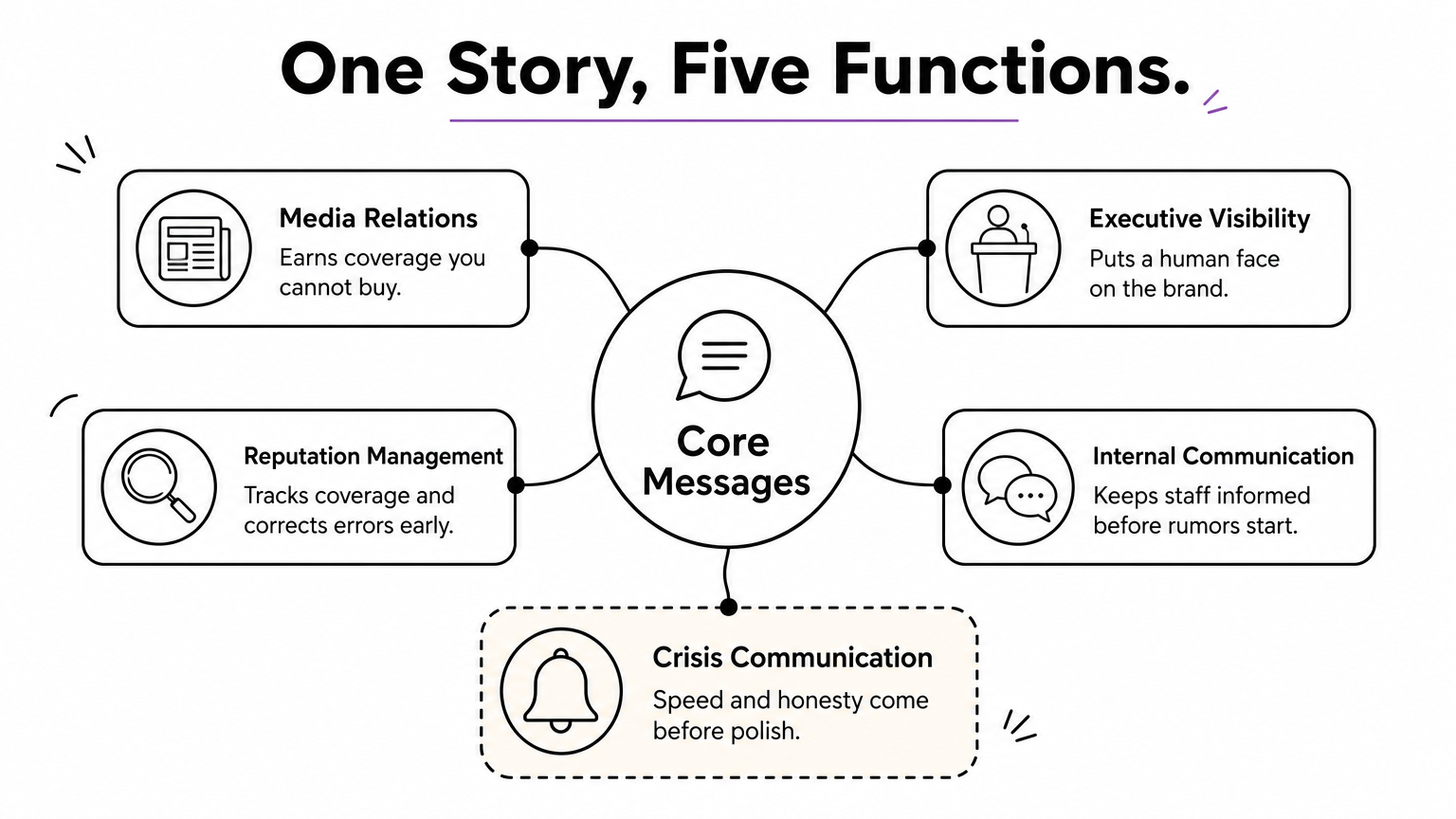
Five functions, one story: the moment they contradict each other, trust starts to leak.
Outward-facing functions
Media relations comes first for most companies. It means building relationships with journalists, writing press releases, and pitching stories that editors actually want. Media relations earns coverage you cannot buy, and a quote from your CEO in a trade title carries more weight than the same claim in an advert. In South Africa, a strong pitch is often a fresh survey, a local angle on a global trend, or expert comment on a news event.
Executive visibility and reputation management sit alongside it. Leaders who write on LinkedIn, speak at events, and answer media questions put a human face on the brand. Reputation management then tracks the result by monitoring coverage, reviews, and social comments, so you can correct errors early instead of discovering them months later.
Inward-facing and crisis functions
Internal communication keeps your own people informed. Staff are your most believable ambassadors, so they should hear about a restructure, a product launch, or a big client win from you first. Regular, predictable updates through email, team meetings, or a chat channel cut rumors before they start.
When something goes wrong, crisis communication takes over. Speed and honesty matter more than polish. Issue a holding statement within the first hour, even if all it says is that you are aware of the problem and are investigating. Your plan should settle four questions before any crisis hits:
- Who is the single spokesperson?
- What do we know, and what do we not know yet?
- Who hears first: staff, customers, or regulators?
- When is the next update?
How to build a corporate communications strategy
Good corporate communications starts with a short written plan that links what you say to what the business wants to achieve. It does not need to be long. A two-page document your team actually uses beats a 40-page deck nobody opens, and you can build one in four clear steps.

Set goals and name your audiences
Start with the business outcome, not the channel. "Be more active on LinkedIn" is a task. "Win three trade media features that support our product launch" is a goal. Tie every goal to a number and a date, then list the audiences who can help you reach it. For example:
- Goal: grow qualified website visits by 20% in six months. Audience: prospects and trade media.
- Goal: reduce staff turnover this year. Audience: employees and team leaders.
- Goal: close partnership deals faster. Audience: investors and partners.
Shape your messages and choose channels
Next, write three or four core messages that say who you are, what you do, and why it matters. Every press release, post, and speech should trace back to them. Test each one: if a competitor could say the same sentence, rewrite it until it is specific to you.
Write your core messages down once, and every channel gets easier.
Channels follow your audience. Journalists respond to a tight pitch by email, investors expect formal reports, and B2B buyers spend time on LinkedIn. Pick two or three channels you can sustain instead of six you will abandon by March.
Assign owners and set a rhythm
Finally, give every function a named owner and put dates in a shared calendar. A plan with no owner stays a document. Check that you have these basics in place:
- A spokesperson who has done interview preparation and is reachable
- Core messages approved by leadership
- A monthly content calendar
- A crisis holding statement drafted in advance
- A quarterly review date in the diary
Review matters as much as the plan itself. Every quarter, compare results against your goals, drop what did not work, and repeat what did. Our section on measurement below shows which numbers to track.
Examples of corporate communications in practice
Definitions only go so far. Seeing corporate communications at work shows how the functions connect, and it gives you a model you can copy at your own scale.
Everyday examples by function
Most of what you already do falls under one of the five functions. The difference is whether it is planned and consistent or improvised. These examples suit a small or mid-sized South African business with a lean team and a modest budget.
| Function | Practical example | Audience |
|---|---|---|
| Media relations | A press release on a new Johannesburg office, plus pitches to two trade titles | Journalists, prospects |
| Executive visibility | A monthly LinkedIn article from your MD on a sector trend | Clients, candidates |
| Reputation management | A weekly check of coverage and Google reviews, with replies inside 24 hours | Customers |
| Internal communication | A short Monday email with wins, changes, and key dates | Employees |
| Crisis communication | A holding statement and Q&A sheet drafted in advance for a system outage | All audiences |
One launch, one outage, one story
Imagine you are launching a new payments product. Media relations delivers a press release with a customer case study and a pitch to fintech reporters. Your CEO publishes a LinkedIn post about the problem the product solves. Staff get a briefing the day before, so they can answer questions from friends and clients with confidence. Every piece draws on the same three core messages.
Now picture an outage during launch week. Because the plan exists, your spokesperson posts a holding statement within the hour, support staff get a short script, and employees hear the news before social media tells them. Customers see a company that is in control, and the launch story survives.
A good plan makes your worst day sound like the same company as your best day.
How to measure corporate communications success
You set goals with numbers and dates in your strategy, so measurement mostly means checking them. Track a few metrics tied to those goals and ignore the rest. Reporting on everything usually teaches you nothing, and a short scorecard is easier to discuss in a leadership meeting.
Match each metric to a goal
Each function of corporate communications has a number that shows whether it is working. Pick one or two metrics per goal and note where the data lives, so the check takes minutes instead of days.
| Goal | Metric | Where to find it |
|---|---|---|
| Media coverage | Placements in target titles, key messages quoted | Media monitoring, Google Alerts |
| Website growth | Referral visits from coverage and LinkedIn | Google Analytics |
| Executive visibility | Impressions, follower growth, inbound requests | LinkedIn analytics |
| Internal communication | Email open rates, pulse survey scores, turnover | Email tool, HR records |
| Reputation | Review rating, tone of mentions, reply time | Google reviews, social listening |
| Crisis readiness | Minutes to first holding statement | Incident log |
Look past vanity numbers
Volume flatters you. Fifty mentions in low-quality listings are worth less than one feature in the title your buyers actually read. Count coverage that carries your core messages, quotes your spokesperson, and links back to your site.
Results in the business close the loop. Ask new clients how they heard about you, and note when prospects mention an article or post on a sales call. Those comments count as data once you log them every month, because they connect your communication to revenue.
Measure one thing above all: did the right people hear the right message?
Build a simple quarterly report
Put everything on one page each quarter. A report your team reads in five minutes will change what you do next, while a long one gets filed away. Include:
- Each goal, with the target and the actual result
- Your three best pieces of coverage or content
- One lesson, one thing to stop, and one thing to repeat
Keep the same format every quarter. Trends over time tell you far more than any single month, and they show leadership that the work is paying off.
Careers and study paths in corporate communications
This field suits people who write clearly, think strategically, and stay calm under pressure. You can enter from journalism, marketing, or a communication degree, and employers care more about proof of work than about any single qualification. Most careers follow a ladder, with roles that map onto the five functions covered earlier.

Common roles and how they progress
Entry roles focus on doing: writing, monitoring, and coordinating. Senior roles focus on advising leadership. You move up by owning outcomes, not just tasks, so start tying your work to the metrics from the measurement section.
| Level | Typical title | Main focus |
|---|---|---|
| Entry | Communications assistant or coordinator | Drafting, media monitoring, social posts |
| Mid | Communications officer or media relations specialist | Pitching, press releases, spokesperson prep |
| Senior | Communications manager | Strategy, budgets, crisis planning |
| Executive | Head of corporate affairs or communications director | Advising the CEO and board |
Study and training options
Many South African universities offer degrees or diplomas in communication science, public relations, or journalism. An honours degree adds strategic depth. Short courses in media training, digital content, and crisis communication fill gaps quickly, and they suit people moving across from another field. The Public Relations Institute of Southern Africa (PRISA) is the professional body, and membership gives you networking and credibility early on.
Qualifications open the door, but a portfolio of published work gets you the job.
Build that portfolio from day one. Write for a company blog, volunteer to draft a press release, or ghostwrite a LinkedIn post for a manager. Real samples with real results will outweigh a clean transcript in most interviews.
Where to find corporate communications jobs
Search by several titles, not only "corporate communications jobs", because employers also write "corporate affairs", "PR", or "communications partner". Set alerts for three or four title variations so you see roles as they appear. Good places to look include:
- LinkedIn Jobs, where hiring managers often post directly
- Indeed, PNet, and Careers24 for broad South African listings
- Career pages of companies you admire, since many roles never reach job boards
- Agency and professional body networks, where referrals often beat cold applications
Putting corporate communications to work
Corporate communications comes down to one habit: say the same true thing, consistently, to every audience that matters. The five functions, a short written strategy, and a handful of honest metrics give you a system instead of scattered posts. You do not need a big team or budget to start.
Begin this week with three small steps. Write your core messages, draft a crisis holding statement, and book your first quarterly review. Those basics already put you ahead of most competitors in your industry.
If you would rather have experienced help, get in touch with Purple Word Box about your PR and corporate communications. Maria Joubert advises clients directly, with practical, honest guidance from strategy through to media coverage.