

If you have seen the term in a job ad, a university prospectus, or a board report, you may still wonder what strategic communications actually means. The phrase gets used loosely. Some people treat it as another word for PR. Others think it is just marketing with a better title.
Here is the short answer. Strategic communications is the planned use of messages, channels, and relationships to help an organization reach a specific goal. Every message ties back to a business objective and a defined audience, such as customers, investors, employees, regulators, or the media. Nothing is sent just to fill space. It also gives people a clear career path, from communications officer to head of corporate affairs, with degrees and short courses that feed into it.
In this article, you will get a full definition, the main areas it covers, and how organizations use it to reach stakeholders. We also look at what to study and which roles to aim for. Our view comes from hands-on PR work with South African businesses, where clear, honest messaging has to earn results, not just look polished.
Why strategic communications matters for organizations
Organizations that communicate without a plan tend to talk about whatever feels loudest this week. A product launch gets a press release, a bad review gets a defensive post, and the CEO’s LinkedIn page goes quiet for months. Strategic communications fixes this by making every message earn its place. Here is why that matters in practice.
It keeps messages tied to goals
Without a goal, communication becomes activity. You publish, post, and pitch, but nobody can say what changed. Strategic communications starts with the outcome, such as winning a tender, recruiting engineers, or reassuring investors after a weak results period. Then you work backward to the audience, message, and channel that can get you there.
Every message should answer one question: what do we want this audience to think, feel, or do?
Resources are tight in most small and mid-sized South African businesses. A planned approach tells you what to drop as well as what to do. If a channel does not reach a stakeholder who matters, you stop spending time on it and put that effort where it moves a measurable result.
It builds trust with every stakeholder
Different groups need different things from you, and one generic message rarely works for all of them. Trust is built by meeting each group’s actual need, which means knowing what those needs are before you write anything. A simple view looks like this:
- Customers: proof that you deliver and a clear reason to choose you
- Employees: clarity on direction, especially during change
- Investors and lenders: confidence in leadership and numbers
- Media: accurate facts and quick access to a credible spokesperson
- Regulators and partners: transparency and consistency over time
It protects your reputation under pressure
Crises show quickly whether a plan exists. A data breach, a product recall, or a service failure that hits customers leaves you hours, not days, to respond. Organizations with a named spokesperson, approved holding statements, and a clear escalation path respond faster and say fewer things they later regret.
Trust built beforehand also pays off. Journalists return calls from companies they already know, and customers forgive mistakes from brands that were honest in good times. That goodwill is hard to build in the middle of a crisis, so start before you need it.
How to build a strategic communications plan
A strategic communications plan does not need to be a 40-page document. For most small and mid-sized businesses, two or three clear pages that your team actually uses beat a deck nobody opens. The aim is a working tool, not a showpiece.
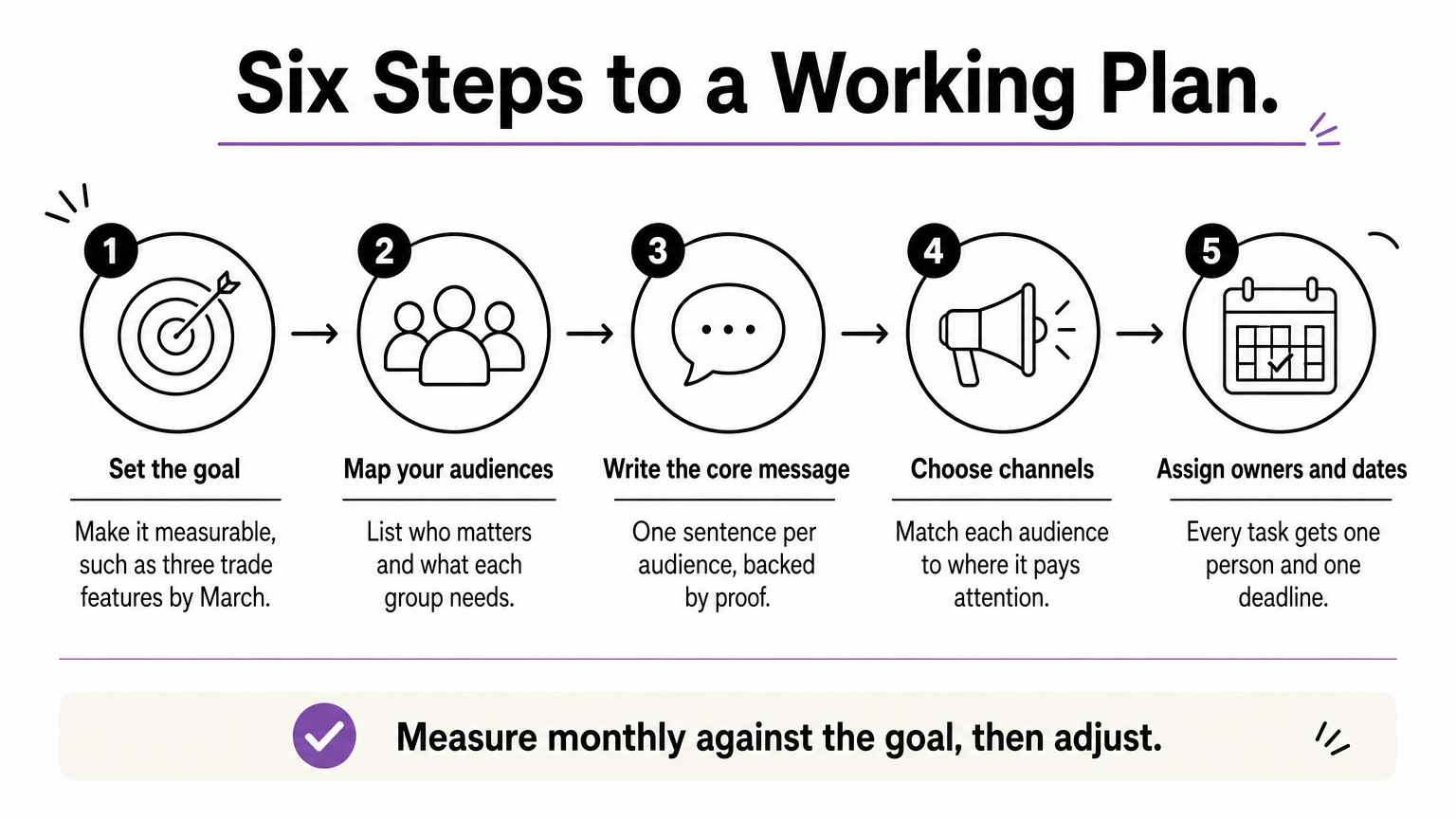
The six steps
Work through these in order, because each step depends on the one before it. Skipping the goal and jumping to channels is the most common way plans go wrong.
- Set the goal. Make it measurable, such as "secure three trade media features by March."
- Map your audiences. List who matters and what each group needs from you.
- Write the core message. One sentence per audience, backed by proof.
- Choose channels. Match media, LinkedIn, email, or events to where each audience pays attention.
- Assign owners and dates. Every task gets one person and one deadline.
- Measure and adjust. Review monthly against the goal, not against how busy you were.
If you cannot measure the goal, you cannot judge the plan.
Test it before you launch
Share the draft with someone outside the project, ideally a person who fits one of your audiences. Ask them what they would take away from your message. If their answer differs from your intent, rewrite the message, not the explanation.
Finally, keep room for surprises. A plan that leaves no capacity for a crisis or a media opportunity will break the first time the news cycle moves. Reserve roughly 20 percent of your time and budget for what you cannot predict.
Strategic communications vs PR, marketing and advertising
These four terms overlap, which is why people swap them. The real difference is scope. Strategic communications is the umbrella that sets goals and messages, and the other three are disciplines that carry those messages out.
Where each one fits
| Discipline | Main focus | Typical example |
|---|---|---|
| Strategic communications | Aligning all messaging to organizational goals | A plan for announcing a merger to staff, clients, and media |
| Public relations | Earning trust and coverage through relationships | Pitching a trade journalist a client story |
| Marketing | Creating demand for products or services | An email campaign or content series |
| Advertising | Paid placement of controlled messages | A sponsored LinkedIn post or radio spot |
Notice who holds control. With advertising you pay, so you decide every word. With PR you earn coverage, so a journalist decides what runs. Earned coverage carries more credibility, but it gives you less control over the final wording.
Why the distinction matters
Mixed signals are the usual cost of ignoring it. A company runs a price-led ad campaign while its PR team pitches a premium, service-first story. Customers and journalists notice the gap, and trust drops. Strategic communications keeps all four aligned to one goal and one core message.
PR, marketing, and advertising are the tools; strategic communications decides how they work together.
Before you approve any campaign, ask two questions. Which business goal does it serve? And does its message match what you say everywhere else?
Examples of strategic communications in practice
Definitions only go so far. These three scenarios show strategic communications at work. They are composites of situations we see with South African businesses, not named clients, but the steps are real.
Launching a product
Picture a Johannesburg software firm that wants 50 demo requests from finance directors. That single goal shapes every task, and each channel repeats one core message: a faster month-end close.
| Audience | Channel | Message angle |
|---|---|---|
| Finance directors | Trade media feature | Close the books in two days |
| Prospects | CEO LinkedIn posts | Lessons from customer results |
| Existing clients | Early access to the new module |
Responding to a crisis
Say a logistics company has a system outage that delays deliveries. The first two hours decide the story. A prepared team briefs staff first, sends customers a direct update, and gives the media one named spokesperson with an approved statement.

In a crisis, your own people and customers should never learn the news from a journalist.
Afterward, the company publishes what went wrong and what changed. Openness after the fact rebuilds the trust the outage dented.
Building a leader’s profile
A founder preparing for a funding round needs investors to recognize her name. Over six months, she publishes one opinion article a month, offers journalists comment on industry news, and posts weekly on LinkedIn.
Results are tracked against the goal: media mentions, inbound investor enquiries, and profile views from target firms. If a tactic produces none of these, she drops it.
Careers and study paths in strategic communications
Strategic communications offers a broad career ladder, and you can enter it from several directions. Most people start in a support role and move up by proving they can tie messages to results.
Roles to aim for
| Role | What you do | Stage |
|---|---|---|
| Communications officer | Draft content, run social channels, support media requests | Entry |
| PR or media relations specialist | Pitch journalists, write press releases, track coverage | Early to mid |
| Communications manager | Own the plan, budget, and spokesperson preparation | Mid |
| Head of corporate affairs | Advise executives, guide reputation and crisis response | Senior |

Agency work is a fast route up. You handle several industries at once, so you learn how different audiences behave quickly. In-house roles give you depth in one organization, which suits people who want to shape its long-term reputation.
What to study
Employers rarely demand one exact degree. A bachelor’s degree in communication, journalism, public relations, or marketing is the usual starting point in South Africa. An honours or master’s in strategic communication helps if you want to move into management.
Short courses fill gaps quickly. Useful topics include:
- Media relations and pitching
- Crisis communication
- Business writing
- Measurement and analytics
Skills matter as much as certificates. Clear writing is the one every role rewards, and a portfolio of real work, even volunteer or personal projects, often beats a qualification on its own.
Employers hire the person who can show a message that moved a result.
Putting strategic communications to work
Strategic communications comes down to one habit: start with the goal, then choose the audience, message, and channel that serve it. Done well, it keeps PR, marketing, and advertising pulling in the same direction and protects your reputation when pressure hits.
Whether you are building a plan for your business or mapping your own career, the same test applies. Can you point to a measurable result that a specific message helped produce? If you can, you are doing it right. If you cannot, tighten the goal before you add more activity.
If you want senior-level help turning this into a working plan, talk to Purple Word Box about PR and communication support. You will work directly with an experienced practitioner who gives you honest advice and clear, practical next steps.