
You can spend months on press coverage, LinkedIn posts, and events and still not know if anyone remembers your name. That is the problem with brand awareness. It feels real, but unless you track it, you cannot prove it is growing. Choosing the right brand awareness measurement tools is what turns a hunch into a number you can show your board.
So how is brand awareness measured? You combine a few signals. Direct traffic and branded search volume show how many people look for you by name. Share of voice and mentions show how often you appear in conversations and media compared to competitors. Surveys then tell you what people recall and recognize when nobody prompts them. No single metric tells the whole story, so you need two or three that work together.
Below are seven tools we see work for South African businesses, from free options like Google Analytics and Google Trends to social listening platforms and brand tracking surveys. For each one, you will see what it measures, what it costs in effort, and who it suits best, so you can build a simple tracking setup without overspending.
How brand awareness is measured and calculated
Direct and indirect signals
Brand awareness measurement falls into two camps. Direct methods ask people what they know, usually through surveys. Indirect methods infer awareness from behavior, like searches, visits, and mentions. Direct methods give you true recall. Indirect methods give you trends over time, and most of them cost little or nothing.
| Metric | Type | What it tells you | Typical source |
|---|---|---|---|
| Unaided awareness | Direct | Who names you without prompting | Survey |
| Aided awareness | Direct | Who recognizes you from a list | Survey |
| Branded search volume | Indirect | How many people search your name | Google Trends, Search Console |
| Direct traffic | Indirect | How many people type your URL | Google Analytics |
| Share of voice | Indirect | Your mentions versus competitors | Social listening, media monitoring |
A simple brand awareness formula
There is no single official brand awareness formula, but the two most useful calculations are simple. Use the first for surveys and the second for mentions.
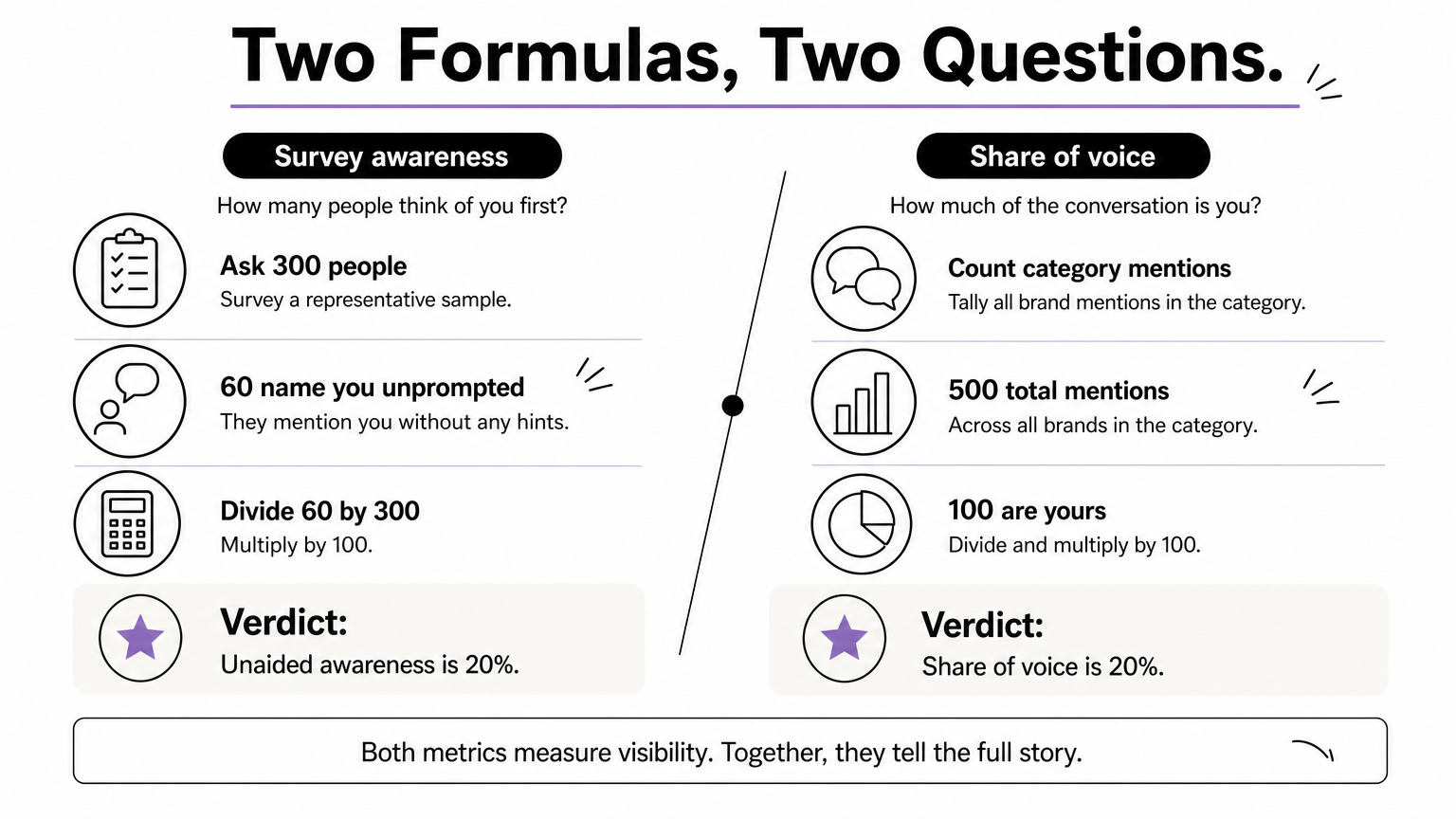
Awareness % = (respondents who know your brand ÷ total respondents) × 100
Share of voice % = (your mentions ÷ total category mentions) × 100
Here is a quick example. Say 60 of 300 survey respondents name your company without a prompt. Your unaided awareness is 20%. If competitors and you together earned 500 media mentions last quarter and 100 were yours, your share of voice is also 20%. Run the same brand awareness calculation every quarter and the trend matters more than any single result.
Set a baseline first
Start by recording where you stand today. Pull 90 days of branded search data, direct traffic, and media mentions before your next campaign launches. Without a baseline, you cannot tell growth from noise. A spike after a press release means little if you never knew what a normal week looked like.
A brand awareness number only means something when you compare it to your own baseline.
Finally, pick two or three metrics and stick with them. One direct signal and two indirect signals is a sound mix. The seven brand awareness measurement tools below each feed one or more of these metrics, so you can match each tool to the number it improves.
1. Purple Word Box media and PR coverage tracking
What it measures
Of all the brand awareness measurement tools here, this one is built into the PR work itself. Purple Word Box tracks where your brand appears and how much of the conversation you own:
- Placements per quarter
- Outlet quality and audience fit
- Message pickup, meaning whether journalists use your key points
- Share of voice against named competitors
How it works
Every placement is logged against your pre-campaign baseline. Maria Joubert, who leads the agency, reviews the results with you and links each placement to the release, pitch, or article that earned it. You see which stories landed and which fell flat.
Coverage only counts as awareness when you can tie it to a message and a result.
Who it is for
Small and mid-sized South African businesses suit it best, especially those chasing trade or mainstream recognition. It also helps leaders who want to build a profile as spokespeople and prefer senior, hands-on advice to a junior account manager.
Client testimonials from companies such as TreasuryONE and Esri South Africa cite improved media coverage and brand visibility. That is the outcome this kind of tracking should show you.
Cost and effort
Cost depends on how much PR activity you run, so ask for a quote based on your goals. Tracking comes with the PR service rather than as a separate product.
Your effort is light. Expect to approve messages and share news as it happens, then review a coverage summary each quarter.
2. Brand awareness surveys
What it measures
Surveys capture what no dashboard can: what people actually remember about you. They feed the survey half of the brand awareness formula covered earlier.
- Unaided awareness: who names you when asked about your category
- Aided awareness: who recognizes you from a list
- Perception: the words people link to your brand
How it works
Ask five to eight questions and send them to 200 to 300 people in your target market. Use your email list, LinkedIn, or a paid panel. Repeat the survey every quarter with identical wording so the results compare cleanly.
Order matters. Ask the open, unprompted question first, then show a list of brands. Otherwise the list plants answers in your respondents’ heads.
Ask the unprompted question before you show any list of brands.
Who it is for
Businesses with a clearly defined audience get the most from surveys, especially B2B firms running PR or events who want proof that campaigns changed recall.
Skip it if you serve a tiny niche. When you can only reach 50 people, phone your best prospects instead and ask what they know about you.
Cost and effort
Costs vary by route. These figures are rough estimates, so confirm them with any provider.
| Route | Typical cost | Your effort |
|---|---|---|
| DIY with Google Forms | Free | A few hours per wave |
| Paid respondent panel | Roughly R10,000 to R40,000 per wave | Light, once the questions are set |
Expect the DIY route to skew toward people who already know you. A panel gives a fairer read of how brand awareness is measured across a cold audience.
3. Google Analytics
What it measures

Google Analytics shows how many people find your site without a nudge. Among all the brand awareness measurement tools here, it is the easiest to start with, because three numbers do most of the work:
- Direct sessions: visitors who type your URL or use a bookmark
- Organic search sessions: visits that tend to rise when more people look for you
- New users: a rough count of first-time visitors
How it works
Open Reports, then Acquisition, then Traffic acquisition. Set the date range to 90 days and record the direct and organic rows as your baseline. Then compare each quarter against the last, and keep a log of campaign launches, press hits, and events beside the numbers.
Direct traffic is the closest free proxy for people who remember your name.
Treat it as a proxy, not proof. Some untagged traffic lands in direct, such as clicks from WhatsApp or certain email apps. Add UTM tags to your own links so that the direct channel stays as clean as possible.
Who it is for
Any business with a website can use it. It suits companies running PR, LinkedIn activity, or events, because you can watch for a lift in direct and organic visits in the weeks after each push.
Small sites with only a few hundred visits a month will see noisy swings. In that case, compare quarters, not weeks, so a single busy day does not fool you.
Cost and effort
Standard Google Analytics is free. Setup takes under an hour, or a short job for your web developer. After that, plan on about 15 minutes a month to check the channel report and update your log.
4. Google Trends and Search Console
What it measures
These two free brand awareness measurement tools show how many people search for your name and whether interest is rising or falling. Each covers a different angle:
- Google Trends: relative search interest in your brand versus competitors, filtered to South Africa or a province
- Search Console: branded clicks, impressions, and average position for queries that include your name
How it works
In Google Trends, enter your brand name and up to four competitors. Set the region to South Africa and the range to 12 months. The chart shows interest on a scale of 0 to 100, not raw search counts, so read it as a trend line and not as a headcount.
Search Console is more precise. Open Performance, add a query filter that contains your brand name, and record clicks and impressions each month. Include common misspellings and your founder’s name if people tend to search for them.
Branded search is the clearest free sign that people remember you without being reminded.
Compare the numbers against the dates of your press coverage, LinkedIn pushes, and events. A bump a week after a feature runs is evidence that coverage sent people searching.
Who it is for
Companies with an existing name and a verified website get the most from this pair. It suits businesses running PR or events, because you can see whether a campaign moved search demand within a few weeks.
Very new or niche brands may hit a wall. Trends shows nothing for low-volume terms, so rely on Search Console instead, where even a handful of branded searches still appear.
Cost and effort
Both tools are free. Verifying your site in Search Console takes about 15 minutes with an HTML tag or DNS record. After that, plan on 10 minutes a month to export branded clicks and impressions into your tracking log.
5. Social listening tools
What it measures
Social listening tools scan social platforms, news sites, blogs, and forums for your brand name. They report mention volume, which is how often people talk about you, and sentiment, which is whether they sound positive, neutral, or negative. Most also calculate share of voice against competitors.
How it works
Enter your brand name, common misspellings, product names, and your spokespeople’s names. Add two or three competitors. The tool collects matching posts and charts them, so you can log weekly mention counts and run the share of voice calculation from earlier.
Mentions only measure awareness when you compare them to your competitors’ mentions.
Filter out noise early. A brand name that doubles as a common word will pull in irrelevant posts, so add exclusion terms until the feed is clean. Then mark campaign dates on the chart to see which activity moved the numbers.
Who it is for
Companies with an active public audience get the most value, especially consumer brands and B2B firms that post often on LinkedIn. If you earn only a handful of mentions a month, a paid platform is overkill. In that case, search your name natively on LinkedIn and Facebook each week.
Cost and effort
Prices vary by provider and change often, so treat these as rough estimates and confirm them before you commit.
| Route | Typical cost | Your effort |
|---|---|---|
| Native platform search | Free | 15 minutes a week |
| Paid listening platform | Roughly R1,500 to R20,000 a month | 2 hours to set up, then 30 minutes a week |
Start free. Upgrade only when manual checking stops giving you a clear picture.
6. Brand tracking platforms
What it measures
Brand tracking platforms run continuous brand surveys and show the results on a live dashboard. They measure the same things as the one-off surveys above: unaided awareness, aided awareness, and perception. The difference is that they add trend lines by audience segment, such as industry, job title, or region.
How it works
You build the questionnaire once. The platform then recruits respondents from its panel on a rolling basis, often weekly, and updates your scores without extra work. Most let you benchmark against named competitors and mark campaign dates on the chart. Because the sample stays steady, you can see within weeks whether a PR push moved recall, instead of waiting for the next quarterly survey.
A tracking platform turns a one-off brand awareness survey into a live trend line.
Who it is for
Mid-sized and larger companies with year-round marketing spend and a broad audience get the most from these platforms. They suit leadership teams that want brand awareness measurement reviewed monthly. If you sell to a small B2B niche, the panel may not reach enough of your buyers, so stick with a manual survey and phone calls instead.
Cost and effort
Most vendors sell annual subscriptions, and pricing is rarely public. The figures below are rough estimates, so confirm them with any provider before you commit.
| Tier | Typical cost | Your effort |
|---|---|---|
| Entry-level subscription | Roughly R60,000 to R150,000 a year | Half a day to set up, then about an hour a month |
| Enterprise tracker | Often R300,000 or more a year | Vendor-assisted setup, monthly review |
Budget for the questionnaire design too. Poorly worded questions give you a precise answer to the wrong question.
7. Google Alerts and media monitoring
What it measures
Of the seven brand awareness measurement tools here, this is the one that catches earned media. It counts the articles, blog posts, and press mentions that name your brand, your spokespeople, or your products. Those counts feed the share of voice calculation from earlier.
- Mentions per month
- Outlets that mention you
- Competitor mentions for comparison
How it works
Go to Google Alerts, enter your brand name in quotation marks, and set delivery to once a day. Create separate alerts for your spokespeople, your products, and two competitors. Then log every mention in a sheet with the date, the outlet, and whether you earned it.
Google Alerts gives you a floor for your mentions, never a complete count.
Alerts only find what Google indexes. Paywalled articles, print, radio, and most social posts slip through, so treat the totals as a minimum. A paid media monitoring service closes those gaps by scanning print, broadcast, and online sources.
Who it is for
Every business can start with alerts, and it is the easiest first step if you run PR or plan a launch. Companies that depend on print or broadcast coverage should add a paid monitoring service. Without one, brand awareness measurement will undercount you.
Cost and effort
Alerts are free. Paid monitoring is quoted per client, so these figures are rough estimates to confirm with any provider.
| Route | Typical cost | Your effort |
|---|---|---|
| Google Alerts | Free | 20 minutes to set up, 10 minutes a week |
| Paid media monitoring | Roughly R3,000 to R15,000 a month | Light, plus a monthly review |
Start with the free route. Pay only when your coverage outgrows what alerts can find.
How to choose the right tools for your business
Seven tools do not mean seven subscriptions. The right brand awareness measurement tools depend on your budget, your audience size, and how much PR activity you run. Start with the free tools, then add a paid one only when it answers a question the free ones cannot.
Match the tool to your stage
Your stage decides the mix. A company with 300 site visits a month gets little from a R100,000 tracker. Match spend to audience size, and let your PR and event plans decide how much coverage tracking you need.
| Your situation | Start with | Add later |
|---|---|---|
| Tight budget, small team | Google Analytics, Search Console, Google Alerts | A DIY survey in Google Forms |
| Active PR and events | Coverage tracking, Google Alerts | Social listening |
| Large audience, year-round spend | Brand tracking platform, social listening | Paid media monitoring |
Build a stack of three
Aim for one direct signal and two indirect ones. A quarterly survey, Google Analytics, and Google Alerts make a sound start. Review all three on the same day each quarter, and log your campaign dates beside the numbers.
Consistency beats sophistication, so track the same few measures for a full year before you judge them.
Resist the urge to swap tools when a number dips. Changing methods breaks your baseline, and then you cannot compare this quarter with the last. If a tool is not giving you a clear answer after two quarters, replace it. Until then, keep the setup steady and let the trend build.
Start tracking what matters
Brand awareness stops being a hunch once you measure it. How is brand awareness measured? You record a baseline, pick one direct signal and two indirect ones, and review them on the same schedule every quarter. Several of the brand awareness measurement tools above cost nothing, so the only real barrier is getting started.
This week, pull 90 days of Google Analytics and Search Console data, set up a Google Alert for your name, and draft a short survey. Those three steps give you a working baseline within days. From there, the trend does the talking, and you add paid tools only when the free ones stop answering your questions.
If you want your coverage tracked and tied to real results, talk to Purple Word Box about PR you can measure. You get senior, hands-on advice from Maria Joubert and numbers you can show your board.