

To write a thought leadership article, choose one question your customers keep asking, take a clear position on it, back that position with your own experience and evidence, and publish it under your name where your audience already reads. It works when the reader finishes knowing what you think and why you are qualified to think it.
Most attempts miss. Leaders write a thinly disguised advert, or they repeat advice that every competitor has already published. Editors skip it and readers forget it. The fix is not better prose. It is a sharper opinion and a repeatable process for turning expertise into words.
This guide explains what a thought leadership piece is, then walks through four steps: choosing a topic, building the argument, writing the draft, and publishing it. Purple Word Box includes thought leadership articles in its PR work for business leaders, so the advice comes from a practitioner’s view of what editors and readers respond to.
What a thought leadership article is and is not
A thought leadership article is a short opinion piece, usually 700 to 1,200 words, in which a named expert argues a position on a problem their audience cares about. It teaches or challenges. It does not sell.
How it differs from other formats
The easiest way to stay on track is to know which job your piece is doing. A thought leadership piece has one job: to show how you think.
| Format | Main job | Who speaks | Reader’s takeaway |
|---|---|---|---|
| Thought leadership article | Argue a position | A named expert | "This person understands my problem" |
| Press release | Announce news | The company | "Something happened" |
| Blog post | Inform or answer a search | The brand or staff | "I learned how to do it" |
| Sales page | Convert | The brand | "I can buy this" |
If your draft reads like the bottom two rows, it is not yet thought leadership content. The test is simple: could a competitor sign this article without changing a word? If yes, it has no opinion in it.
A thought leadership article earns trust by taking a position, not by describing a product.
What you need before you start
Gather four things before you open a blank page:
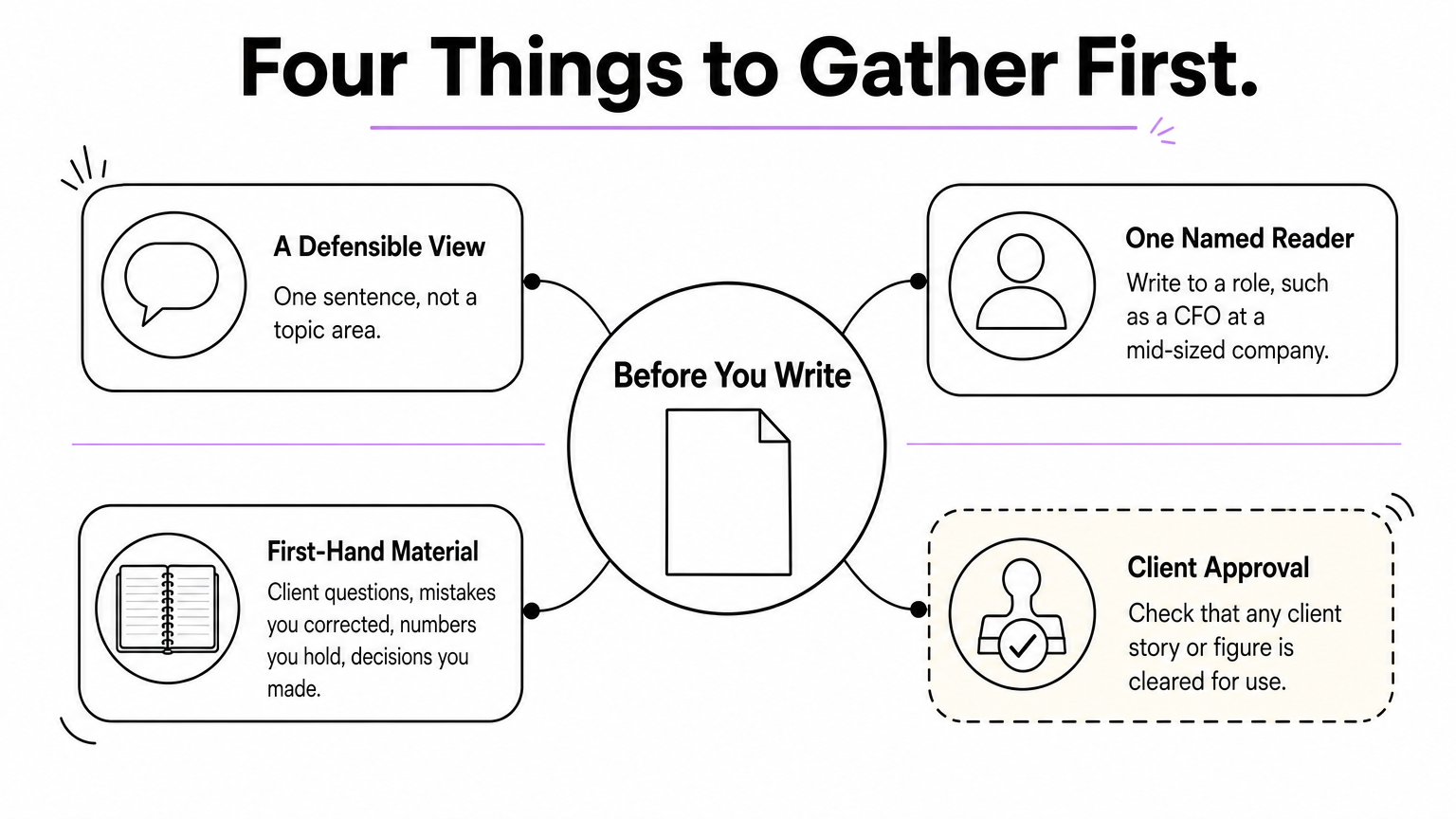
- A view you can defend. One sentence, not a topic area.
- One reader. Name the role, such as a CFO at a mid-sized company, and write to that person.
- First-hand material. Client questions, mistakes you corrected, numbers you hold, decisions you made.
- Approval. Check that any client story or figure is cleared for use.
Step 1. Choose a topic only you can cover
Pick a topic where your direct experience gives you something a general writer cannot say. The strongest ideas sit where three things overlap: a question your audience asks, a view you hold, and evidence you can show.
Run your idea through three filters
Ask three questions. Do clients or prospects ask about this repeatedly? Do I disagree with the common answer? Can I support my view with something I have seen or measured? If any answer is no, drop the idea or reshape it.
Thought leadership content ideas to start from
These angles work across industries. Replace the examples with your own field.
| Idea type | What it sounds like |
|---|---|
| Myth you correct | "Why more reporting does not mean better decisions" |
| Lesson from a mistake | "What a failed product launch taught us about timing" |
| Prediction with reasons | "Where our industry will be in three years, and why" |
| Process you changed | "How we cut onboarding from weeks to days" |
| Reaction to news | "What the new regulation means for small businesses" |
| Unpopular advice | "Why you should say no to your biggest client’s request" |
Choose one. A thought leadership piece that tries to cover three ideas ends up proving none of them.
If a competitor could have written your topic, keep narrowing until only you could.
Step 2. Build the argument before you write
Write your position in one sentence, then outline the piece so every paragraph supports it. A clear outline takes 15 minutes and saves hours of rewriting.
State your position in one sentence
Use this format: "Most people believe X, but in my experience Y, because Z." For example: "Most firms treat LinkedIn as a broadcasting tool, but in my experience it works as a listening tool, because the best posts answer what clients already ask." If you cannot fill in the gaps, you do not have a position yet. You have a subject.
Use a copyable outline
This outline fits most thought leadership articles of around 900 words. Paste it into your document and fill it in.
Headline: [Promise the opinion, not the topic]
Opening (80 words): The problem your reader faces, in their words
Position (50 words): Your one-sentence view
Reason 1 (200 words): Evidence or story from your experience
Reason 2 (200 words): A second proof point, ideally a number
Counterpoint (120 words): The best argument against you, and your reply
What to do (150 words): Three actions the reader can take this week
Close (60 words): Restate the position, no sales pitch
The counterpoint is what separates an opinion from a rant. Admitting the other side exists makes your side more believable.
Fix the position first; the paragraphs are easy once the argument is settled.
Step 3. Write it in your own voice
Write the way you would explain the issue to a sharp colleague: short sentences, plain words, one idea per paragraph. If you are working out how to write thought leadership content that sounds like you, dictate the first draft, then tidy it.

Open with the problem, not your biography
Your first 80 words decide whether anyone reads on. Start with the reader’s situation or a specific moment, such as a client call or a budget meeting. Do not start with your company’s history or a definition of the industry. Your credentials belong in the byline and one sentence in the body, where they support a claim.
Prove claims with evidence you can stand behind
Every major claim needs support. Use your own results, a client scenario with names removed if needed, or a figure from a source you can cite. Link to authoritative sources such as government statistics, research bodies or standard-setting organizations, and skip vague phrases like "studies show." Do not pad with footnotes either. A thought leadership article is not a dissertation, so cite only what a skeptical reader would question.
Avoid three habits that weaken the piece:
- Buzzwords like "synergy" or "cutting-edge."
- Self-praise about your company’s strengths.
- Hedging every point so no one can disagree.
Specific stories and numbers make an opinion credible; adjectives never do.
Step 4. Edit, publish and place your article
Cut the draft by 15 percent, check it against your one-sentence position, and publish it where your target reader already spends time. Writing is half the work. Placement is the other half.
Edit for opinion and clarity
Run this checklist before you share the draft:

- Does the headline promise a view, not just a subject?
- Can a reader state your position after the first two paragraphs?
- Does every section support that position?
- Is there at least one story or number only you could provide?
- Is every sentence free of sales language?
- Has someone outside your field read it and understood it?
Read it aloud. Wherever you stumble, rewrite.
Publish and place it
Post the article on your own website first, then share the main argument on LinkedIn with a short, personal introduction. Then consider pitching it to trade publications or industry media as a byline article. Editors want exclusive, non-promotional pieces, so send a short pitch with your headline, your position in two sentences, and why you are qualified. Purple Word Box handles this pitching and placement for clients. Reuse the material afterward as a newsletter item or a talking point for interviews.
One strong article, shared in three places, beats three weak articles shared in one.
Start with one opinion you can defend
A good thought leadership article comes down to a single defensible opinion, supported by your own experience and delivered in plain language. Choose a topic only you can cover, outline the argument, write it like you talk, then edit hard and place it where your readers are. Do that once a quarter and your credibility builds with every piece.
If you would rather work with a senior PR practitioner on the writing and placement, you can talk to Purple Word Box about your thought leadership articles.