

Building thought leadership takes four steps, in this order: set a business goal, choose your audience and a clear position, publish original insight on a steady rhythm, then share it where your buyers already pay attention and measure what happens. Follow that sequence and you have a thought leadership plan you can run in 90 days and sharpen every quarter. Skip the order and you get scattered posts that nobody connects to your name.
Most attempts stall for the same reason. Leaders have real expertise but start from the channel ("we need to be on LinkedIn") instead of the question, so what they publish sounds like everyone else in the industry. Others write one strong article, hear nothing back, and quit. Thought leadership pays off slowly, so your strategy has to survive the quiet months.
This guide covers the full thought leadership strategy, from goals to review. It includes a position statement template, a pitch email you can copy, a monthly content rhythm and a table for tracking results. It draws on how we approach PR and content work for business leaders at Purple Word Box.
Before you start: what building thought leadership takes
Building thought leadership requires three things before any content exists: something original to say, a person willing to say it publicly, and the patience to keep saying it. This section helps you check that you have them.
What thought leadership is, and what it is not
Thought leadership is original, useful insight on a problem your buyers care about, shared often enough that people link you with the topic. It is not company news, a product brochure written as an article, or a recycled summary of what the industry already says. The simplest test is this: would a buyer forward the piece to a colleague who has never heard of you?
Expertise and thought leadership are different things. Expertise is what you know. Thought leadership is a position you take on what that knowledge means, such as which common practice is outdated or which risk everyone underrates. Without a position, you are a reference book. With one, you give people something to agree with, argue with or repeat.
Thought leadership is a position you hold and prove repeatedly, not a content format.
Five prerequisites to check
Check these five things before you commit time or budget. If two or more are missing, fix them first.
- Proof you can show. Client results, your own data, years of hands-on experience or a method you have refined. Opinions without evidence read as marketing.
- A visible leader. At least one person who will put their name on the work and give you a couple of hours each month for interviews and reviews.
- Willingness to take a stance. You do not need to be provocative, but you must be prepared to say something a competitor would not.
- An owner. One person responsible for the calendar, whether in-house or at an agency.
- Patience. Expect months, not weeks, before people quote you or ask for you by name.
Decide whose voice carries it
Decide early whether the voice is the company or a named person. People trust people, so a named executive with a profile, a byline and a face usually travels further than an unsigned company blog. Company-voice content still suits research reports and formal corporate positions. Choose people for their subject knowledge and their ability to explain it, not for their job title. A specialist engineer or a head of risk can carry a theme better than a CEO who dislikes writing.
Not every member of the leadership team needs a platform. A common mistake is spreading the effort across six executives and getting thin results from all of them. Start with one or two named voices, get the rhythm working, and add more once the first ones are producing.
Step 1. Set goals and a baseline
Start your thought leadership plan with one primary business objective and a record of where you stand today. Both decide every topic and format that follows, and both give you something to measure against in 90 days.
Choose one primary objective
Pick one primary objective and at most one secondary. A plan built to win media recognition looks very different from one built to feed sales conversations, and trying to do everything produces content that does nothing well.
| Objective | What your content should do | Metric worth watching |
|---|---|---|
| Credibility in your industry | Show original thinking backed by evidence | Speaking invitations, peer mentions, requests for your view |
| Lead generation | Address problems your buyers discuss and search for | Inbound enquiries and sales calls that cite your content |
| Media recognition | Offer expert views journalists can use | Interview requests, quotes, published bylines |
| Recruitment | Show how your leaders think and work | Quality of applicants, referrals |
| Client retention | Keep existing clients informed and confident | Client engagement, renewal and upsell conversations |
Be wary of activity metrics such as impressions and likes. They are easy to count, but a post seen by 10,000 irrelevant people is worth less than one read by three finance directors you want to meet.
Record a baseline and set a 90-day target
Before you publish anything, record where you stand today. Search your name and company on Google, count media mentions from the past 12 months, note your LinkedIn follower count and typical post reach, and ask your sales team how many prospects mention your content. Save it on one page. Without it, you cannot show progress in month three.

Here is a worked example. A 40-person accounting software company wants more inbound enquiries from finance directors. Its baseline is two LinkedIn posts a month, no media mentions and no enquiries that mention content. The 90-day targets are 12 LinkedIn posts from the finance lead, three published articles (one in trade media), two journalist commentary placements and five sales conversations where the prospect has read something the company wrote. Those targets are modest enough to hit and specific enough to review.
Pick one objective first, because it decides every topic and format that follows.
Step 2. Define your audience and position
Building thought leadership works when you know exactly who you are speaking to and what you want them to think differently. This step produces an audience profile and a one-sentence position that your whole thought leadership strategy hangs on.
Map the people you want to reach
Your audience is narrower than "our customers." Large purchases usually involve a person who signs, a person who evaluates and a person who influences, and each reads different things. A CFO cares about risk and cost, a technical lead about how it works. Choose the one or two roles that matter most for your objective, then fill in this profile with your sales team and three clients, not from guesswork.
Role and industry: [e.g., finance director, mid-sized manufacturer]
Their three biggest problems this year: 1. ... 2. ... 3. ...
Where they get information: [publications, LinkedIn, events, newsletters, peers]
What they currently believe about our topic: ...
What we want them to believe instead: ...
The last two lines matter most. The gap between them is your content opportunity, and it keeps you from writing about topics that interest you but not your buyers.
Find your white space and write your position
Your position lives where three things overlap: a problem your audience has, proof that you know it well, and a view that differs from the usual advice. List the topics you could speak on, then search each one and read the first page of results. If every result says the same thing, you need a sharper angle or a different topic.
Write the position as one sentence using this template.
Most [people in our industry] believe [common view].
We believe [your view], because [evidence or experience].
This matters to [audience] because [consequence].
A filled-in version: most companies wait until they have news before they talk to the media. We believe steady expert commentary builds more credibility than announcements, because journalists go back to sources who give them useful context. This matters to founders who have plenty of knowledge and little news.
Then limit yourself to two or three themes under that position. Each theme should be something you can discuss for a year without repeating yourself. Test the themes against your own business too. If a theme invites questions you cannot answer honestly, such as a sustainability claim your operations do not support, drop it. Credibility lost is hard to win back.
A position is one sentence that a buyer could repeat to a colleague.
Step 3. Create content that proves your point
Content in a thought leadership plan has one job: to prove your position with evidence, again and again, in formats your leader can sustain. This step covers formats, how to build each piece, and a monthly rhythm.
Match formats to your goal and your people
Choose three formats at most to start, based on your objective and what your leader can keep up. Quality and consistency beat variety.
| Format | Best for | Effort |
|---|---|---|
| LinkedIn posts from a named leader | Steady visibility, conversation with peers | Low, weekly |
| Expert commentary to journalists | Media recognition, third-party credibility | Low to medium, as stories arise |
| Opinion article on your site or as a published byline | Showing depth, sales material | Medium to high |
| Original research or survey | News value, hard evidence | High |
| Webinar or small briefing event | Relationships with a defined audience | High |
| Newsletter | Keeping clients and prospects close | Medium, regular |
For most businesses starting out, LinkedIn posts, one opinion article a month and commentary to journalists is the most workable mix. Add research or events once the basics run smoothly.
Build every piece on a claim, proof and action
Every piece should carry one claim, one proof and one action. The claim is your position applied to a specific situation. The proof is a number, a client situation (anonymized if needed), a lesson from your own experience or a source your reader respects. The action is what the reader can do on Monday. If a draft lacks any of the three, it is commentary, not thought leadership.
Interviews are the fastest route to a draft. Record a 30-minute conversation with your leader, ask what they would tell a client facing this problem, and shape the transcript into an article and several posts. Keep their phrasing, because a leader’s own voice is what readers come to recognize. If time is the bottleneck, a writer can do this on the leader’s behalf. Purple Word Box writes opinion articles and LinkedIn thought leadership posts for leaders in exactly that position.
Set a monthly rhythm you can keep
A rhythm you can keep beats a burst you cannot. This monthly pattern suits one named leader:
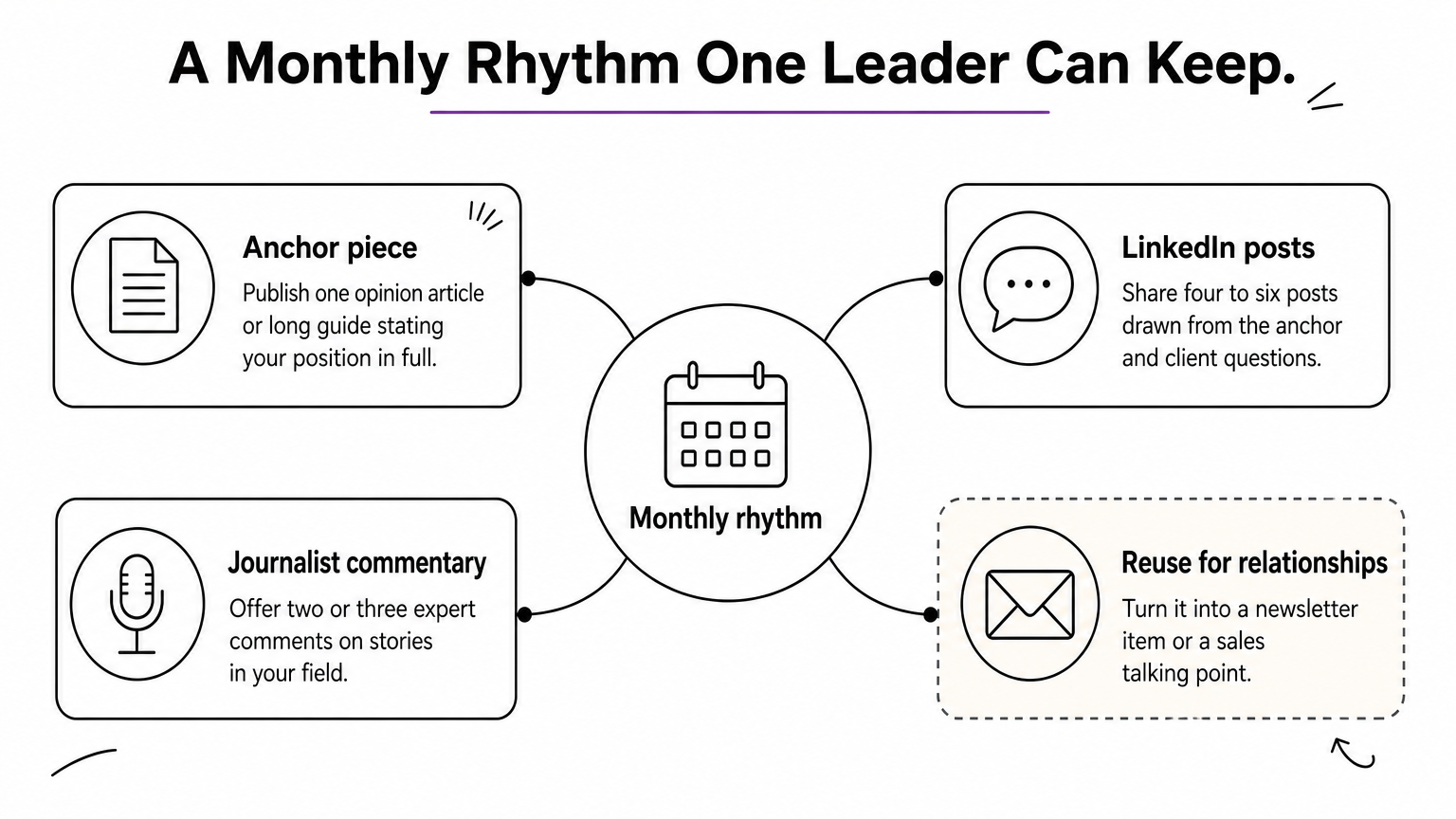
- One anchor piece: an opinion article or a long guide that states the position in full.
- Four to six LinkedIn posts drawn from the anchor piece and from questions clients have asked.
- Two or three offers of commentary to journalists on stories in your field.
- One reuse for existing relationships, such as a newsletter item or a talking point for sales calls.
Plan the anchor topics for the next three months in one sitting, then fill in details each month. Keep a topic bank: every time a client asks a sharp question, add it. Real questions make the best content ideas because you know someone wants the answer.
Consistency on a narrow set of themes beats occasional brilliance on a broad one.
Step 4. Share it, measure it, refine it
Execution is where a thought leadership strategy either becomes visible or stays in a drafts folder. This step covers distribution, a pitch template, a quarterly review and the mistakes that stall most plans.
Share it where your audience already looks
Use three routes: owned channels (your website, newsletter and LinkedIn), earned media (published bylines, quotes, interviews) and live settings (webinars, briefings, speaking slots). Earned media does the most for credibility, because a third party is vouching for you. When you pitch an opinion article to an editor, lead with the argument and why it matters to their readers now. Keep it short.

Subject: Opinion piece: [one-line argument]

Hi [Name],

[One sentence on the argument and why it matters to your readers now.]

Why I can write it: [role, experience or data in one line].

What readers will take away:
- [Takeaway one]
- [Takeaway two]

Happy to send a draft or talk through the angle.

[Name, title, phone number]
Prepare your spokesperson before any interview. Rehearse the three points they want to land and the hard question they hope not to get. Media training for spokespeople is built around exactly that. Then reuse each piece: one article can become four or five LinkedIn posts, a newsletter section, a slide for sales and the opening of a small breakfast briefing for clients and prospects.
Measure and review every quarter
Review the plan every 90 days against the baseline from Step 1. Check the leading signals monthly and the business results quarterly.
| Signal | Where to look | What good looks like |
|---|---|---|
| Publishing consistency | Your calendar | The monthly rhythm held without gaps |
| Target-role engagement | LinkedIn comments, replies, profile views | The roles you chose reacting, not only peers |
| Journalist response | Your pitch log | Replies, requests for comment, repeat contact |
| Inbound enquiries | CRM or inbox | More prospects mention your content |
| Sales conversations | Feedback from sales | Prospects arrive already knowing your view |
| Invitations | Email and LinkedIn | Speaking and panel requests |
Ask three questions at each review: which topics drew your target audience, which pieces did sales actually use, and what gap is left. Then change formats freely but hold your position for at least a year. Credibility comes from repetition, and switching themes every quarter resets the clock.
Mistakes that stall a thought leadership strategy
These five mistakes show up most often:
- Writing for everyone, so no one remembers you.
- Publishing opinions without evidence behind them.
- Chasing trending topics outside your real expertise.
- Stopping after one quiet quarter, just before recognition builds.
- Counting impressions instead of conversations.
Credibility comes from saying the same true thing, in useful new ways, for long enough that people repeat it.
Start with one position and 90 days
Building thought leadership is a sequence, not a burst of posting. Set one objective and a baseline, define a narrow audience and a position you can prove, publish on a rhythm one leader can sustain, and review the results every quarter. Pick the position this week, write the first anchor piece within a month and let the plan run.
If you would rather have senior help, the AI-Era Brand Visibility Programme from Purple Word Box is a three-month PR engagement for South African organizations. It starts with a brand visibility audit and then delivers a tailored campaign that includes thought leadership articles, expert commentary, media pitches and executive LinkedIn content. It is PR work, so it cannot promise coverage, but it gives your plan structure from day one.