

To learn how to write a press release, follow one fixed order. Find a real news angle, write a headline and lead that answer who, what, when, where and why, add facts and one quote in descending order of importance, close with a boilerplate and contact details, then edit and send it to the right journalists. Keep it to one page, roughly 400 to 500 words, and write it so a journalist could publish it with few edits.
Most releases fail before anyone reads the second paragraph. Journalists receive dozens a day, and the ones that lose are usually company announcements dressed up as news. They have vague headlines, buried facts and superlatives nobody can check. Business owners know their story well, but they have not yet shaped it into what an editor needs.
This guide comes from Purple Word Box, a South African PR agency that writes press releases for local businesses and for UK and US technology brands entering the South African market. Below you get the grounding you need, five steps with examples, a copy-and-paste format, and a pitch email to send with your release.
What a press release is and what to prepare first
A press release is a short, factual announcement written for journalists, and you should settle the news, the facts and a spokesperson before you write a word. Approach it as the reporter would: what do they need to publish this without calling you?
When a press release is the right tool
Write one when you have news that a journalist can verify and that readers outside your company would care about. Common triggers are:
- A product or service launch
- A senior hire or leadership change
- A funding round, acquisition or partnership
- An award, certification or milestone backed by numbers
- An event with a date, venue and a clear reason to attend
- New research or data
- A public statement during a crisis
Skip it for routine updates, a discount or a new blog post. For a smaller story, a short pitch email to one journalist works better, because it explains why the story suits that reporter’s beat. The two work together. The pitch gives a personal reason to care, and the release gives the full facts in a format that can be lifted straight into a story.
A press release works only when the news matters to someone outside your company.
What to gather before you write
Collect the raw material first, because hunting for a number halfway through a draft is how errors creep in. Have these ready:
- The news in one sentence
- Three hard facts, such as numbers, dates, prices in rand and locations
- A spokesperson with a name, a title and time for interviews
- A timing decision: release now, or under embargo until a set date and time
- Images, such as a headshot, product shot or event photo, in high resolution and with credits
- One web page that holds more detail for journalists who want it
Why South African newsrooms need a local angle
A global announcement is not automatically a South African story. A US or UK launch becomes one when you add local customers, local pricing in rand, a local spokesperson or local data. Journalists are short of time, so copy that already contains the local angle is easier to run than copy they must adapt.
Maria Joubert spent 11 years in UK agencies before returning to South Africa in 2011, and the gap shows up often. International teams send the head office version unchanged, and it lands in a local inbox with no reason to care. Decide now which South African fact will carry your story, and build the release around it.
Step 1. Find the news angle and the audience
Your angle is the single reason a stranger should care about your announcement this week. You find it by testing the story against the questions editors ask without thinking.
Test your story for newsworthiness
Run your announcement through the table below. A story that passes at least two tests has an angle. A story that passes none is an update, not news, so wait until you have something stronger.
| Test | Question to ask | It passes when |
|---|---|---|
| New | Has this been reported before? | It is a first, or a clear change from before |
| Relevant | Who is affected, and how many? | A defined group, such as 2,000 customers or a whole industry |
| Close | Does it touch the outlet’s readers locally? | It involves South African jobs, customers or rand figures |
| Proven | Can you back it with evidence? | You have a number, a document or a named customer |
| Human | Is there a person who can comment? | A founder, customer or expert is available |
Be honest when you score your own story. Founders tend to rate "we are expanding" as a ten, while a reporter hears "a company grew".
Pick one angle and one audience
Every release gets one angle and one audience. Say a payments company launches an invoicing tool. It could pitch the product features to technology media, the time saved to finance and business media, or the jobs created to general business media. Pick the one with the strongest proof. Here that is the time saved, aimed at finance teams, because it comes with a number.
Then write the news as one sentence in this shape: [Who] does [what] so that [who benefits], [when]. For example: "Acme Payments launches an invoicing tool so finance teams close their books two days faster, from today."
If you cannot state the news in one sentence, the release is not ready to write.
Step 2. Write the headline, dateline and lead
The headline states the news, the dateline anchors it in time and place, and the lead delivers the five Ws in one short paragraph. Get these three right and a journalist knows within ten seconds whether the story is for them.
Write a headline that states the news
Keep the headline to about 70 characters or fewer, write it in the present tense, and include one specific detail, such as a number. State the fact and drop the adjectives. Exaggeration is the quickest way to lose a journalist, because they read it as advertising.
| Weak headline | Stronger headline |
|---|---|
| Acme is thrilled to announce an exciting new solution | Acme launches invoice tool that cuts month-end close by two days |
| Local company wins big | Acme Logistics wins national award for road safety record |
| Acme partners to take things to the next level | Acme and a university to train 500 data analysts by 2028 |
Write the headline last if that helps. You often find the sharpest version only after the body is done. An optional subheading can add one line of detail, but never rely on it to carry the news.
Add the dateline and release line
Start with a release line, either FOR IMMEDIATE RELEASE or EMBARGOED UNTIL [date, time]. An embargo asks journalists to hold the story until a set moment, which suits sensitive or high-impact news because it gives them time to check facts. Only use one with journalists who have agreed to it first.
Then add the dateline: the city in capitals, the date, and a dash. For a South African audience, write the date as day, month, year, for example JOHANNESBURG, 16 November 2026 –. Use local spelling in the release itself, such as "organisation" and "programme", and write money as "R2.5 million". Small details like these show you know the market.
Write a lead that answers the five Ws
The lead is the first paragraph, and it carries the whole story. Aim for one or two sentences, under 50 words. It must answer:
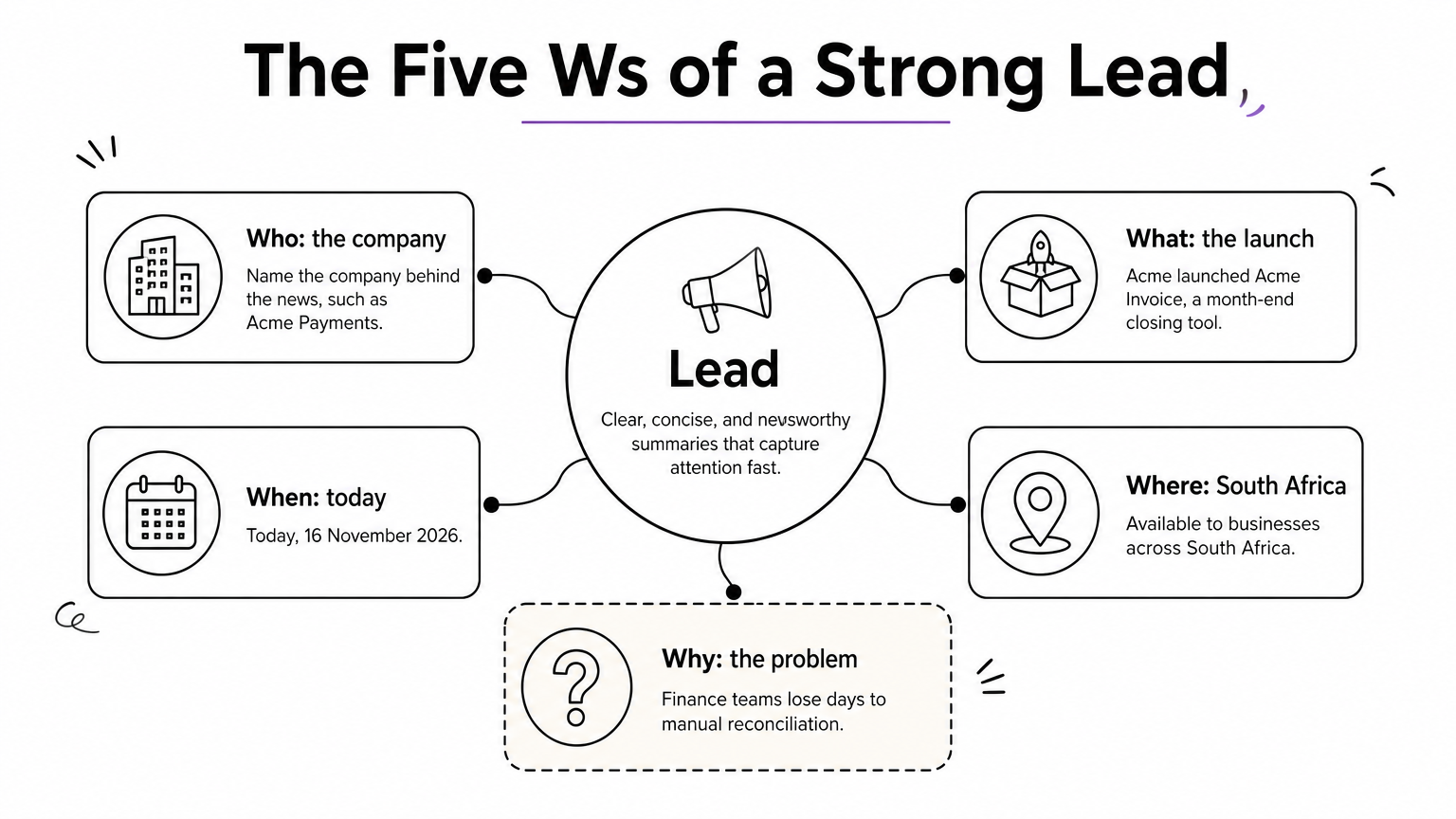
- Who: Acme Payments
- What: launched Acme Invoice, a month-end closing tool
- When: today, 16 November 2026
- Where: available to businesses across South Africa
- Why: finance teams lose days to manual reconciliation
Here is how that reads in one paragraph (an illustrative example, not a real announcement): "Acme Payments today launched Acme Invoice, a tool that cuts month-end closing time for South African finance teams by two days. It is available from today from R499 per month."
Write the lead so that a journalist who reads nothing else still has the story.
Step 3. Write the body, quote and supporting facts
The body backs up the lead with context, evidence and one human voice, ordered from most to least important. Everything here must be a fact a journalist can check, and everything else gets cut.
Order the body from most to least important
Use the inverted pyramid. The paragraph right after the lead holds the strongest supporting fact, the next holds the second strongest, and so on. Editors cut from the bottom, so nothing vital can sit there. Aim for three to five short paragraphs of two to four sentences each, with one idea in each.
A useful test is to delete your last paragraph and ask whether the story still works. If it does, you ordered it correctly. If it doesn’t, move that point up. Good material for the body includes figures, dates, prices, customer numbers, a short background on the problem and details on how to access the product or event.
Write a quote that adds something
A quote should give a journalist something they cannot get from the facts: an opinion, a reason or a consequence. "We are excited to launch this product" says nothing. "Finance teams told us the last two days of every month are lost to chasing invoices, and that is the problem we built this to remove" gives a reason and a voice.
Attribute every quote with a full name and job title. One or two quotes are enough for a one-page release. Choose the person closest to the news, such as the CEO for strategy, a product lead for a launch or a customer for results. Get the quoted person to approve the wording before you send it.
Strip out hype and jargon
Read each sentence and ask whether a stranger could verify it. If not, replace the claim with the fact behind it.
| Replace this | With this |
|---|---|
| World-class, cutting-edge solution | What the product does and for whom |
| Leading provider in the market | A ranking, market share or customer count, with its source |
| Innovative, game-changing | The measurable change, such as "two days faster" |
| Leverage synergies | What the two companies will actually do together |
Ask a friend outside your industry to read the draft. If they stumble, journalists will too. Also avoid sales calls to action such as "buy now" or "don’t miss out". They make the release read like an advertisement, and editors bin advertisements.
Every claim in a press release should be something a journalist can check in five minutes.
Step 4. Add the boilerplate, contacts and format
The close of the release does three practical jobs. It tells journalists who you are, how to reach you and that the text has ended. Then you lay everything out in the standard format so it can be read at a glance.
The format at a glance
Every press release, whatever the type, follows the same structure. Use this table as a checklist for the order and length of each part.
| Element | What goes in it | Typical length |
|---|---|---|
| Release line | FOR IMMEDIATE RELEASE or an embargo time | One line |
| Headline | The news, present tense | About 70 characters or fewer |
| Dateline | CITY, day month year – | One line |
| Lead | Who, what, when, where, why | Under 50 words |
| Body | Supporting facts, in descending importance | Three to five short paragraphs |
| Quote | A named person with something to say | One or two sentences |
| Boilerplate | Who you are | Two to three sentences |
| Contact details | Name, mobile, email, link to images | Three or four lines |
| End mark | ### | One line |
The full release should fit on one page, two at most, at roughly 400 to 500 words.
Close with boilerplate, contacts and an end mark
The boilerplate is a short "About" paragraph at the bottom. State what the company does, for whom and since when, in two or three factual sentences, plus your website. It rarely changes, so check it is still true before every send. Out-of-date headcounts and old product names are common mistakes.
Under it, add a media contact: a real person who will answer the phone this week, with a mobile number and an email address. Add a link to a folder of images and background material so journalists need not ask. Finish with ###, or "-30-" or "XXX", to show that no more copy follows.
Copy this press release format
Paste this into a document and replace the bracketed parts. Delete any line you do not need.
FOR IMMEDIATE RELEASE

[Headline: the news in about 70 characters, present tense]

[Optional subheading: one line of extra detail]

[CITY], [day month year] - [Lead: who, what, when, where and why in one or two sentences, under 50 words.]

[Paragraph 2: the strongest supporting fact or number.]

"[Quote that gives an opinion or a reason, not a repeat of the facts]," said [Full name], [job title] at [Company].

[Paragraph 4: background or a second fact.]

[Paragraph 5: price, availability, date, or how to take part.]

About [Company]
[Boilerplate: two to three factual sentences on what you do, for whom and since when. Website address.]

Media contact
[Name], [role]
[Mobile number] | [Email address]
Images and more information: [link]

###
Step 5. Edit, send and follow up
Proofread and fact-check the release, send it to a short list of the right journalists with a personal note, and follow up once. This is where most of the effort should go, because a perfect release sent to the wrong people earns nothing.
Edit and fact-check
Read the release aloud, then work through this list before anything leaves your hands:
- Every number, date, name and job title is checked against a source
- The spelling of each person’s name and the company name is confirmed
- The quoted person has approved the quote
- No sentence contains hype you cannot prove
- Every link opens the right page
- A colleague outside your field has read it and understood the news
A typo in a headline costs you credibility with a journalist for the whole release. If you have time, leave it overnight and read it again with fresh eyes.
Send it to the right journalists
Build a list of 10 to 20 journalists who cover your topic, rather than blasting hundreds of contacts. Read their recent articles, and personalize each email with one line that shows why your story fits their beat. Paste the release into the body of the email, because many journalists will not open attachments from strangers. Attach a Word or PDF copy only as an extra.
Use a subject line that states the news, as in the template below. For timing, the common rule of thumb is a weekday between Tuesday and Thursday in mid-morning, after journalists have settled into their day. Urgent news overrides that rule. You can also pay a distribution service to push a release to a wider list, but a targeted personal email to the right reporter usually works better than a paid blast.
Subject: [Company] launches [product] for [audience]: [one proof point]

Hi [Journalist first name],

[One sentence on why this suits their beat, such as a recent piece of theirs.]

[Two sentences: the news and the single strongest number or fact.]

The full release is below, and [Name], [job title], is available for an interview this week.

Images: [link]

Kind regards,
[Name]
[Role, company]
[Mobile number]

[Press release pasted here]
Follow up once and measure what happens
Wait two to three working days, then send one short follow-up. Offer something new, such as an extra data point, a spokesperson for comment or a fresh image. If there is no reply after that, move on. Chasing journalists repeatedly burns the relationship you will need for the next announcement.
Then track results: where the story appeared, how many people visited your site from those links, and which journalists replied. Be realistic about what you can control. Editors decide what runs, which is why Purple Word Box does not guarantee coverage for any release. What you can control is the quality of the story, the release and the targeting.
You cannot control whether a story runs, but you can control whether it is worth running.
Put your first release together
Writing a press release comes down to a repeatable order. Find an angle that passes the newsworthiness test, state the news in a short headline and lead, support it with checkable facts and a quote that adds something, close with a boilerplate and contacts, then edit hard and send to a short, relevant list. Keep it to a page, keep it factual and give the story a South African reason to matter.
If you have the news but not the time, or you want a senior practitioner to shape the angle and pitch it for you, Purple Word Box writes and places press releases for businesses at every stage. You can ask Purple Word Box for a quote on your press release and talk through what you want to announce.