

To build brand awareness in social media, choose one or two platforms where your buyers already spend time, set a single awareness goal, post a consistent mix of useful content in a recognizable voice, and widen your reach through engagement, partnerships and a small paid budget. Then track reach and follower growth every month and adjust. That is the whole method, and the sections below show you how to apply each part.
The problem most businesses run into is not a lack of posting. It is posting without a goal. Pages go quiet for weeks, content changes tone from one post to the next, and success gets judged by follower counts that say little about whether anyone remembers you. Platforms also limit how far organic posts travel, so improving brand awareness on social media takes more than good intentions and a content calendar.
This guide gives you a short prerequisites section, then four steps you can act on this month: pick platforms and a goal, build a recognizable identity and content mix, grow your reach, and measure the result. At Purple Word Box, we help South African businesses and their leaders become visible through PR and LinkedIn content, and the advice here reflects what works in that kind of practical, business-focused communication.
What brand awareness on social media means
Brand awareness on social media is how easily your target audience recognizes and remembers your brand when they meet it in their feed, in a search or in a conversation. It is about recall, not applause. Before you start, you also need a few basics in place.
Awareness is recall, not follower count
A person is aware of your brand when they recognize your post before reading the name, or mention you unprompted when a colleague asks for a recommendation. Followers, likes and views are signals that you are moving in that direction. They are not the destination. A page with 800 followers who are all decision-makers in your industry does more for you than 8,000 followers who will never buy.
Awareness means the right people remember you, so measure memory and reach before you chase follower counts.
What to have ready before step 1
Gather these before you open a scheduler:
- A defined audience: job title or customer type, industry, and the problem they want solved.
- One sentence on what you want to be known for, such as "plain-language payroll advice for small businesses".
- Consistent brand basics: your logo, colors and a handle that matches your business name on every platform.
- One owner for the account and about three hours a week to run it.
Step 1. Choose platforms and set one goal
Pick one or two platforms where your audience is already active and set a single, measurable awareness goal for the next 90 days. Trying to be everywhere is the fastest way to be forgettable, because you spread the same hours across channels you cannot keep up.
Match the platform to your buyer
Use this table as a starting point, then check where your own customers are by asking them.
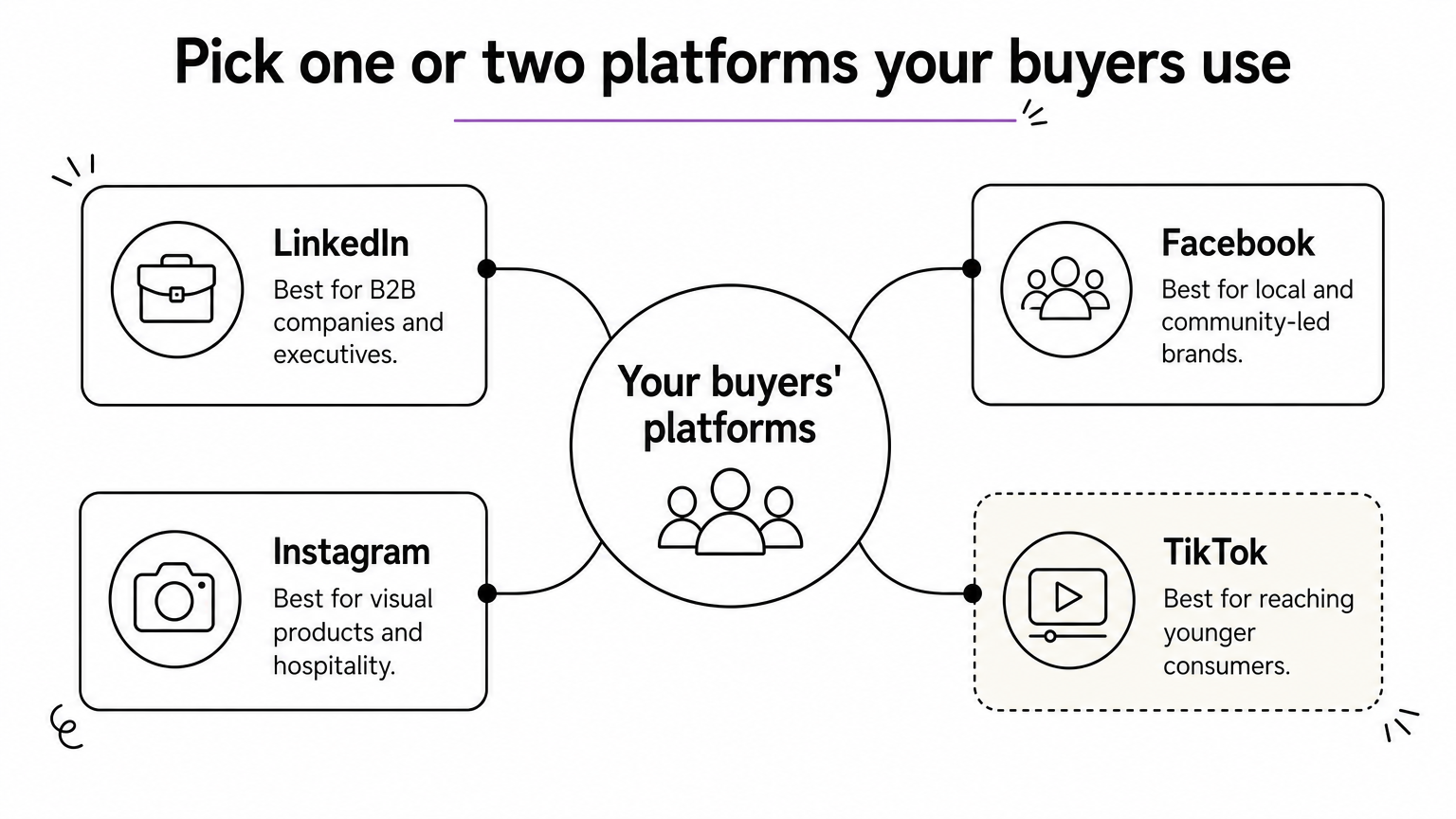
| Platform | Best suited to | Content that fits |
|---|---|---|
| B2B companies, executives, professional services | Opinion posts, short insights, company news | |
| Local and consumer brands, community-led businesses | Photos, events, customer stories, group discussion | |
| Visual products, lifestyle, hospitality | Reels, carousels, stories | |
| TikTok | Brands reaching younger consumers | Short, informal video that shows personality |
A 15-person IT services firm selling to other businesses should start on LinkedIn alone. A coffee roaster selling to consumers might choose Instagram and Facebook.
Write your awareness goal
A goal gives every post a job. Copy this template and fill in your numbers:
In the next 90 days, grow monthly reach among [target audience]
on [platform] from [current number] to [target number],
by publishing [number] posts per week.
Filled in, it might read: "Grow monthly reach among finance managers on LinkedIn from 8,000 to 12,000 by publishing three posts a week." If you do not know your current reach, record this month’s figure from the platform’s analytics and use it as your baseline.
One platform, one audience and one number will beat five platforms and no plan.
Step 2. Build a recognizable voice and content mix
Make your brand identifiable at a glance by fixing how you look and sound, then publish a repeatable mix of content. Recognition comes from repetition, so consistency matters more than any single clever post.
Fix your visual and verbal identity
Use the same logo, colors and handle everywhere, and decide on three words that describe your voice, for example "direct, practical, warm". Write them down and check every draft against them. Anyone who posts for you should be able to match the tone without asking.
People also tend to engage with people more than with logos. For businesses selling to other businesses, a leader’s profile, with thought leadership posts written in their own voice, often builds awareness faster than a company page alone. That is the thinking behind our Social & Profile service for leaders and companies who want a clearer, more credible online presence.
Plan a content mix you can sustain
Here is a simple split to start with. It is a rule of thumb, not a law, so adjust it after a few months of data.

| Content type | Share of posts | Purpose |
|---|---|---|
| Educational (tips, answers to common questions) | 50% | Shows expertise and earns saves and shares |
| People and behind the scenes | 30% | Builds familiarity and trust |
| Promotional (offers, launches) | 20% | Turns awareness into enquiries |
Publish at a pace you can keep up for 90 days. Three posts a week, every week, builds more recognition than ten posts in one week followed by a month of silence. An account that looks abandoned also makes people wonder whether you are still in business.
Show up on a steady schedule in a voice people recognize, and memory builds itself.
Step 3. Widen your reach through people and paid
Once your content is consistent, extend its reach by talking with your audience, working with other voices, and putting a small budget behind your best posts. Organic posting alone rarely reaches beyond people who already follow you.
Engage and make sharing easy
Reply to every comment and message, ideally within a day. Spend ten minutes a day commenting on posts from customers, partners and industry voices, because thoughtful comments put your name in front of their audiences. End posts with a question people can answer in one line.
When a customer posts about you, thank them publicly and, with their permission, share it. Each share is a recommendation from someone your audience trusts. Respond to complaints calmly and in public, since other readers will judge your brand by how you handle them.
Partner and promote
Collaborate with people who serve your audience without competing with you: an industry commentator, a complementary business, or a local creator. Joint posts, guest appearances and shared giveaways all introduce you to ready-made audiences. PR works the same way. When a journalist publishes your expert comment or your press release gets picked up, sharing that coverage on social adds third-party credibility to your profile. Our PR and media relations service is built around this.

Then put a small budget behind proof. Take your best-performing organic post, choose an awareness or reach objective, target your defined audience, and run it for two weeks with a test budget, for example R2,000. Compare the cost per thousand people reached against your organic results before deciding whether to spend more.
Organic content earns trust, and a small paid boost puts proven content in front of people who do not follow you yet.
Step 4. Measure and adjust
Check a handful of awareness metrics at the same time each month, compare them with your baseline, and change one thing at a time. Without this step you are guessing.
Track the metrics that show recall
| Metric | What it tells you | Where to find it |
|---|---|---|
| Reach | How many unique people saw your content | Platform analytics |
| Follower growth rate | How fast your audience expands | Platform analytics |
| Shares and saves | Whether content is valuable enough to pass on | Platform analytics |
| Branded searches | Whether people look for you by name | Google Search Console |
| Direct website traffic | Whether people remember your address | Website analytics |
Reach and shares show whether your content is traveling. Branded searches and direct traffic are the closest proof that awareness is turning into memory.
Work through a monthly review
Here is a worked example. Your LinkedIn baseline is 8,000 reach and 600 followers. After three months, reach is 12,400 and followers are 750. Reach grew 55% (4,400 divided by 8,000), and followers grew 25% (150 divided by 600). Your goal of 12,000 was met.
Now look at why. List your five best posts, note what they had in common, and make more like them next month. Drop the formats that earned the least. Change one variable at a time, such as posting time or format, so you know what caused any difference.
What you measure monthly shows you what to repeat, so reach and recall improve with each review.
Start small and stay consistent
Brand awareness in social media grows when you choose your platforms carefully, set one clear goal, sound the same everywhere, engage with real people, and measure what changes. None of the four steps is complicated, and none works if you skip it or abandon it after a few weeks.
If you would rather have an experienced practitioner shape your profile content and social posts and media visibility with you, talk to Purple Word Box about a practical plan for your business.