
You hear the phrase everywhere, but ask five people what brand awareness means and you will get five different answers. Some point to likes on social media, others to name recognition, and neither tells the full story. If you run a business in South Africa and you are trying to figure out whether people actually know who you are and what you stand for, you need a definition you can act on, not a buzzword.
At its simplest, brand awareness refers to how easily your target audience recognises and recalls your business when they think about your industry or need your product. It sits apart from brand image, which is about what people think of you once they know you exist. Awareness comes first. Without it, even the best messaging and the strongest reputation go unnoticed.
This article breaks down what brand awareness means in plain terms, why it matters for growth and credibility, and how building brand awareness works through media relations, content, and consistent public visibility. You will also find practical strategies for brand awareness that small and mid-sized South African businesses can realistically apply.
Why brand awareness matters for your business
Ask yourself a blunt question: if a potential customer needed exactly what you sell tomorrow, would your name come to mind first, or would they Google it and pick whoever shows up? That single question explains why brand awareness matters more than almost any other marketing metric. It is not vanity. It is the difference between being the obvious choice and being invisible in a market where buyers already have too many options.

The first step in every buying decision
Before anyone chooses a supplier, a service provider, or a product, they go through a mental shortlist. Psychologists call it the "consideration set," and if your business is not on it, you never get the chance to compete on price, quality, or service. Increasing brand awareness puts you on that shortlist before the buying decision even starts. Businesses that skip this step often wonder why their sales team struggles to book meetings, when the real problem is that nobody outside their existing client base has heard of them.
Trust follows recognition, not the other way around
Repetition builds familiarity, and familiarity is the shortcut our brains use to judge trustworthiness. This is well documented in behavioural research and it explains why the same five brands dominate top-of-mind recall in almost every industry, from banking to insurance to fast food. A business that appears consistently in the media, on LinkedIn, and in industry conversations earns a kind of default credibility that a newer or quieter competitor simply cannot buy overnight.
People trust what they recognise before they trust what they are told.
Global research from Edelman’s Trust Barometer consistently shows that trust in institutions and brands is built cumulatively, through repeated exposure and consistent behaviour, not through a single campaign or press release. That is exactly why senior-level PR work, the kind built on sustained media relations rather than one-off stunts, tends to outperform short bursts of paid promotion over time.
What low awareness actually costs you
Weak awareness does not just mean fewer social media likes. It shows up in your bottom line, in your hiring pipeline, and in how much leverage you have in negotiations. Consider what changes when awareness is missing versus when it is strong:
| Business area | Low brand awareness | Strong brand awareness |
|---|---|---|
| Sales cycle | Longer, more explaining required | Shorter, prospects arrive pre-sold |
| Pricing power | Forced to compete on price | Can justify premium pricing |
| Media coverage | Journalists don’t know who to call | Journalists reach out first |
| Talent attraction | Harder to recruit senior candidates | Candidates seek you out |
| Investor confidence | Requires more convincing | Recognition builds credibility fast |
Each row on that table represents real money and real time. A company with strong recognition spends less convincing people it is legitimate and more time closing deals or building the next opportunity.
Why brand awareness matters more in South Africa’s competitive market
South African business owners often underestimate how noisy the local market has become. Between LinkedIn, industry publications, and a growing number of digital-first competitors, the businesses that get remembered are the ones showing up consistently, not the ones with the biggest single campaign. Small and mid-sized companies rarely have the marketing budgets of national brands, which makes strategic public relations and media relations even more valuable per rand spent. A well-placed article in a trade publication or a well-timed media pitch can do more for recognition than months of unfocused social posting, because it borrows the credibility of the publication itself.
Growth-focused founders in South Africa also face a specific challenge: many are excellent at their craft but invisible outside their existing network. That gap between competence and recognition is precisely what strategic PR is meant to close. If your business does strong work but nobody outside your client list knows it, awareness building through PR and media relations becomes the fastest, most credible way to close that gap, faster than trying to build an audience from a blank social media page.
Understanding what is brand awareness and why is it important is really about understanding leverage. Every media mention, every recognisable spokesperson, and every consistent piece of content adds a small amount of leverage you can use later, whether that is negotiating a partnership, raising capital, or simply making your next sales call easier. The next section breaks down exactly how to build that leverage, step by step.
How to build brand awareness step by step
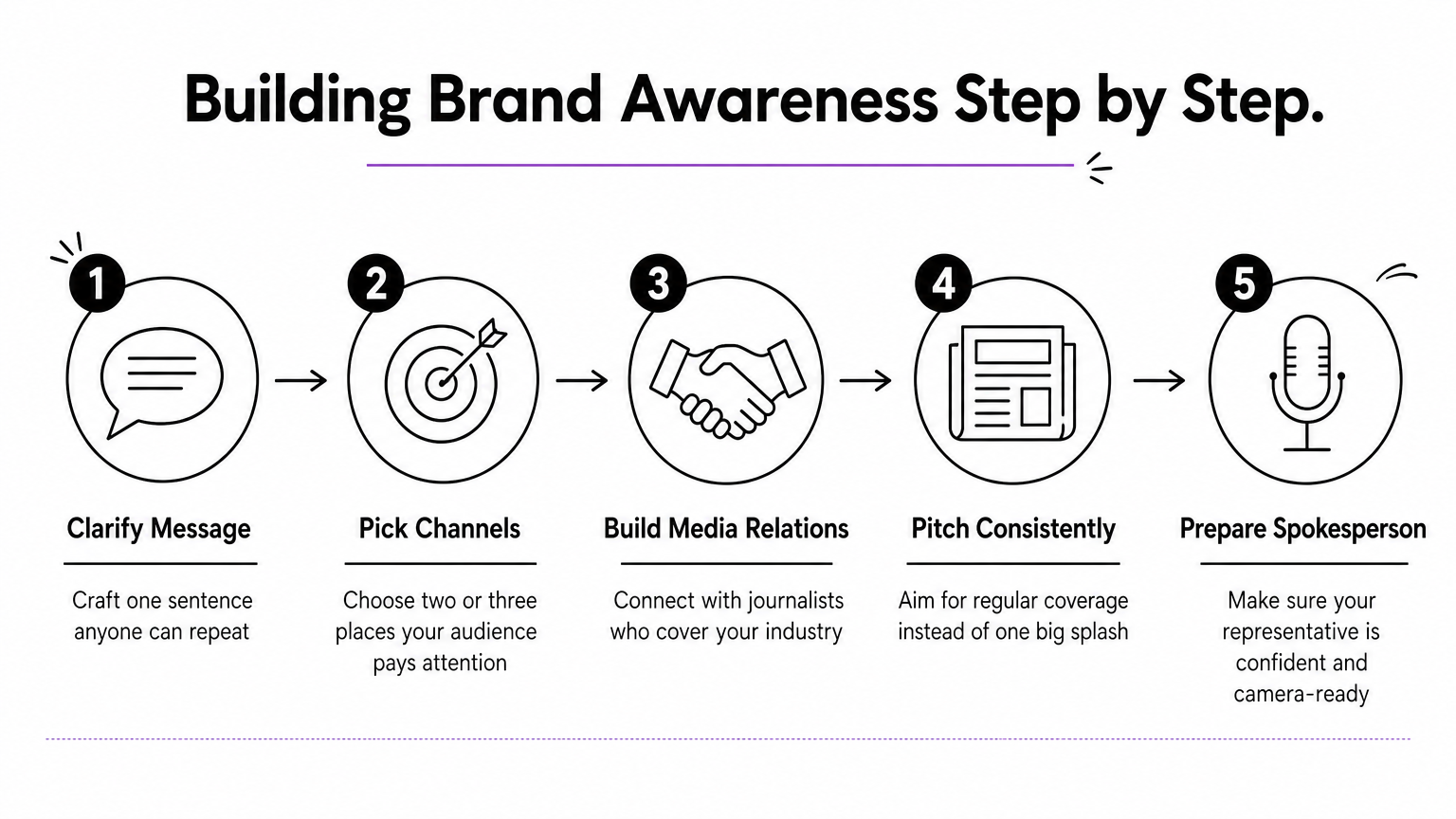
Building brand awareness is not a single campaign you launch and forget. It is a sequence of deliberate actions that compound over months, not days. Businesses that treat building brand awareness as a checklist item rather than an ongoing practice usually see a short spike in attention and then silence. The steps below reflect how PR practitioners actually approach this work with clients, starting from clarity and ending with consistency.
Start with a clear, specific message
Before you pitch a journalist, post on LinkedIn, or brief a spokesperson, you need one sentence that explains what your business does and who it serves. Vague positioning is the number one reason awareness campaigns fail, because journalists and audiences cannot repeat what they cannot understand. Write that sentence down, test it on someone outside your industry, and refine it until a stranger can repeat it back accurately.
Identify where your audience already pays attention
Don’t spread yourself across every platform and publication hoping something sticks. Map out the two or three places your specific audience actually consumes information, whether that’s a trade publication, a LinkedIn feed, or a regional business news outlet, and concentrate your effort there first.
Use media relations to borrow credibility
Once your message is clear, PR and media relations become your fastest route to real awareness, because a mention in a trusted publication carries weight that a self-published post cannot match. Journalists need reliable sources, and a well-crafted press release or media pitch that offers genuine insight, not just a sales pitch, gets picked up far more often than generic company news.
Awareness grows fastest when someone else vouches for you, not when you vouch for yourself.
Show up consistently, not occasionally
Repetition is what turns a single mention into recognition. Set a realistic cadence for media pitches, content, and public appearances, and stick to it even when results feel slow at first. A quarterly burst of activity followed by silence teaches your audience to forget you.
Here’s a practical sequence to follow:
- Clarify your message so it fits in one sentence anyone can repeat.
- Identify your two or three priority channels based on where your audience actually spends time.
- Build media relationships with journalists and editors who cover your industry.
- Pitch consistently, aiming for regular coverage rather than one big splash.
- Support coverage with content, turning each media mention into a LinkedIn post or website feature.
- Prepare your spokesperson so they’re ready and confident whenever a media opportunity arises.
- Review and adjust every quarter based on what’s actually generating recognition.
Prepare your spokesperson to carry the message
Even the best PR strategy stalls if the person representing your business freezes in an interview or gives inconsistent answers across platforms. Getting a founder or executive media-ready, comfortable with key messages, confident on camera, and clear under pressure, is often the missing piece between a good press release and coverage that actually lands. Senior-level guidance here matters more than most businesses expect, because a single strong interview can do the work of months of unfocused marketing. This is exactly where hands-on, strategic PR support makes the difference between sporadic mentions and a recognisable, trusted name in your industry.
Where digital marketing fits into your brand awareness strategy
Digital marketing does not replace public relations, it extends its reach. Once a media mention or a strong piece of content exists, digital channels are what carry it past the original audience and into the feeds, inboxes, and search results where your target market actually spends time. Understanding digital marketing and brand awareness as two halves of the same effort, rather than competing tactics, is what separates businesses that build lasting recognition from those chasing scattered wins.
Content turns a single mention into ongoing visibility
Once a journalist covers your business or a spokesperson lands an interview, that moment has a shelf life unless you extend it. Repurposing that coverage into a LinkedIn post, a website article, or a short newsletter update means the same story reaches your audience three or four more times, in three or four different formats. Search engines also reward businesses that publish consistently around their area of expertise, which means well-written content does double duty: it keeps you visible to people who follow you already, and it helps new prospects find you when they search for solutions in your industry.
SEO makes your recognition findable
Brand awareness built through media coverage means little if someone searches your name and finds nothing to confirm what they just heard. Basic search engine optimisation, using clear headings, answering the questions your audience actually asks, and linking your own coverage back to your site, ensures that when curiosity strikes after a media mention, your website is there to meet it. This is where a lot of businesses lose momentum: they get the coverage but never build the digital footprint that turns a fleeting mention into a lasting impression.
Coverage without a digital footprint disappears the moment someone stops looking at it.
Social media sustains the relationships PR starts
LinkedIn, in particular, is where South African business decision-makers already spend meaningful time, and it is where a spokesperson’s credibility either grows or stalls after a media appearance. Sharing insights, commenting on industry news, and engaging with the same journalists and clients who cover or work with you keeps your name active in a way that a single press release cannot. Small, mid-sized businesses do not need a large following here, they need a credible social profile and consistent presence among the specific people who make buying decisions.
Where paid advertising fits, and where it doesn’t
Paid ads can accelerate reach, but they rarely build the same trust as earned media, because audiences know an ad is bought while a media mention is earned. Use paid promotion to boost content that already has traction, such as a strong article or a well-received interview clip, rather than as your primary awareness driver.
| Digital channel | Best used for | Limitation |
|---|---|---|
| Content marketing (blog, articles) | Extending media coverage, improving search visibility | Slow to build without consistency |
| SEO | Making your name findable after coverage | Takes months to show results |
| LinkedIn / social media | Sustaining relationships, spokesperson visibility | Requires ongoing personal engagement |
| Paid advertising | Boosting existing strong content | Trust builds slower than earned coverage |
Used this way, digital marketing does not compete with your PR strategy, it protects the return on every media placement you already earned.
Brand awareness vs brand image: what’s the difference
Confusing these two ideas is one of the most common mistakes South African businesses make when planning a communications strategy. Brand awareness answers a simple question: do people know you exist? Brand image answers a different question entirely: what do people think of you once they know? You can have high awareness and a poor image, just as you can have a fantastic reputation among a tiny handful of people who have never heard of you outside your existing client base. Treating them as the same thing leads businesses to pour budget into visibility campaigns while ignoring the perception problems sitting right underneath.

Why the sequence matters
Awareness has to come first, because you cannot shape an opinion that does not yet exist. Think of a new competitor entering the insurance space in South Africa. Nobody has an opinion of them yet, positive or negative, simply because nobody knows they are there. Every press release, media pitch, and LinkedIn post in that early phase is doing awareness work. Only once people recognize the name does image start to form, built from customer experience, media tone, spokesperson credibility, and how the business handles both praise and criticism in public.
You cannot manage a reputation nobody has noticed yet.
How the two work together in practice
A useful way to separate the two is to look at what each one actually measures and what moves the needle:
| Aspect | Brand awareness | Brand image |
|---|---|---|
| Core question | Do people know we exist? | What do people think of us? |
| Built through | Media mentions, repetition, visibility | Customer experience, tone, values, consistency |
| Measured by | Recognition, recall, reach | Sentiment, reviews, perception surveys |
| PR role | Getting the name in front of people | Shaping how the name is discussed |
| Risk if weak | Invisible to your market | Known but distrusted or misunderstood |
A business with strong awareness but a weak image often looks like a company everyone has heard of but nobody quite trusts, think of a brand that gets plenty of coverage but consistently attracts skeptical comments underneath it. Flip that around and you get a business with a loyal, glowing reputation among existing clients that simply cannot grow, because too few prospects ever hear about it in the first place.
Where PR strategy addresses both at once
Good public relations work does not chase one at the expense of the other, which is worth weighing up if you are asking whether to hire a PR agency or handle it yourself. A well-placed media pitch builds awareness the moment it’s published, but the substance of that coverage, the honesty of the quotes, the clarity of the spokesperson, the relevance of the insight, is what starts shaping image from that first mention onward. This is why senior-level PR guidance matters more than volume of coverage, and why it pays to know what to check before signing with a PR agency: a single thoughtful interview that positions your spokesperson as genuinely knowledgeable does more for both metrics than a dozen shallow mentions that people forget within a week. If you are only tracking mentions and never asking what those mentions communicated about your business, you are managing half the equation and hoping the rest sorts itself out.
How to measure brand awareness
Measuring brand awareness is where most South African businesses get stuck, because unlike sales figures, recognition doesn’t show up neatly on a single dashboard. You need a mix of direct signals, indirect signals, and old-fashioned asking, and you need to track them over months rather than expecting a single report to tell the whole story. Businesses that skip measurement often keep spending on activity without knowing whether it’s actually building recognition or just generating noise.
Direct measures: asking people what they know
The most honest way to gauge awareness is to ask your market directly. A short survey to existing customers, prospects, or even a general sample of your target industry, asking whether they recognize your name and can describe what you do, gives you a baseline reading you can repeat every six to twelve months. Unprompted recall, where someone names your business without being shown a list, is the gold standard here, because it reflects real top-of-mind status rather than recognition triggered by a logo or a list of options.
If people can’t name you without a prompt, you don’t have awareness yet, you have exposure.
Indirect measures: watching the digital footprint
Beyond surveys, a handful of measurable signals tell you whether recognition is growing. Search volume for your brand name is one of the clearest indicators: if more people are typing your business name into Google month over month, more people have heard of you somewhere and are following up. Website traffic from direct visits, meaning people typing your URL straight into a browser rather than arriving through an ad, works the same way. Track these alongside media mentions, social shares, and branded search terms to build a fuller picture.
| Metric | What it tells you | How to track it |
|---|---|---|
| Unprompted recall (survey) | True top-of-mind awareness | Quarterly or biannual surveys |
| Branded search volume | Growing curiosity about your name | Google Search Console, Google Trends |
| Direct website traffic | People actively seeking you out | Website analytics |
| Media mentions | Reach and credibility gained | Media monitoring, manual tracking |
| Social engagement | Sustained visibility among your audience | LinkedIn and platform analytics |
Reading the numbers in context, not isolation
One metric on its own rarely tells you much. Rising branded search combined with flat media mentions might mean a recent interview is still working its way through your audience. Strong social engagement paired with low direct traffic could mean people know your name but haven’t yet connected it to your website. Set a simple quarterly review where you look at all five metrics together, note what changed, and connect it back to what you actually did, whether that was a press release, a LinkedIn push, or a spokesperson interview.
Turning measurement into decisions
Tracking numbers only matters if it changes what you do next. If unprompted recall is climbing but branded search stays flat, your website or SEO work needs attention. If media mentions are strong but recall isn’t moving, the coverage might not be reaching the right audience or landing with enough substance. This is exactly the kind of pattern a senior PR practitioner reviews with clients regularly, adjusting the strategy based on what the numbers actually show rather than repeating the same tactics and hoping for a different result.
Turning awareness into lasting trust
So what does brand awareness mean for your business, once you strip away the buzzwords? It means being the name that comes to mind first, backed by consistent media presence, clear messaging, and a spokesperson people trust. Awareness opens the door, but image and measurement are what keep that door open once prospects walk through it. Chase one without the others and you end up either invisible or misunderstood, neither of which grows a business.
Getting this right takes more than a single campaign or a lucky mention. It takes the kind of sustained, senior-level PR work that builds recognition and reputation at the same time, month after month. If you are ready to stop guessing and start building real, lasting visibility for your business, start a conversation with Purple Word Box and let’s map out a strategy that actually moves the needle.