

Digital PR is the practice of earning coverage, mentions and links for your brand on news sites, trade publications, blogs, podcasts and social platforms, using stories that journalists and editors want to share. It is public relations built for the web. The result is not only a reader’s attention but also a link to your site, a named mention of your business and a credible signal for search engines. You may also see it called digital marketing PR or online PR. It is the same idea.
Unlike advertising, you do not buy the placement. You earn it by giving a publication something worth publishing, such as original data, an expert opinion or a timely comment on the news. That is why digital PR sits where PR, content marketing and SEO overlap.
This guide covers why it matters, how to build a strategy and plan, which tactics and ideas work, and how to run and measure your first campaign. It comes from Purple Word Box, a South African PR agency, where finding the story and pitching it to the right media is the daily work.
Why digital PR matters for SEO and brand visibility
Digital PR matters because it earns the two things that are hardest to fake: trusted third-party coverage and links from reputable sites. Both make your business easier to find and easier to believe.
How digital PR supports SEO
Search engines use links to discover pages and as one signal of how a page is regarded. A link from a respected news or industry site, placed there by an editor, carries more weight than dozens of weak directory links. That is the core of digital PR and SEO.

Mentions without links also help. When your name appears repeatedly beside your topic, more people search for your brand by name, and that behavior is worth having. Be careful with shortcuts, though. Google’s spam policies treat buying links to influence rankings as a violation, so earned coverage is the safe route.
Digital PR earns the links and mentions that paid shortcuts cannot safely buy.
How it differs from traditional PR
The goal is the same: a better reputation. What changes is the channel and how you measure it.
| Traditional PR | Digital PR | |
|---|---|---|
| Main channels | Print, radio, TV, events | Online news, blogs, podcasts, social |
| Typical output | Press clippings and reach | Links, mentions, referral traffic |
| Success measure | Coverage volume, sentiment | Referring domains, branded search, leads |
| Content shelf life | One edition or broadcast | Stays online and searchable |
You do not have to choose. The best campaigns use both, and a strong story often lands in print and online at once.
How to build a digital PR strategy and plan
A digital PR strategy is a short written plan that links one business goal to one story, one audience and a list of publications. Keep it to a page. If it needs more, the goal is probably unclear.
Set a goal and know your audience
Start with one goal, such as more links to a service page, more media recognition or more inbound enquiries. Then decide who you want to reach. A goal and audience pair tells you which publications matter. A fintech aiming at finance managers needs trade and business media, not lifestyle blogs.
Build the story and the target list
Journalists need a reason to cover you, so your story needs a clear news angle. Good angles are new data, a surprising trend, a strong opinion or a useful answer to a current problem. Your product alone is rarely news.

Next, build a list of 20 to 30 journalists and editors who recently covered your topic. Read their last few pieces, then note what they cover and how they write.
Decide who does the work
You can run a plan in-house if someone has the time to write, pitch and follow up. Digital PR services help when you lack that time or your media contacts. At Purple Word Box, Maria Joubert, who has more than 20 years of PR experience, identifies the story, packages it and pitches it to the right media, working directly with you instead of through layers of account managers.
One goal, one story and one researched target list beat a broad plan nobody finishes.
Digital PR tactics and ideas that earn coverage
The tactics below are the ones that earn coverage most reliably. Pick one or two that fit your resources, not all of them.
Core tactics compared
| Tactic | What you do | Best for |
|---|---|---|
| Original research | Survey customers or analyze your own data and publish the findings | Earning links from news and trade sites |
| Expert commentary | Offer a short, quotable opinion on a story a journalist is covering | Building authority at low cost |
| Newsjacking | React to breaking news within hours | Timely visibility, when you can move fast |
| Thought leadership | Publish a bylined opinion article on an industry site | Showing expertise in your field |
| Podcasts and interviews | Pitch a founder or specialist as a guest | Reaching niche, loyal audiences |
Tactics such as expert commentary and thought leadership cost mostly time. Research costs more, but it tends to earn the most links because other writers cite the numbers.
Ideas you can adapt
Imagine a payroll software company. It surveys 300 small business owners about late client payments and publishes the findings with three clear charts. Business reporters can use those figures in their own stories, and each one that cites the survey is a chance for a link back.
A logistics firm could offer a sharp comment whenever a policy announcement affects freight costs. A cybersecurity company could publish a short explainer on a new scam, with advice readers can use today. Each idea gives a journalist something useful and specific that they could not easily write alone.
If a journalist can use your idea without calling you, it is too thin. Add data or a real opinion.
How to run your first digital PR campaign
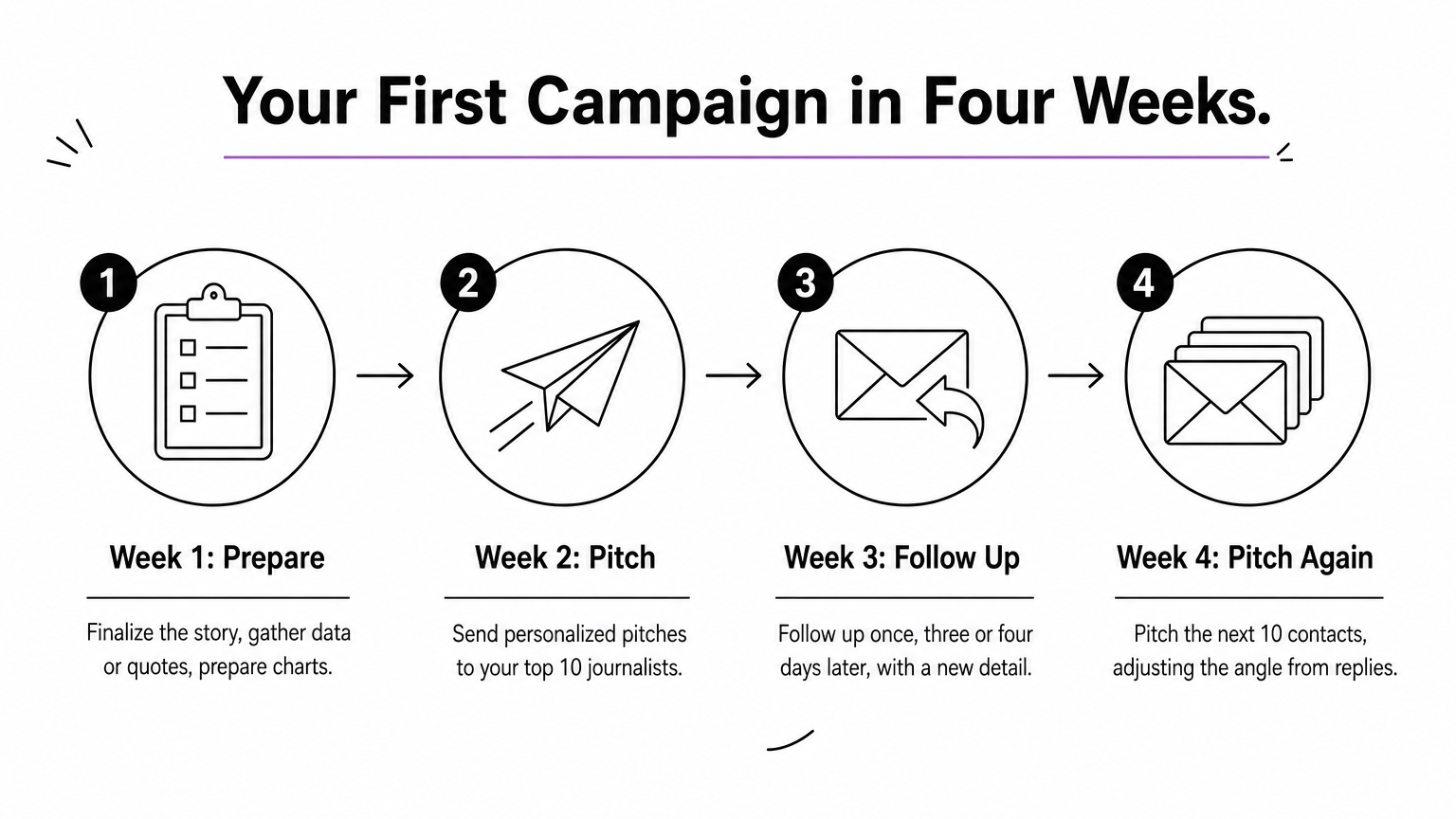
Run your first campaign as a four-week cycle: prepare the story, pitch in small batches, follow up once, then measure. Start small and learn from the first round.
Pitch and follow up
- Week 1: Finalize the story, gather the data or quotes, and prepare any charts or images.
- Week 2: Send personalized pitches to your top 10 journalists. Keep each to a short paragraph with the angle, the evidence and what you can offer.
- Week 3: Follow up once, three or four days after the first email, with a new detail rather than a "just checking in".
- Week 4: Pitch the next 10 contacts, adjusting the angle based on any replies.
Personalization is what separates a pitch that gets read from one that gets deleted. Mention a recent article of theirs and say why your story fits their readers.
Measure what happened
Give a campaign four to eight weeks before judging it, because links and mentions often appear after publication. Then track:
- Referring domains: new sites linking to yours because of the coverage
- Referral traffic: visits from the coverage, in Google Analytics
- Branded search: growth in searches for your name, in Google Search Console
- Enquiries: calls, forms or emails that mention the article
Compare each against your starting numbers, and keep a simple log of which angles and publications worked so campaign two starts smarter.
Judge a campaign by the links, traffic and enquiries it produced, not by how many emails you sent.
Start with one story
Digital PR is earned visibility online: coverage, mentions and links that build trust with readers and search engines. It differs from traditional PR in its channels and measures, but the craft is the same. Find a real story, pitch it to the right people and follow up with care.
Choose one goal, one angle and a list of 20 journalists, and run a four-week campaign. If you would rather have senior help shaping the story and pitching it, talk to Purple Word Box about your next PR campaign.