

The best way to publish a free press release is to pick one or two reputable platforms that match your goal, not to blast every site you can find. PRLog suits companies that announce news often. OpenPR suits anyone targeting European readers. PR.com suits businesses that also want a company profile. IssueWire suits a first release with images or video. EIN Presswire suits one major announcement.
The problem is that free sites sell visibility, and visibility is not coverage. A release posted on a free site gives you a public, shareable page. It does not put your story in front of a journalist, and it does not promise Google indexing or useful backlinks.
This article compares five platforms on limits, media options and cost, then shows you what to do before and after you submit. We are a South African PR agency, so we write releases and pitch journalists for a living. That is why we focus on what each site can realistically do for you.
What free press release sites can and cannot do
Free press release sites publish your release on their own domain and sometimes push it to RSS feeds, but they do not pitch journalists for you. Knowing that split saves you from expecting results these sites were never built to deliver.
What free distribution gives you
A free site gives you a hosted, shareable URL for your news. That helps when you want a credible link to send to customers, partners or a reporter. It does not give you guaranteed indexing or ranking gains. Google does not promise to index every page, and its spam policies warn against press release links built mainly to manipulate rankings.
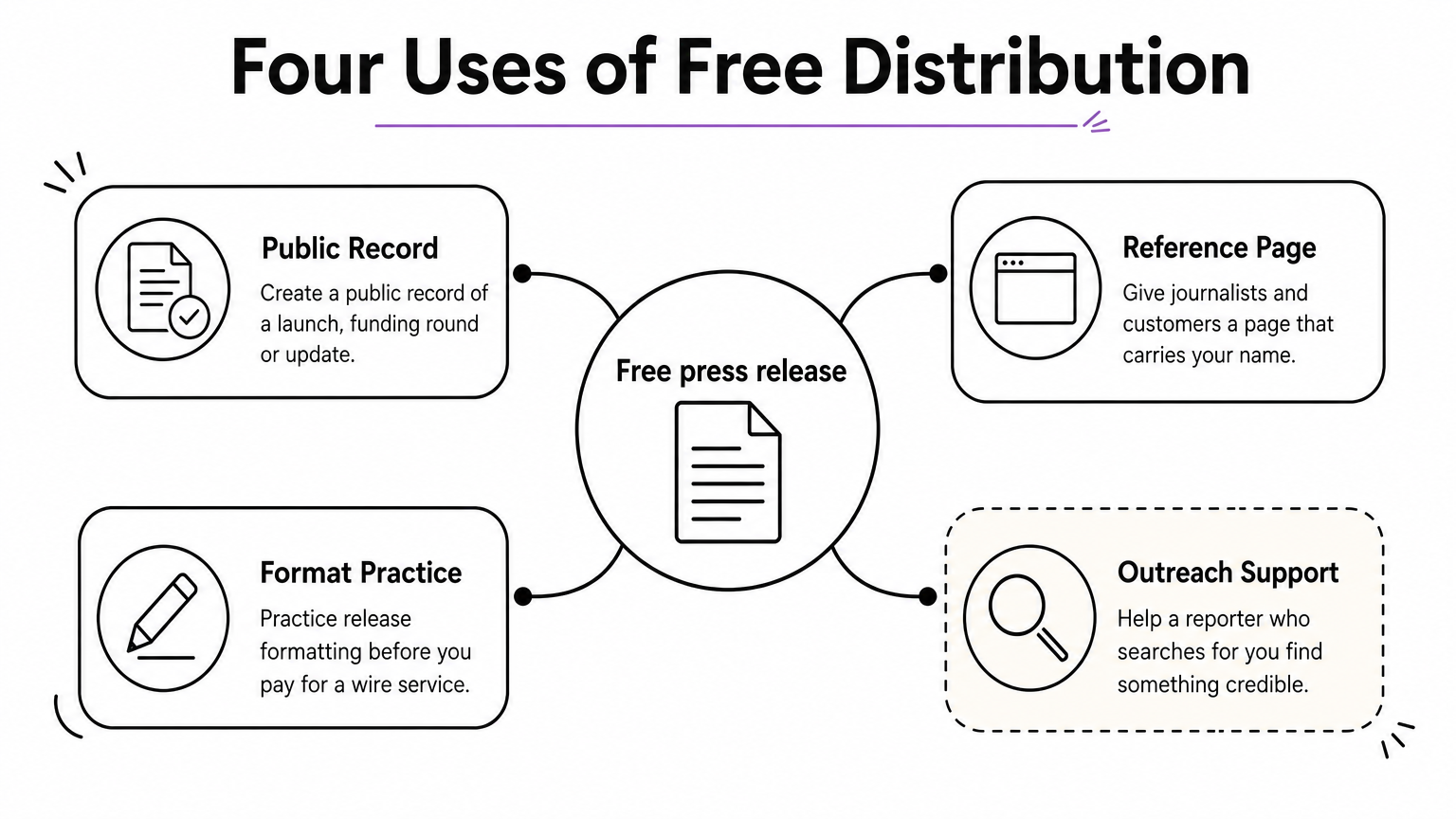
Free distribution is useful for four things:
- Creating a public record of a launch, funding round or company update
- Giving journalists and customers a reference page that carries your name
- Practicing release formatting before you pay for a wire service
- Supporting direct outreach, so a reporter who searches for you finds something credible
A free press release gives you a public page, not an audience.
The five platforms at a glance
This table sets the main limits side by side. Free plans change, so check each site’s current terms before you submit.
| Platform | Free allowance | Images and video | Main catch |
|---|---|---|---|
| PRLog | Unlimited releases | Images and video | Hosting only, no journalist outreach |
| OpenPR | 1 release per month | Images only | Word limit of about 800 to 1,000 |
| PR.com | Unlimited, basic plan | No | Paid plans from about US$60 add wider syndication |
| IssueWire | First release only | Images and video | Paid releases cost US$21 to US$65 |
| EIN Presswire | 1 release in total, approval-based | No | Paid releases start at US$149 |
Before you submit anywhere
Keep your release to roughly 300 to 500 words, and publish the same news on your own blog first. That way your site holds the original version. Search engines may group near-identical copies and show only one, so submitting to six sites does not give you six search results. Two relevant platforms beat six random ones.
South African readers also have local options. PressPortal publishes releases at no cost, and MyPR has a free submission page, with a paid featured option listed at $7.50 via PayPal. Local sites make sense when your news has a South African angle. If you want coverage in a newspaper or trade title, you still need to pitch the journalist directly.
1. PRLog
PRLog is the most flexible place to publish a free press release when you have news often. It has no cap on how many releases you submit.
How it works
PRLog lets you publish unlimited free releases with images and video, and it makes them available through RSS feeds. Each release sits on prlog.org with its own URL, so you can drop the link into emails and social posts.
It is a publishing platform, not a distribution network. PRLog will not contact journalists for you, and Google decides whether to index your page and when. Treat the release as a reference page you control.
PRLog is the easiest free place to publish often, as long as you do the pitching yourself.
Who it suits and what it costs
PRLog suits teams with regular news, such as product updates, new hires and event announcements. It also suits anyone who wants video on a free plan, or who wants to test release formatting before paying for a wire.
- Cost: free
- Limit: no cap on the number of releases
- Media: images and video
- Reach: its own domain and RSS feeds
2. OpenPR
OpenPR is a good free press release site if you can live with one release a month and you care about European reach.
How it works
OpenPR allows one free release per month and leans toward search-oriented distribution through its own site and RSS. It is based in Germany, so it carries more weight in European media circles than most US-centred sites.
Free submissions are limited to roughly 800 to 1,000 words and images only. Appearing in a feed does not mean Google News will pick you up, so treat that as a bonus and not a plan.
OpenPR rewards one well-chosen announcement a month, not a stream of small ones.
Who it suits and what it costs
OpenPR suits businesses with one solid piece of news a month and an audience in Europe. That includes US and UK tech brands that want a European footprint alongside South Africa. If you issue more than one release a month, pair it with PRLog.
- Cost: free
- Limit: 1 release per month
- Media: images only
- Word count: about 800 to 1,000 on the free plan
3. PR.com
PR.com stands out because it adds a company profile to your release. That gives you more than a single URL.

How it works
PR.com pairs release distribution with a business directory. A free account allows unlimited basic submissions, and you can tag each release to an industry for category-targeted distribution.
The free plan has no multimedia. Paid plans, starting around US$60, add syndication to major news outlets and wider reach. The real draw is the directory profile, because your company page can be indexed alongside your releases.
PR.com is worth it when you want a hosted company presence, not just a release link.
Who it suits and what it costs
PR.com suits new B2B companies with a thin media footprint, and anyone who wants a free hosted profile to point people to. It is less useful if your release depends on a strong image or video.
- Cost: free basic plan, paid plans from about US$60
- Limit: unlimited basic submissions
- Media: none on the free plan
- Extra: business directory profile and industry tagging
4. IssueWire
IssueWire is a one-time free offer. It works best for a first release that needs visuals.
How it works
IssueWire gives you one free release, with images and video, and indexes it across about 150 partner sites. After that, paid plans run from US$21 to US$65 per release.
Free here is a trial, not a plan. Use that single release on news that justifies a product photo or an explainer video, because you cannot repeat the offer.
IssueWire’s free release is a trial, so spend it on news that deserves visuals.
Who it suits and what it costs
IssueWire suits first-time users with a strong visual asset. Here is a worked example. If you announce news four times in a year, one release is free and three are paid, which comes to US$63 at the lowest listed price and US$195 at the highest. If you publish that often, PRLog is the cheaper habit.
- Cost: first release free, then US$21 to US$65 per release
- Limit: one free release
- Media: images and video
- Reach: about 150 partner sites
5. EIN Presswire
EIN Presswire offers a free route that is closer to an application than a submission. It is best kept for one big announcement.

How it works
You send your details through its contact form, the team reviews the request, and if approved you receive upload instructions. Your release then goes out on one distribution channel of your choice from its network, and you get a distribution report.
The free tier has no images, video, RSS syndication or scheduling. Those need a paid plan, which starts at US$149 per release. Approval is not guaranteed.
EIN Presswire’s free slot is a single shot, so save it for your biggest news.
Who it suits and what it costs
EIN Presswire suits a funding round, a major launch or a milestone where you want an industry-specific channel and a distribution report. You get one free submission in total, so do not spend it on routine news.
- Cost: one free submission, paid plans from US$149 per release
- Limit: 1 release in total, approval required
- Media: none on the free tier
- Extra: distribution report and one channel of your choice
Choosing where to publish first
Start with the goal. If you publish news often, use PRLog. If you have one monthly announcement for a European audience, use OpenPR. If you want a company profile, add PR.com. Save IssueWire and EIN Presswire for the releases that carry visuals or real weight. Add a local South African site when your news has a local angle.
Whichever you pick, a free site hosts your release. It does not place it with an editor. We do not guarantee earned coverage either, because editorial decisions sit with journalists and editors. What you can control is a clear story, a tight release and a well-aimed pitch.
If you want help with that part, talk to Purple Word Box about getting your release in front of journalists.