
The best ideas for brand awareness do three things. They put one clear message in front of the right people, they repeat it until it sticks, and they cost an amount you can sustain. If you need credibility quickly, start with media coverage and leader profiles on LinkedIn (ideas 1 and 2). If your budget is tight, content, partnerships and referrals (ideas 3, 5 and 6) do the most per rand. If you want something people pass on, look at the participation campaigns in idea 8.
The problem for most business owners is not a shortage of ideas. It is that awareness is hard to see. A campaign can lift recall for months before a single sale shows up, so it is tempting to quit early or to scatter effort across ten channels at once.
Purple Word Box is a South African PR and communications agency that works with start-ups, SMEs and large corporations. This article explains what a brand awareness campaign is, then gives you nine ideas with real examples, a short method for each, and an honest view of who it suits and what it costs.
What a brand awareness campaign is
A brand awareness campaign is a planned effort, usually across several channels, to make a target audience familiar with your brand, what you offer and what sets you apart. Its goal is recognition and recall, not an immediate sale.
What a campaign includes
Every campaign has four parts: a message you want to be known for, an audience you want to reach, channels where that audience pays attention, and a time frame long enough for repetition to work. Typical triggers are a new business, a launch in a new market, or an older brand that needs a fresher reputation.
Awareness also comes in levels, and it helps to know which one you are building.
| Level | What it means | What it looks like |
|---|---|---|
| Brand recognition | People identify you when they see your name, logo or colors | They spot your stand at an expo |
| Brand recall | People remember you without a prompt | They name you when asked about your category |
| Top-of-mind awareness | You are the first brand they think of | You are the first supplier they call |
| Brand dominance | You are the only brand they can name | You are the default choice |
How it differs from a sales campaign
A sales campaign is judged on conversions, so it chases clicks and quotes this month. An awareness campaign is judged on whether more of the right people know you, so it runs longer and repeats one message.
Dove’s Real Beauty platform is the classic case. It did not rely on a single advert. It held one belief about self-image for years, until Dove owned that emotional territory. Expect recall and branded search to move before revenue does, and plan for that patience from day one.
Awareness is a long game built on one message, repeated until people remember it.
How to tell it is working
Set a baseline before you start, then run brand awareness tracking on these signals monthly:
- Branded search: how often people search for your business name, visible in Google Search Console.
- Direct traffic: visitors who type your web address straight into the browser.
- Mentions: media coverage, social tags and shares of your content.
- Audience growth: followers and engagement from the people you actually want to reach.
- Customer answers: a simple "How did you hear about us?" asked of every new customer.
1. Earn media coverage with a PR story
Media coverage is one of the strongest ideas for brand awareness because a publication’s attention carries a credibility that paid ads cannot buy. You pitch a genuine story, and the outlet introduces your brand to its readers for you.
How to run it
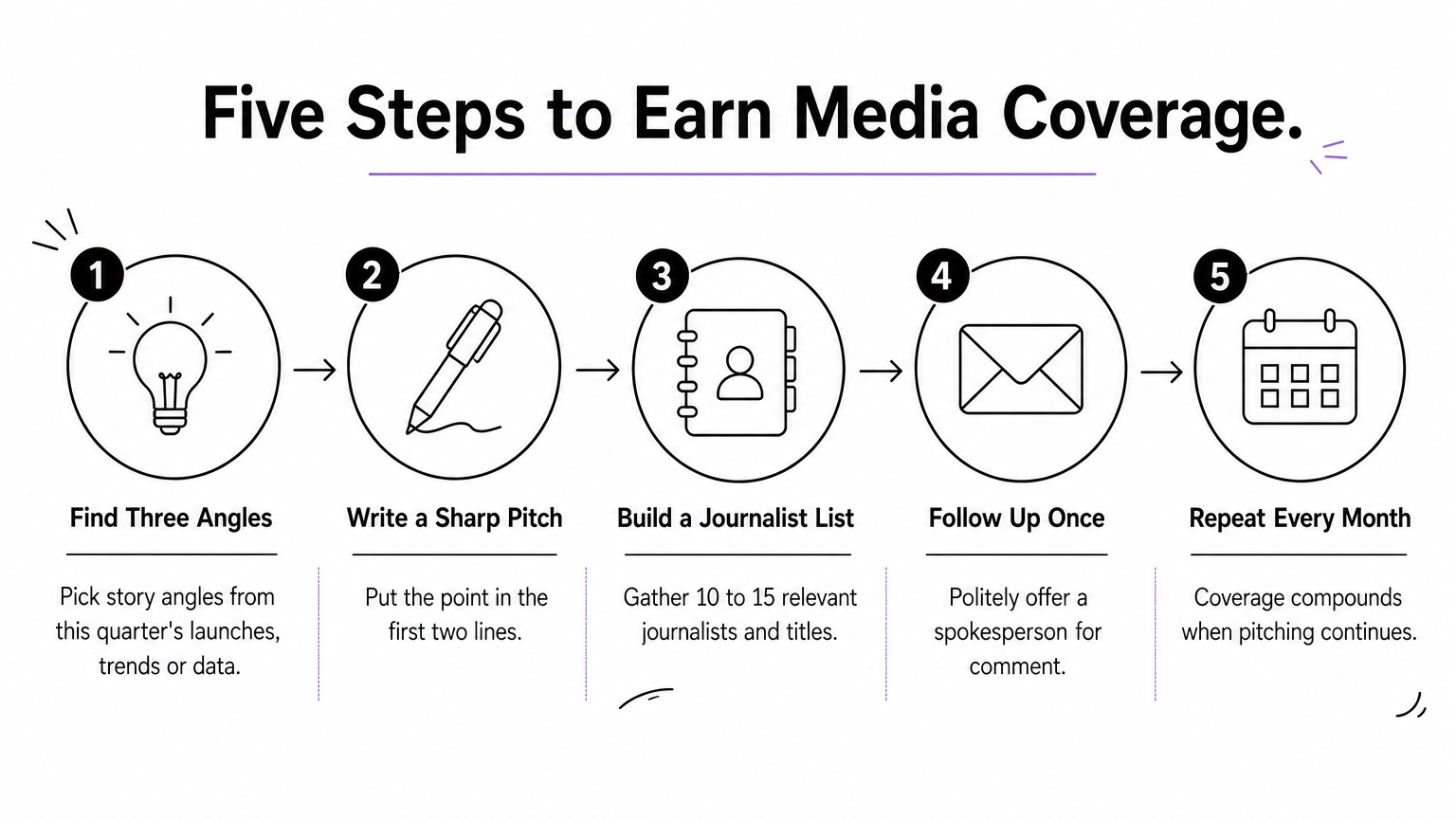
Start with the story, not the product. Journalists want news, data, a firm opinion or a human angle, so look for a launch, a trend you can comment on, or insight from your own numbers. Then match each story to the right journalist or trade title and pitch it in a short, clear email.
- Find three story angles in your business this quarter.
- Write a short pitch or press release with the point in the first two lines.
- Build a list of 10 to 15 relevant journalists and trade titles.
- Follow up once, politely, and offer a spokesperson for comment.
- Repeat every month, because coverage compounds.
Journalists cover stories, so give them a story before you give them your name.
Who it suits and what it costs
Coverage suits B2B companies, professional services and founders whose customers buy on trust. It costs time more than media budget, because earned placements are not bought. Your real outlay is either your own hours or an agency’s fees, and results build over months, not days.
Purple Word Box does this work through PR strategy, press releases, media pitches, thought leadership articles and content placements, led hands-on by Maria Joubert, who has more than 20 years of PR experience. Our work helped TreasuryONE gain mainstream media recognition in its market. We also manage PR for UK and US brands launching in Africa, and we talk about how AI search changes PR in our PR in an AI era campaign.
2. Build your leaders’ profiles on LinkedIn
People engage with people more readily than with company pages. A leader who shares useful insight on LinkedIn builds awareness for the whole business, one post at a time.
How to run it
Pick three topics your leader knows better than anyone and post on them consistently. Once or twice a week is a realistic rhythm. Write about real customer questions, lessons from a project, and comments on industry news rather than company announcements.
Then take the same expertise further:
- Write a guest article for an industry publication.
- Accept podcast invitations that reach your buyers.
- Speak at a panel, breakfast or webinar.
- Reuse every talk as three or four short posts.
A leader with a clear point of view is the cheapest, most trusted media channel you own.
Who it suits and what it costs
This idea suits founders, executives, spokespeople and subject matter experts who sell expertise. The cash cost is low, but the time cost is real. A busy leader rarely has hours for drafting, so most posts stall without support.
Purple Word Box handles this through its Social & Profile service: curated digital communication, profile-building content, thought leadership posts and LinkedIn profile management. We also provide practical media training for your spokespeople, so they sound clear when a journalist or podcast host calls.
3. Publish content that answers customer questions
Helpful content builds awareness because people research long before they buy, and the brand that answers their questions is the one they remember. It also compounds, since a good article keeps working for years.

How to run it
Do not stop at "buy" keywords. Someone selling home security might write about how to protect a home during load shedding, not only about alarm prices. That reaches people at the start of their research, when your name can still become the default.
- List the 20 questions customers ask most.
- Answer one per article, in plain language, with your brand clearly named as the author.
- Turn the best articles into a newsletter, a case study or a whitepaper.
- Update older pieces instead of letting them age.
Consistent, clear content also gives AI search tools more reliable material about who you are and what you do.
Answer the question before the buyer is ready to buy, and your name is already familiar when they are.
Who it suits and what it costs
Content suits businesses with long buying cycles, such as technology, finance, professional services and manufacturing. It costs little cash but steady effort, and you will wait months for search traffic to build.
Purple Word Box writes opinion articles, blogs, case studies, whitepapers, newsletters and exhibition-related content. Our Marketing service is for businesses that know what they want to say and need help shaping the message.
4. Host or join events your audience attends
An event gives you face time with the right people and a stream of content afterward. It is one of the most memorable ideas for brand awareness because people recall experiences better than adverts.
How to run it
Choose one clear goal per event, such as meeting journalists, introducing a product, or thanking clients. Then match the format to the goal:
- Media briefings and product launches for press attention.
- Thought-leadership breakfasts and conferences for authority.
- Webinars and hybrid events for reach on a small budget.
- Client appreciation events and roadshows for loyalty.
Brand every touchpoint, from invitations to speaker slides. Follow up within days with a thank-you and a useful summary. A pop-up works too. M&M’s set up a flavor-voting pop-up where visitors tasted, photographed and voted, and a table at a local expo can do the same on a smaller scale.
An event pays off in the follow-up, so plan the week after before you plan the day itself.
Who it suits and what it costs
Events suit businesses with a defined audience that can be invited, such as B2B firms, professional services and launch-stage brands. A webinar costs mostly time and a platform. An in-person event adds venue, suppliers, catering and materials, so set a budget against a single goal.
Purple Word Box plans and supports events from concept to delivery, including suppliers, branding, guest communication, speaker preparation, media coordination and post-event follow-up. Webinars and customer events, online or in person, are handled professionally.
5. Partner with complementary brands and creators
Partnerships borrow an audience that already trusts someone else. They are among the cheapest ideas for brand awareness because you trade value, not budget.
How to run it
Look for businesses that sell to the same people but not the same thing. A wedding venue and a florist is one pairing. An accounting firm and a payroll provider is another. Then co-create something worth sharing, such as a joint webinar, a shared guide or a cross-promotion to both lists.
For influencers, judge fit before follower count:
- Do they match your brand’s values?
- Is their audience engaged, not just large?
- Does their audience match your buyers?
Consider an affiliate arrangement, so you can see which creator actually drives interest.
Partner with brands that share your customers, not your product, and both audiences gain something.
Who it suits and what it costs
Partnerships suit local service businesses, consumer brands and professional firms with an obvious neighbor in the market. Co-marketing costs mostly time and goodwill. Influencer fees vary widely by reach and format, so agree deliverables in writing and start with one small collaboration.
Keep the message consistent across partners. A joint campaign that confuses what each brand stands for builds noise, not awareness. Agree one sentence about each business before you launch.
6. Launch a referral program
A referral program turns happy customers into your most believable marketing. Dropbox is the best-known case: it rewarded both the person who invited and the person who joined with extra storage, and sign-ups grew fast.

How to run it
Make the program simple enough to explain in a sentence. Decide the reward, make sharing effortless, and ask at the right moment, which is just after you have delivered a good result.
- Choose a reward that fits your margins: a discount, credit, gift or service upgrade.
- Give customers a link, code or short message they can forward.
- Ask right after a positive outcome or review.
- Thank every referrer, whether or not the referral converts.
For example, if you have 200 customers and one in ten refers one person, that is 20 new introductions from people who already trust you.
Customers will vouch for you when you make it easy and reward them for it.
Who it suits and what it costs
Referrals suit businesses with satisfied, repeat or long-term customers, such as agencies, clinics, trades and software providers. Cost is controlled because you pay the reward only when a referral succeeds.
Referrals do not fix a weak service. If customers are lukewarm, fix delivery first. Otherwise the program only widens the audience that learns you are average.
7. Hand out useful branded gifts
A useful physical item keeps your name in view long after a meeting ends. A branded gift also gives a client or journalist a reason to remember you.
How to run it
Choose items people use daily, since usefulness decides how long your name stays visible. Keep branding simple: a logo, a web address, or a QR code that leads to a dedicated page so you can see who scans it.
- Give gifts with purpose: at events, at client milestones and in media packs for launches.
- Match the item to the audience, so executives and journalists get different things.
- Order a small run first and check what people actually keep.
A gift earns awareness only when people use it, so choose function over novelty.
Who it suits and what it costs
Branded gifts suit event-led, relationship-led and B2B businesses. The cost is per item, and quantity and quality drive it, so request quotes against a fixed budget rather than a wish list.
Purple Word Box offers promo products, including branded gifts, media packs, event materials and promotional products that support campaigns, visibility and client engagement. They work best tied to a launch, an event or a media push, so the item carries a story, not just a logo.
8. Run a campaign people want to share
Participation campaigns spread because people take part and show others. The best-known brand awareness campaign examples work on a simple pattern: make the audience the star.
How to run it
Spotify Wrapped gives every user a personal recap of their year, and millions share it unprompted. Coca-Cola’s Share a Coke printed names on bottles, so people searched for theirs. The ALS Ice Bucket Challenge worked because the action was simple and tied to a cause. You can borrow the pattern at a small scale.
- Find data you already hold: visits, orders, milestones.
- Turn it into something personal and flattering, such as a year-in-review card for loyal clients.
- Make it easy to share, with your name visible.
- Handle personal data with consent and in line with South Africa’s POPIA.
A simple social poll that asks your audience a fun industry question can also work, and costs nothing but a minute.
Give people something about themselves worth sharing, and your brand travels with it.
Who it suits and what it costs
These campaigns suit consumer brands, memberships and service businesses with repeat clients, such as gyms, salons and clinics. A digital recap costs little cash but needs design and a sound idea. Expect hits and misses, so test it with a small group first.
Avoid forced stunts. A campaign works when the action connects directly to what you stand for. If it does not, people may share it without ever learning what you do.
9. Use paid ads and retargeting for repetition
Paid ads buy repetition, and repetition builds memory. They are the fastest way to reach a precise audience that has never heard of you.
How to run it
Aim your ads at people who match your buyer but have not met your brand, then use retargeting to remind visitors who left without acting. Keep the message consistent, with the same phrasing and visual identity across every ad and your website.
- Use clear brand messages, such as your name plus what you do, instead of clever copy.
- Cap how often one person sees the same ad.
- Judge results on reach, branded search and direct traffic, not clicks alone.
Ads amplify a clear message, but they cannot create one.
Who it suits and what it costs
Paid ads suit businesses that already have a clear message, a credible website and some organic proof. They are the one idea here where budget scales directly with reach, so begin with a small monthly test and increase spending only when branded search starts to rise.
They work best as a booster for the earlier ideas. Promote an article that earned coverage, a webinar, or a partner guide, and you pay to repeat something people have already responded to.
Pick one idea and stay consistent
A brand awareness campaign is a planned, repeated effort to make the right people know who you are, and the nine ideas above are ways to do it at different budgets. Do not try all of them. Choose the one or two that fit your audience and resources, hold one message steady, and measure branded search, direct traffic and mentions against a baseline.
Consistency beats cleverness. Brands that keep showing up with a clear message become the ones people recall when they are ready to buy.
If you want senior, practical help with media coverage, LinkedIn profiles, content or events, talk to Purple Word Box about your PR and communication goals.