

The fastest way to build a media relations strategy template is to work through seven sections on one page: goals, audiences, key messages, a media map, an outreach plan, measurement and a review rhythm. Fill them in that order and you end up with a media relations plan that shows who you pitch, what you say, when you say it and how you judge the result.
Most businesses don’t lack news. They lack a plan. Pitches go out when someone finds a spare hour, every spokesperson tells a slightly different story, and journalists hear from you only when you want coverage. Generic templates don’t fix this, because they hand you blank boxes without saying what belongs in them.
This guide walks through the template in four steps, each with a fill-in block you can copy into your own document. It is written for South African small and mid-sized businesses. It draws on the way Maria Joubert, who has more than 20 years of PR experience, approaches media work at Purple Word Box: practical, senior-led and free of unnecessary complexity.
What a media relations strategy template covers
A media relations strategy template is a one-page structure that records who you want to reach through the media, what you want to say and how you will get it in front of journalists. It works only if every box forces a decision, so each section below asks a question instead of naming a topic.
Strategy versus plan
People use "media relations strategy" and "media relations plan" as if they were the same thing. For a smaller business, one document can carry both. The strategy is the thinking: goals, audiences and messages. The plan is the doing: media list, calendar, owners and pitches. Keep both on the same page so the thinking never drifts away from the doing.

A strategy without a calendar stays an idea, and a calendar without a strategy turns into noise.
The seven sections at a glance
Each section answers one question. The steps that follow build them in this order.
| Section | Question it answers | Built in |
|---|---|---|
| Goals | What must media coverage achieve for the business? | Step 1 |
| Audiences | Who do we need to reach, and what do they read, hear or watch? | Step 2 |
| Key messages | What should they remember, and what proves it? | Step 2 |
| Media map | Which outlets and journalists reach those audiences? | Step 3 |
| Outreach plan | What do we pitch, to whom and when? | Step 3 |
| Measurement | How do we know it worked? | Step 4 |
| Review rhythm | When do we revisit and change it? | Step 4 |
What to have ready before you start
Gather four things first, so you don’t stall halfway through:
- Your business goals for the next 12 months.
- A list of upcoming news: launches, hires, results, events, client wins.
- The names of spokespeople who have time to give interviews.
- Copies of past coverage, if you have any.
Set aside two to three hours for a first draft. Ideally, include one decision-maker in the room, because a plan the boss hasn’t approved rarely survives the first busy month.
Step 1. Set goals and audit your starting point
Write one business goal, then turn it into two or three media goals that each carry a number and a date. Coverage is a means, so every goal has to name what the coverage should change for the business.
Audit where you stand
Spend an hour collecting facts before you set targets. Pull every article, quote and mention from the last 12 months, and note the outlet, the tone and whether your key message appeared. Then search your company and spokespeople on Google the way a journalist would. Finally, check where your competitors are being quoted.
Competitor coverage shows you where space is open, and what a journalist finds when they search you shows what to fix before you pitch. An outdated website biography or an empty LinkedIn profile can sink a pitch that is otherwise strong.
Write goals with numbers and dates
Vague goals such as "raise awareness" can’t be checked. Use this pattern: outcome, number, outlet type, deadline.
Here is a worked example. A logistics software company wants more enterprise enquiries. Its business goal is to win three enterprise clients in 12 months. Its media goal is to secure six pieces of coverage in trade and business media within six months, with at least two quoting the managing director as a named expert. Six pieces in six months is one a month, a pace most small teams can sustain.
A media goal is only useful if you can count it and tie it back to a business result.
Copy this block into your document:
SECTION 1. GOALS
Business goal for the next 12 months:
Media goal 1 (outcome + number + outlet type + deadline):
Media goal 2:
How these media goals support the business goal:
Coverage in the last 12 months (count, outlets, tone):
Where competitors are being quoted:
What a journalist finds when they search us:
Step 2. Define audiences and key messages
List the two or three audiences who influence your business goal, then write one core message and three proof-backed supporting messages for them. Journalists are the channel, not the audience. The people behind the publication are who you are really talking to.
Name audiences by what they decide
For each audience, write down what they decide and where they get their information. Finance directors at mid-sized firms, for example, decide on software purchases. They read business press, trade newsletters and LinkedIn. Secondary audiences might include investors, job candidates or channel partners.
Limit yourself to three audiences. Every extra one widens the media list and thins the message. If you can’t say what an audience decides, remove it.
SECTION 2A. AUDIENCES
Audience 1:
  What they decide:
  Where they get information (press, radio, podcasts, newsletters, LinkedIn):
Audience 2:
Audience 3:
Build a message house
Start with a core message, one sentence a journalist could repeat without editing. Under it, write three supporting messages. Give each one proof: a figure, a client result, original data or a clear example. Messages without proof read as marketing and get cut.

Then assign a spokesperson to each topic. If your leaders rarely give interviews, practise before the first call. Purple Word Box offers practical media training for this, so spokespeople stay on message under questioning.
If a message has no proof behind it, a journalist will cut it.
SECTION 2B. KEY MESSAGES
Core message (one sentence):
Supporting message 1:      Proof:      Spokesperson:
Supporting message 2:      Proof:      Spokesperson:
Supporting message 3:      Proof:      Spokesperson:
Words and claims we avoid:
Step 3. Map your media and plan outreach
Build a list of 15 to 25 outlets and journalists who cover your topics for your audiences, rank them in tiers, then schedule pitches against real news angles. A short, well-researched list beats a long one that nobody reads.
Build the media map
Start from your audiences, not from the biggest names. For each audience, list where they look for information: national business press, trade titles, regional papers, radio, podcasts and newsletters. Then find the specific journalist or editor on each. Read their last ten pieces and note what they cover and which formats they use.
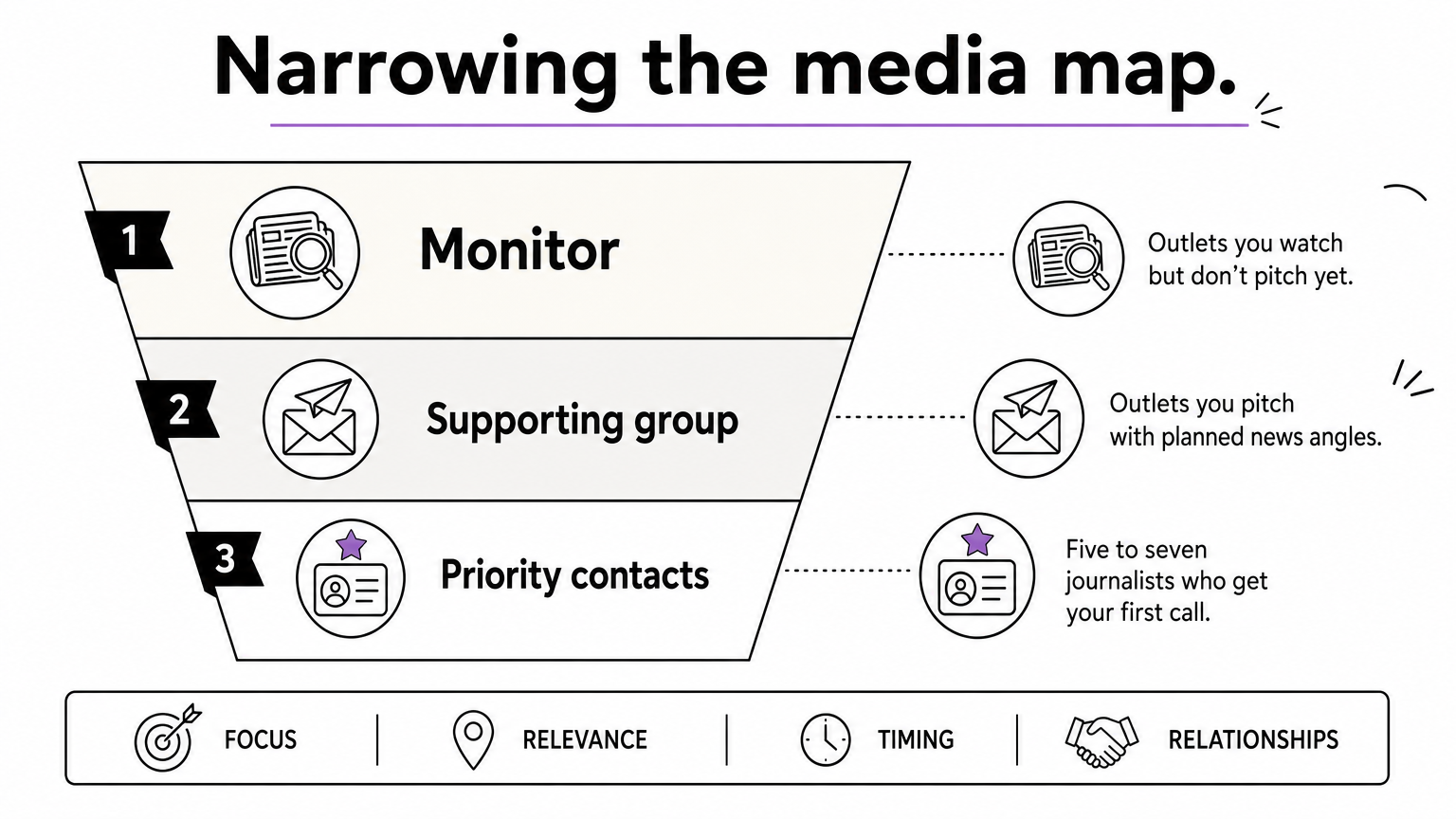
Rank your targets in tiers. Tier 1 is your five to seven priority contacts, Tier 2 is the supporting group, and Tier 3 is outlets you monitor but don’t pitch yet. A sample layout looks like this:
| Tier | Outlet type | Contact | Beat | Best format | Typical lead time |
|---|---|---|---|---|---|
| 1 | Business daily | [Name] | [Beat] | Expert comment | Same day to days |
| 1 | Trade magazine | [Name] | [Beat] | Opinion article | Weeks |
| 2 | Radio or podcast | [Name] | [Beat] | Interview | Days to weeks |
| 2 | Regional paper | [Name] | [Beat] | Local angle | Days |
Match news angles to a calendar
Journalists need a reason to cover you now. Strong angles include company news, original data, expert comment on a story already in the headlines, client stories (with permission) and opinion articles. Map each angle to a month and a Tier 1 or Tier 2 contact.
Work out your volume from your goal. If you need six placements in six months and you plan on one in three pitches landing, you need 18 pitches, which is three a month. Treat one in three as an assumption to test, not a benchmark. Adjust it after your first quarter.
Pitch the angle that fits the journalist’s beat, not the story you most want to tell. Follow up once, two to three working days later, and then move on.
Pitch the angle that suits the journalist’s beat, not the story you most want to tell.
SECTION 3. OUTREACH PLAN
Month | Angle | Target outlet and contact | Spokesperson | Assets needed | Owner | Pitch date | Follow-up date

PITCH SKELETON
Subject: [Specific angle, not "Press release"]
Hi [First name],
[One sentence on why this fits their beat or a recent story.]
[Two sentences: the news or insight, and the proof behind it.]
[Name, title] is available for comment on [dates]. [Data, photo or case study] is ready to send.
Kind regards,
[Name, phone number]
Step 4. Measure results and review the plan
Choose one or two metrics for each goal, record them monthly and review the whole plan every quarter. Measurement is what turns the template from a document into a habit.
Choose metrics that match each goal
Match the metric to the goal you set in Step 1, not to whatever is easiest to count. Avoid advertising value equivalents, which convert coverage into an imaginary ad spend. The PR industry has widely rejected them as a measure of results.
| If your goal is | Track |
|---|---|
| Visibility | Pieces of coverage in target outlets, and the share that carries your core message |
| Credibility | Named quotes for your spokespeople, and Tier 1 placements |
| Demand | Referral traffic, enquiries that mention an article, LinkedIn engagement on coverage |
| Relationships | Journalist replies, repeat requests for comment |
In the Step 1 example, the managing director’s two named quotes and the six pieces of coverage are the numbers to count. Enterprise enquiries that mention an article show whether the coverage reached the right audience.
Set a review rhythm
Hold a 30-minute monthly check. Compare the pitches sent and the coverage won against the calendar, then note which angles and journalists responded. Once a quarter, rewrite the media map and the calendar, because journalists change beats and news priorities move.
Revisit the goals and messages once a year, or sooner if the business changes direction. A plan that is never reviewed becomes the wrong plan quietly.
The plan only works if you review it on a schedule, because journalists and priorities keep changing.
SECTION 4. MEASUREMENT AND REVIEW
Metric 1 (linked to goal):      Target:      Actual by month:
Metric 2:                       Target:      Actual by month:
Monthly check date:             Owner:
What worked this month (angle, outlet, spokesperson):
What to change next month:
Quarterly review date:          Media map updated: Y / N
Put the plan to work
A media relations strategy template does one job: it makes you decide, in writing, what you want from the media, who you need to reach and what you will say before you send a single pitch. Work through the four steps in order, keep the page to one sheet, and review it monthly. The result is a media relations plan your team can run without guesswork.
If you would rather have an experienced practitioner build and run it with you, Purple Word Box offers media relations support for South African businesses. That includes strategy, press releases, pitches and content placement.