

Media training for executives is structured coaching that prepares senior leaders to handle interviews, presentations and crisis questions with clarity and control. A trainer helps you define your key messages, rehearses you with tough questions in mock interviews, and gives direct feedback on your words, voice and body language. The aim is not to dodge questions. It is to answer them honestly, stay on message, and leave journalists and audiences with the point you intended.
For a CEO, managing director or divisional head, every quote carries extra weight. Investors, staff, customers, regulators and competitors read it at the same time. This guide explains why that makes training worthwhile, how to prepare for an interview step by step, what a good programme covers, practical tips for the interview itself, how to handle a crisis, and how to choose a provider in South Africa.
Purple Word Box is a South African PR and communications agency that runs practical media training for business leaders, executives and spokespeople.
Why media training matters for executives
Media training matters because an executive’s words carry more weight than anyone else’s in the company, and the damage from a careless answer travels faster than the correction. A trained leader gives short, truthful answers that serve the business. An untrained one tends to guess, speculate or ramble, and that is where bad headlines come from.
Your words reach several audiences at once
An interview is never heard by just one audience. Investors, employees, customers, suppliers and regulators all read or hear the same quote, and each one interprets it through their own concerns. A remark about "reviewing headcount" in a radio interview reaches your staff within minutes, long before any decision has been made or communicated.
Listed companies carry an extra burden. Information that could move a share price is expected to go out through the JSE’s SENS service, not drop casually into a conversation with a journalist. Even if your business is private, the same discipline applies to unannounced deals, funding, pricing and restructuring. Training teaches you to recognize the moment a question crosses that line, and what to say instead.
What the difference looks like in practice
The table below shows three hypothetical questions and how an untrained and a trained executive might answer each one.
| Question from the journalist | Untrained answer | Trained answer |
|---|---|---|
| "Are you planning retrenchments?" | "We’re looking at headcount in a few areas." | "No decisions have been made, so I won’t speculate. What I can tell you is how we’re positioning the business for the next three years." |
| "Is your competitor beating you on price?" | "They’re cheap because their quality is poor." | "We compete on reliability and service, and that is what our customers tell us they value." |
| "When will the acquisition close?" | "Should be done by December." | "We’ll announce through the proper channels once there is something to confirm." |
Look at the pattern in the right-hand column. Every trained answer is honest, short and limited to what the executive can stand behind. None of them dodge. They simply refuse to speculate and steer toward something the leader is happy to discuss.
The upside beyond avoiding damage
Media training is not only defensive. Journalists go back to sources who give clear, quotable answers and who are easy to work with, so a confident spokesperson gets called more often. Over time, consistent and credible appearances build recognition for the leader and the company. That visibility supports sales conversations, recruitment and investor confidence, because people trust a face and a voice they have seen handle questions well.
An unprepared answer is rarely a lie. It is usually a guess, and a guess in public becomes a headline.
How to prepare for a media interview, step by step
Prepare in seven steps: understand the brief, set your messages, predict the questions, research the journalist, agree the ground rules, rehearse out loud, and debrief afterwards. Most executives skip the rehearsal and the debrief, and those two steps do the most to improve performance from one interview to the next.
The seven-step checklist
Start at least a few days before the interview, and earlier if the topic is sensitive. Work through the steps in order, because each one feeds the next. The same list works for a five-minute radio slot and a 45-minute feature interview.
- Understand the brief. Find out who the journalist is, which outlet, what format, live or recorded, how long it will run, and what angle the story takes.
- Set your key messages. Choose up to three points you want the audience to remember. The template below helps.
- Predict the questions. List the ten hardest questions you could face, including the ones you hope nobody raises. Write a one-line answer to each.
- Research the journalist. Read or listen to their recent work to see how they frame stories and whether they lean sympathetic or sceptical.
- Agree the ground rules. Confirm the topic, the length, who else is being interviewed, and what is on the record.
- Rehearse out loud. Say your answers aloud while someone fires follow-up questions. Reading them silently does not count.
- Debrief. Within a day, review what landed, where you drifted and what to change next time.
Clear sensitive topics with your legal, finance and investor relations colleagues before the interview, not during it. A ten-minute alignment call removes most of the risk of contradicting a colleague or a regulatory filing.
A simple template for your key messages
A message house keeps you disciplined: one headline, three proof points and one story. Write it on a single page and keep it beside you for phone and virtual interviews. Copy the template below and fill it in.

Headline message (the sentence I want quoted):
Proof point 1 (fact, figure or result):
Proof point 2:
Proof point 3:
Story or example (one customer, one moment, 30 seconds):
Next step for the audience (what should they do or think?):
Topics I will not discuss, and what I will say instead:
Do the arithmetic before you decide how much to prepare. People speak at about 150 words a minute. In a 10-minute radio interview the host introduces you and asks questions, so you may speak for roughly six minutes, which is about 900 words. Answers of 20 to 30 seconds, or 50 to 75 words, mean you will give a dozen or more answers, and each one should carry a single message. That is why three messages are plenty.
Ground rules: on the record, background and off the record
Treat everything as on the record. Journalists use three terms, and you should agree which one applies before you say anything, never afterwards.
- On the record: the journalist can use what you say and attribute it to you by name.
- Background: the journalist can use the information but cannot name you as the source.
- Off the record: the information is not for publication.
The journalist must agree to the label first. The safest rule is simple: if you would not want to see a sentence quoted with your name beside it, do not say it. This includes the chat before the recording starts and the small talk once the microphone is "off".
Three messages you can say in your sleep beat ten that you have to read from notes.
What a media training programme covers
A solid programme for executives covers message development, question handling, delivery, format-specific practice and crisis response, and it ties them together with mock interviews. Lectures alone do not change behavior. The practice interviews, with honest feedback, are what make the difference.
The core modules
Programmes differ in length and depth, but these are the modules you should expect to see covered.
- Message development: turning your business story into three clear, quotable points with proof.
- Question handling: bridging back to your messages, answering hostile or loaded questions, and dealing with "gotcha" questions calmly.
- Delivery: pace, tone, volume, posture, eye contact, gestures and removing filler words.
- Format practice: radio, TV, print, podcasts and virtual interviews, each with its own habits.
- Crisis response: holding statements, the first hours of a crisis, and who speaks for the company.
- Recorded and shared clips: writing answers that still make sense when a 15-second excerpt is posted on social media.
How a typical session runs
Most sessions follow the same arc. You begin with your real situation, such as an upcoming results announcement, a product launch or a difficult issue, so the practice is relevant rather than generic. Many programmes run for half a day to a full day, and one-on-one sessions suit CEOs and managing directors because the practice can focus on their actual issues.
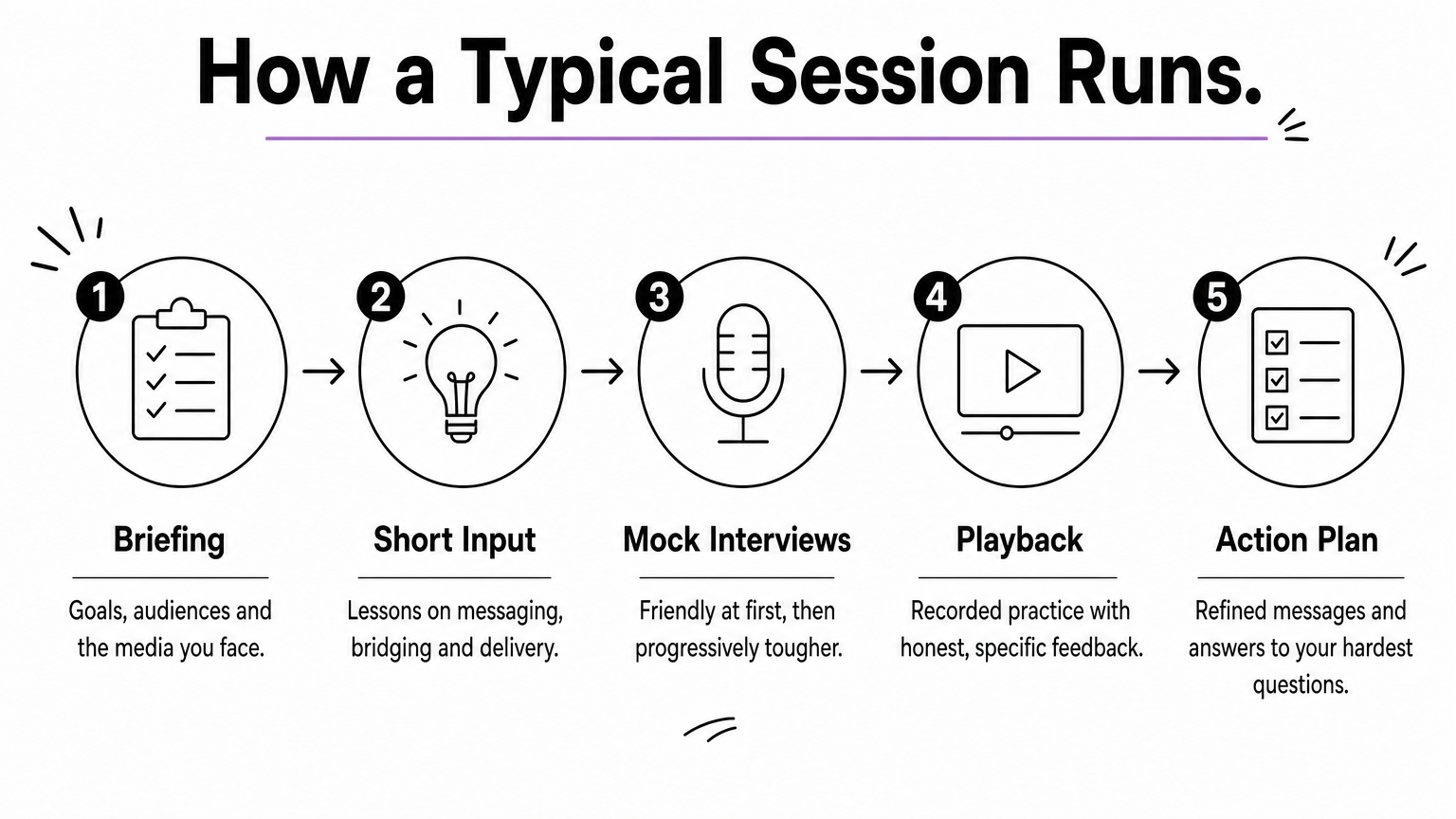
- Briefing on your goals, your audiences and the media you deal with.
- Short input on messaging, bridging and delivery.
- Mock interviews, starting friendly and becoming progressively tougher.
- Playback and feedback, ideally with a recording you can watch yourself.
- A written action plan with your refined messages and answers to your hardest questions.
If you are training several people, ask for individual feedback to each person. Group sessions work well for spokespeople and subject matter experts, but a CEO’s hardest questions are often not ones you want to rehearse in front of colleagues.
A programme that never puts you in front of a microphone or camera is a lecture, not training.
Media training tips for executives during the interview
The best tips come down to four habits: lead with your answer, keep it short, be honest about what you do not know, and treat every conversation as on the record. They sound simple. They are hard under pressure, which is why practice matters more than theory.
Answer first, then bridge to your message
Start with a direct answer or acknowledgment, then add the point you want the audience to hear. This is called bridging, and it is not the same as evading a question. You respond to what was asked, then move to what matters. Here is a hypothetical example.
Question: "Is load shedding hurting your margins?"
Answer: "It’s a real pressure for every business, and we’ve felt it. What matters to our customers is that their orders arrive on time, and we’ve invested in backup power at our depots, so that hasn’t changed."
That answer has three parts: acknowledge, bridge, deliver your message. Useful bridging phrases include "What matters most here is…", "Let me put that in context…", and "The bigger picture is…". Use them sparingly. If you bridge on every answer, journalists notice and push back.
Say it plainly
Plain language makes you quotable. Drop the jargon and acronyms, because most of your audience does not share your industry vocabulary. Replace abstract claims with a number or a short example. "We cut delivery times from five days to two" beats "we have significantly improved our logistics efficiency".
Silence is fine. You do not need to fill every pause, and a pause before a hard question makes you look thoughtful. Avoid "no comment", which sounds like guilt. Say what you can: "I’m not able to discuss that yet, but I can tell you where things stand on…" If you do not know a figure, say so and offer to send it later. A promise to follow up costs nothing, while a wrong number costs credibility.
Do and don’t at a glance
| Do | Don’t |
|---|---|
| Lead with your answer | Build up to it with a long background |
| Keep answers to 20 to 30 seconds | Keep talking to fill silence |
| Say "I’ll come back to you with that figure" | Guess a number or a date |
| Use plain words and short examples | Use jargon, acronyms or internal terms |
| Assume the microphone and recording are live | Joke or vent before or after the interview |
| Talk about your own company’s strengths | Criticize competitors by name |
| Correct a wrong premise politely | Repeat a negative word the journalist used |
You are not answering the journalist’s question for the journalist. You are answering it for the person listening.
Handling crisis communication and tough questions
In a crisis, speak early, stick to verified facts, show concern for the people affected, and say what you are doing next. Executives who go quiet for a day leave a gap that rumor, social media and competitors fill. Executives who speculate create a second crisis on top of the first.
The first hour
Your first statement does not need every answer. It needs to show that you are aware, you care and you are acting. Agree the facts with legal and operations, nominate one spokesperson, and release a holding statement quickly. Adapt this template to your situation.

[Company] is aware of [what has happened, in plain words].
Our first priority is [the people affected].
We are [specific action under way].
We will provide an update by [time].
For more information, contact [name, phone, email].
Commit to the update time and keep it, even if the update is "no new information yet". Consistency across channels matters, so the statement on your website, social media and in your interviews should say the same thing. Brief staff before the media, because employees are often the first people journalists call.
Answering hostile questions
Tough questions follow a pattern, and you can practise for them. When a question is hostile, acknowledge the concern, answer what you can, then add context. If a journalist asks, "Why did you let this happen?", start with accountability where it is warranted: "This should not have happened, and we are treating it very seriously." Then state what you know and what you are doing.
Do not repeat loaded words. If the question includes "scandal" or "cover-up", repeating the word in your answer puts it in your mouth and in the quote. Avoid speculating on cause, blame or cost until the facts are confirmed. Write every answer so it works as a standalone clip, because on social media a 15-second excerpt can circulate without the question that prompted it.
In a crisis, the person who speaks first with facts and empathy usually frames the story.
Adapting to radio, TV, podcasts and presentations
Each format rewards a different habit. Radio rewards voice and pace, TV rewards short soundbites and composure, print rewards accuracy, podcasts reward stories, and virtual calls reward a good setup. Knowing which one you face changes how you prepare.
Format by format
| Format | What matters most | Practical tip |
|---|---|---|
| Radio | Voice, pace and clarity, because listeners cannot see you | Speak slightly slower than normal, and stand up for energy |
| TV | Short soundbites and visible composure | Keep your key line under 40 words, look at the interviewer rather than the camera, and avoid busy patterns |
| Print and online | Accuracy and quotable lines | Say figures slowly, then offer to confirm them in writing |
| Podcast | Depth, stories and a conversational tone | Prepare two or three stories, and remember the recording stays online |
| Virtual interview | Camera, sound and setting | Place the camera at eye level, face the light, and use a quiet room with a plain background |
The 40-word limit for TV follows from the numbers earlier: at about 150 words a minute, a 15-second soundbite holds roughly 38 words. If your key line is longer, the editor will cut it for you, and you may not like where.
Presentations, panels and speeches
Presentations follow the same logic as interviews, with one difference: you control the questions until Q&A starts. Open with your main point, not your agenda. Limit yourself to three supporting points, add one story, and close with a clear call to action. Put fewer words on your slides than you plan to say.
Prepare for the Q&A as you would for an interview, with a list of the ten hardest questions. On panels, respect the clock: one message per answer, and do not repeat what the previous speaker said. Assume someone is recording, because a clip from your speech can be shared by people who were never in the room.
Pick the format first, then adjust your style. A great radio answer can be a poor TV answer.
How to choose media training in South Africa
Choose a provider who has worked with journalists, tailors sessions to your industry and your real media, and puts you through practice interviews with honest feedback. For media training for executives in South Africa, local knowledge also counts, because a trainer who knows the local newsrooms, editors and producers can prepare you for how they actually behave.
What to look for
Look for practitioners rather than presenters. A trainer with real PR or media experience can describe how stories are built, what a news editor wants and how a journalist approaches a difficult interview. Beyond that, check for these points:
- Tailoring: the session uses your real messages, issues and upcoming events, not a generic script.
- Practice: you do mock interviews, are recorded and receive specific feedback.
- Range: the programme covers radio, TV, print, podcasts, virtual interviews and crisis scenarios.
- Format options: one-on-one sessions for top executives, and group sessions for spokespeople and experts.
- Follow-up: you leave with written messages and answers, and you can ask questions afterwards.
Questions to ask before you book
Ask a few direct questions, and the answers will tell you more than a brochure. How many of your trainers have worked with the media? How much of the day is spent on practice rather than presentation? Will you use my real issues? Do you record and play back the interviews? Is there support after the session? Can you cover crisis communication if I need it?
Cost varies with the number of people, the length of the session and the amount of customization. Ask for a quote based on your specific brief rather than comparing headline prices. Plan to refresh the training periodically, and again before a high-stakes moment such as a results announcement, a launch or a restructuring.
Where Purple Word Box fits
Purple Word Box offers practical media training for business leaders, executives, spokespeople and subject matter experts. The agency is led by Maria Joubert, who has more than 20 years of PR experience and spent 11 years working at PR agencies in the UK before returning to South Africa in 2011.
Training works best when it connects to real opportunities. Purple Word Box also provides PR and media relations services, including press releases, media pitches, thought leadership articles and interview support. That means the skills you build can be used in actual interviews rather than sitting unused after the session.
The right trainer makes you better at the interviews you will actually give, not the ones in a textbook.
Getting your leaders media-ready
Media training for executives comes down to preparation. Know why your words carry weight, prepare three messages, rehearse out loud, answer briefly and honestly, and have a plan before a crisis arrives. The skills are learnable, and they improve fastest with practice and feedback from someone who has seen how journalists work.
Whether you are preparing for a results announcement, a radio slot or a difficult question you hope never comes, the work you do beforehand decides how the interview goes. If you want practical, senior-level help, talk to Purple Word Box about media training for your leaders.