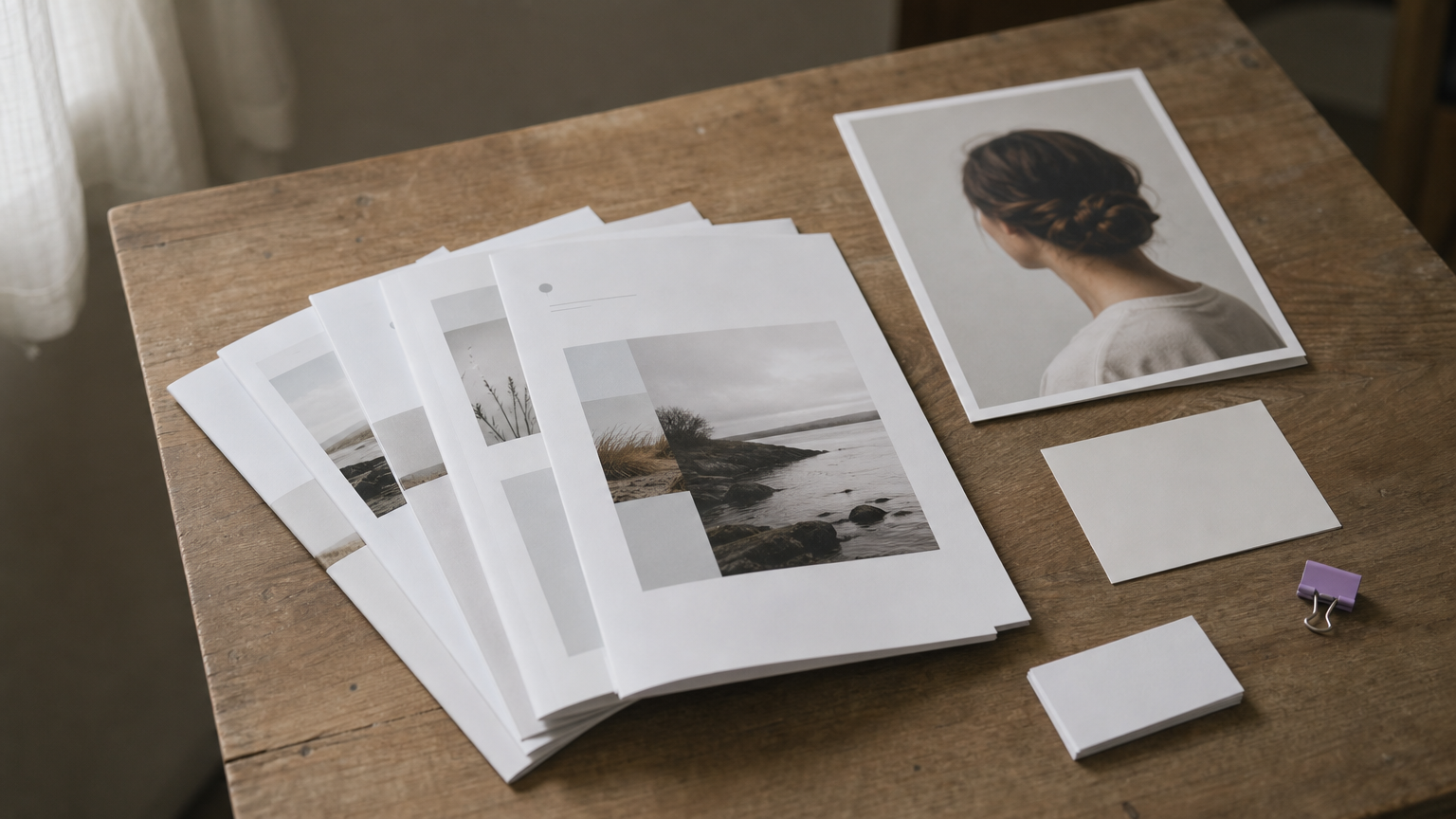
A press release kit template is a ready-made outline for the package of information a journalist needs to write about your business. It covers who you are, what you do, who speaks for you, which images they can use and how to reach you. It is also called a press kit or media kit. You fill it in once, keep it current, and send it whenever a reporter asks for background.
This article gives you the template as plain text. You can copy it into Word, Google Docs or a design tool, so there is nothing to download and no sign-up. You will see why the kit matters, how to build it in the right order, what weak and strong entries look like, and which mistakes make journalists ignore a kit.
Purple Word Box is a South African PR agency led by Maria Joubert, who has more than 20 years of PR experience. We write press releases and media pitches for businesses.
Why a press release kit matters
A press release kit matters because it decides how easy you are to write about. Journalists work to deadlines, and the source who answers every question up front is the one who gets quoted.
What it saves a journalist
If a reporter has to email you for a founder’s title, a logo or the year you started, a competitor with a ready kit may get the mention instead. A press release kit template forces you to put every verifiable fact in one place. That also cuts errors such as misspelled names and wrong job titles in the published story.
Think of the kit as background, not news. A press release announces one thing, such as a launch or an appointment. The kit sits behind every release and answers the questions the release has no room for. Send the release first and the kit alongside it, or link to the kit from the notes to editors.
A press kit is the standing background that makes every press release easier to cover.
What it does for your business
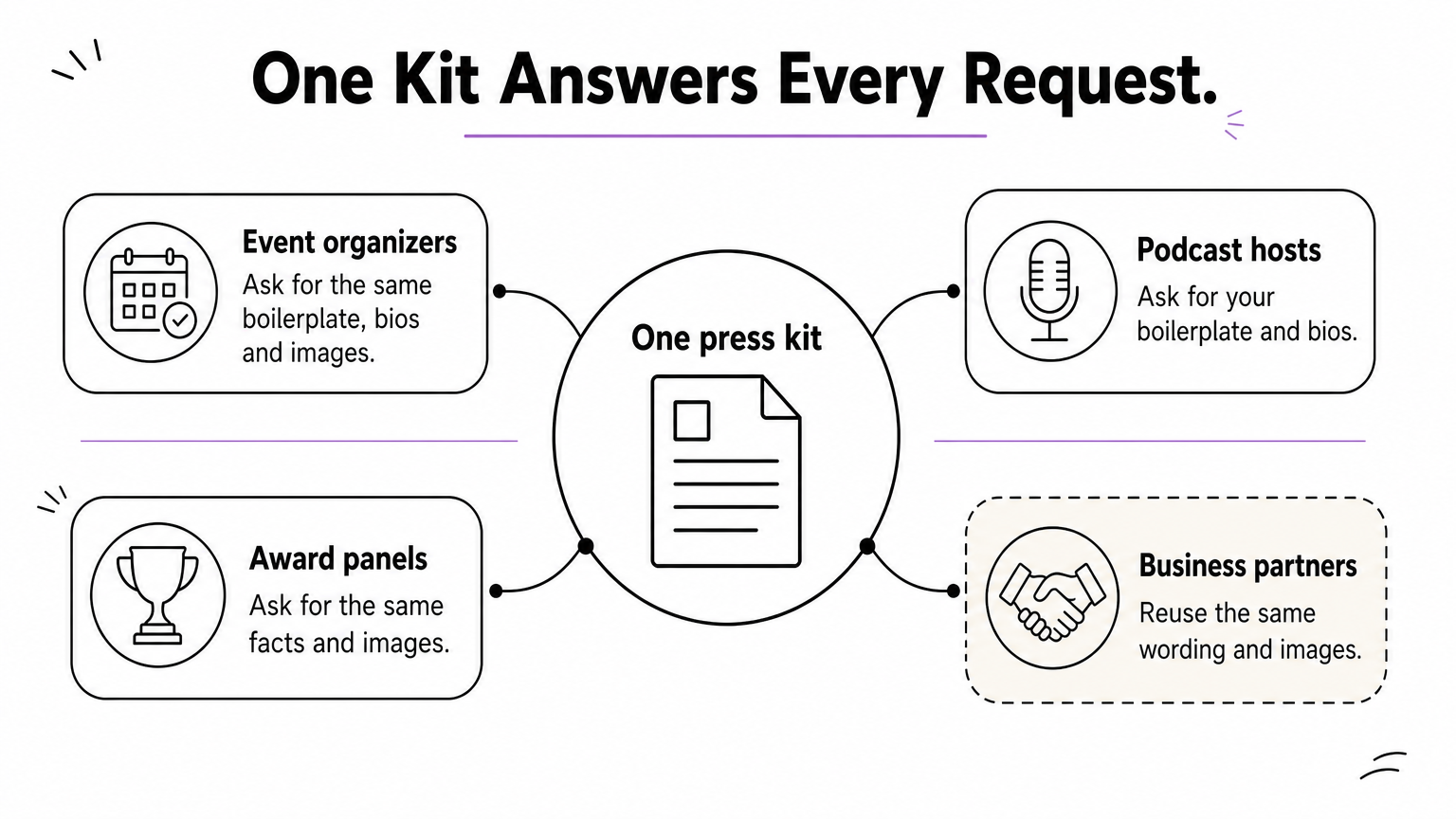
For you, the kit is a single source of truth about the company. Event organizers, podcast hosts, award panels and partners all ask for the same boilerplate, bios and images. Answer them with one link instead of rewriting each time. It also keeps your wording consistent across channels, which matters when several people speak for the business.
Preparation also helps when a journalist calls with a deadline that afternoon. With a kit, sending a bio, a headshot and the company facts takes minutes, so you can spend your time on the comment itself.
How to build your kit with a template
Build the kit by writing the reusable pieces first, then adding assets and contacts. Eight parts cover what journalists ask for most, and each one has a clear job.
The parts a press kit needs
Use the table as a checklist when you work through any press release kit template. The lengths are guidelines, and shorter is usually better.
| Part | What to include | Suggested length |
|---|---|---|
| Company overview | What you do, for whom, where, since when | 100 to 150 words |
| Boilerplate | A short "About" paragraph reused on every release | 50 to 80 words |
| Fact sheet | Founding year, location, headcount, products, key numbers | One page of bullets |
| Spokesperson bios | Name, title, expertise, topics they can comment on | 80 to 100 words each |
| Latest news | Your two or three most recent press releases | Headline, date, link |
| Media coverage | Links to articles that already mention you | 3 to 5 links |
| Visual assets | Logos, product images, headshots, brand colors | High-resolution files |
| Media contact | One named person with email and phone | Three lines |
The order that saves time
Work in this order, because each step feeds the next:
- Write the boilerplate first. The overview and bios borrow its wording.
- Collect the facts for the fact sheet and verify every number with whoever owns it.
- Write each bio in the third person, so a journalist can paste it unchanged.
- Gather your assets and name the files clearly, for example "company-logo-primary.png".
- Add your latest releases and any coverage you have earned.
- Name one media contact who actually answers the phone.
- Review the kit every time a fact changes, and at least twice a year.
Write the boilerplate first, because every other part of the kit borrows from it.
A press release kit template you can copy
Here is a plain-text press release kit template. Paste it into your tool of choice, replace everything in square brackets, and delete any part you cannot support yet.
Copy-and-paste outline
PRESS KIT: [Company name]
Last updated: [Month Year]

1. ABOUT US
[Company name] is a [type of business] based in [city, country] that helps [audience] to [outcome]. Founded in [year], we [main product or service in one sentence].
2. BOILERPLATE (50 to 80 words, reused on every press release)
[Company name] is a [description]. [One proof point, such as customers served or years in business]. For more information, visit [website].
3. FACT SHEET
Founded: [year]
Headquarters: [city, country]
Leadership: [names and titles]
Employees: [number]
Products or services: [list]
Key numbers: [customers, awards, years in business]
Website: [URL]
4. SPOKESPEOPLE
[Name], [Title]
[Two-sentence bio in the third person]
Can comment on: [topic 1], [topic 2], [topic 3]
Headshot: [file name or link]
5. LATEST NEWS
[Headline], [date], [link]
[Headline], [date], [link]
6. MEDIA COVERAGE
[Publication], [headline], [date], [link]
7. VISUAL ASSETS
Logos (PNG and SVG): [link]
Product or service images: [link]
Headshots: [link]
Brand colors and fonts: [hex codes, font names]
8. MEDIA CONTACT
[Name], [Title]
Email: [address]
Phone or WhatsApp: [number]
Available: [hours]
Keep the "Last updated" line. A dated kit tells a journalist the facts are current, and it reminds you to check them.
Weak and strong entries side by side
The template only works if the entries are specific. This comparison uses a made-up bicycle maker, Brightline Cycles, to show the difference.
| Part | Weak entry | Strong entry |
|---|---|---|
| Boilerplate | "A leading provider of innovative mobility solutions." | "Brightline Cycles is an independent maker of steel-frame commuter bikes. Founded in 2018, it sells through 12 dealers." |
| Fact sheet | "A growing team." | "Employees: 14. Founded: 2018." |
| Bio | "Thandi is passionate about bikes." | "Thandi Mokoena, founder and head frame builder, has built bicycles for 12 years and comments on urban cycling and local manufacturing." |
| Assets | A logo pasted into a Word file | Logo as PNG and SVG, headshots as separate files |
| Contact | A general inbox | Named person, mobile number, email and the hours they answer |
If a journalist can quote an entry without editing it, you have written it well.
Format, delivery and mistakes to avoid
Keep one master copy in a document you can edit, export a PDF for email, and host the full kit on your website. Then check the finished kit against the common mistakes below.
Pick a format and a home for it
Write the master in Word or Google Docs. A design tool such as Canva can style it, but the content matters far more than the layout. Export a PDF small enough to attach to an email without bouncing, and link to larger image folders instead of embedding them.
Host the same material on a media or press page of your website, so a journalist can find it without asking. Link that page in your email signature and in the notes to editors of every release.
Mistakes that get a kit ignored
Most kits fail for the same few reasons:
- Sales language instead of facts. "Industry-leading" tells a reporter nothing.
- No date, or outdated numbers and staff who have left.
- Low-resolution or unnamed images that need a reply to fix.
- No named contact, or a contact form instead of a phone number.
- Length. A kit of a few focused pages gets read, and a 30-page brochure does not.
Journalists want facts they can verify and files they can use, not adjectives.
Send a kit journalists can use
A press release kit is a short, current set of facts, bios, images and contacts that sits behind every release you send. Copy the template, fill each part with specifics, check it against the weak and strong examples, and keep it dated. Then host it where a reporter can find it in seconds.
The kit makes you easy to cover, but it does not create the story. You still need news worth pitching and the right journalists to pitch it to. If you want help with that, talk to us about PR and media relations support from Purple Word Box.