

The best thought leadership examples on LinkedIn share three traits: a clear point of view, proof from real experience, and a format built for the feed. Founders and CEOs should study the belief-led posts of Satya Nadella. Companies that own research can copy Deloitte’s approach. Subject experts will get the most from Adam Grant’s short teaching posts. Anyone with a camera and a clear idea can borrow from Jacobs, and anyone short on original ideas can learn from Bill Gates.
Most advice on thought leadership on LinkedIn stays abstract. You are told to "share your expertise" and then left with an empty post box and a fear of sounding like everyone else. Real examples fix that, because you can see what a strong post contains and then copy the structure without copying the words.
Purple Word Box is a South African PR and communication agency led by Maria Joubert, who has more than 20 years of PR experience. The agency writes LinkedIn thought leadership posts for leaders and businesses, so the five patterns below are the same building blocks that sit behind a workable LinkedIn thought leadership strategy.
1. Satya Nadella: the leader’s point of view
Nadella’s LinkedIn presence shows how a CEO builds authority with ideas instead of announcements. If you are a founder or executive, this is the most direct model for your own posts.

What it looks like
Nadella, the CEO of Microsoft, writes about leadership, culture and technology in his own voice. His posts link the direction of the company to a bigger idea about how people work and learn. They do not read like press releases.
The pattern is a belief, a short story and a lesson. The reader learns what he thinks, not just what Microsoft sells. That is why people follow a leader and not a logo.
How to apply it
Choose one belief about your industry that a peer might argue with. Then back it with something you lived through.
- State the belief in the first line.
- Add one real experience, such as a client situation, a failed launch or a hiring decision.
- Close with what it means for the reader.
A leader’s post earns trust when it states a belief, not a product feature.
2. Deloitte Tech Trends: research cut into feed-sized pieces
Deloitte shows how a company turns one big report into many LinkedIn posts. If your business holds data, this is the example to follow.
What it looks like
Deloitte publishes its Tech Trends research as an annual report. On LinkedIn, it presents the findings in short, visual pieces instead of pointing everyone to a long PDF. Each post gives the reader one idea they can absorb in seconds.
The research gives the posts credibility, and the short format gives them reach. Neither would work as well alone.
How to apply it
You do not need Deloitte’s budget. A survey of 30 customers, or a pattern you see across your own client work, gives you numbers that competitors lack.
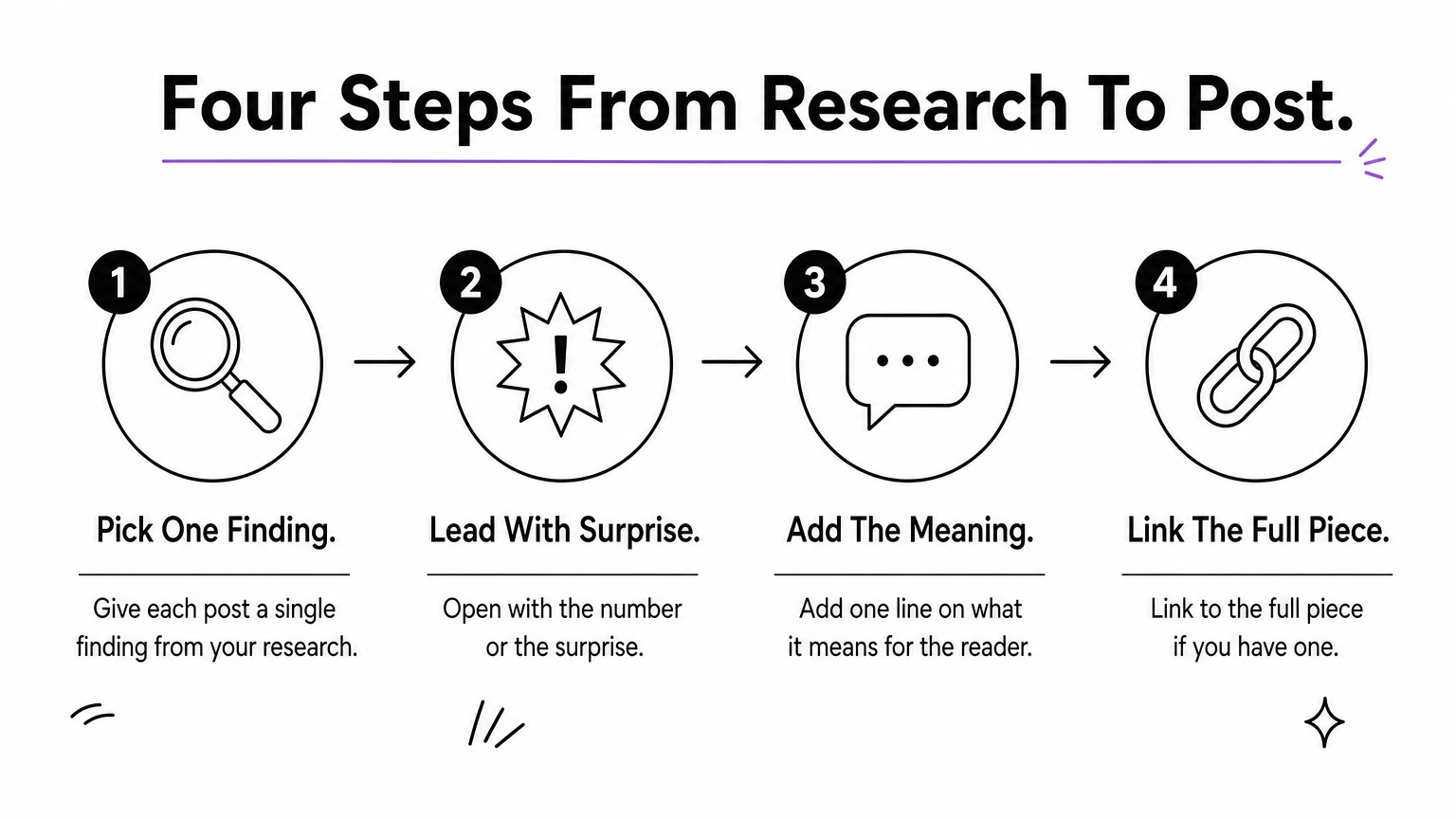
- Pick one finding per post.
- Lead with the number or the surprise.
- Add one line on what it means for the reader.
- Link to the full piece if you have one.
A single piece of research can feed six to eight posts over two months.
One piece of original data can feed weeks of LinkedIn posts.
3. Adam Grant: short teaching posts
Grant shows that thought leadership content on LinkedIn can be short and still carry weight. This suits subject experts who prefer sharp ideas to long essays.
What it looks like
Grant, an organizational psychologist, has built a large following by posting compact observations about work, motivation and behavior. His posts often open with a point that challenges a common assumption, then support it with research or an example.
The reader gets a new way of seeing something familiar. A post like that is easy to react to, easy to share and easy to remember.
How to apply it
Use a fixed structure so that writing each post takes minutes, not hours. Copy and adapt this template:
Hook: One line that challenges a common assumption in your industry.
Evidence: One example, client situation or study that supports your view.
Takeaway: What the reader should do differently on Monday.
Question: One question that invites replies.
Post this kind of piece weekly. Consistency matters more than length.
A strong LinkedIn post teaches one thing and ends with a question.
4. Jacobs: video that sets out a vision
Jacobs, the global professional services firm, has been cited as an example of using video to set out a company vision on LinkedIn. It suits businesses whose ideas are easier to explain by speaking than by writing.

What it looks like
Instead of a long statement, the company explains where it sees its industry going in a video. People see and hear a real voice, which makes the vision feel more human than a paragraph on a page.
Video also breaks up a feed full of text posts. It shows who is behind the idea, which is half of what thought leadership is.
How to apply it
Keep it small. A 60 to 90 second video of a subject expert speaking to camera is enough.
- Make one point per video.
- Add captions so the video works with the sound off.
- Open with your conclusion, not your background.
- Write two or three lines of text above the video so the post also works for people who do not press play.
A short video of a real expert beats a polished statement nobody reads.
5. Bill Gates: curated learning
Gates shows that you can lead thinking without producing original research. This suits professionals who read widely and want to be known for good judgment.
What it looks like
Gates shares what he is reading and learning with his LinkedIn following, including book recommendations and reflections. He explains why something mattered to him, so the reader gets a view and not just a list.
Curation builds authority when you add your own opinion. Generosity builds goodwill because the reader gets value without being sold to.
How to apply it
Run a monthly "what I learned" post in your field. Pick one report, book or news event, say what surprised you, and say what you disagree with. The disagreement is what separates thought leadership from sharing links.
If you want to build this into an ongoing routine, a LinkedIn thought leadership strategy can be as simple as one pillar topic, two formats from this list and a weekly posting rhythm.
Curation becomes leadership the moment you add your own opinion.
Where to start with your own posts
Pick the example closest to the way you already think. Leaders with strong opinions should start with the Nadella pattern, and businesses with data should start with Deloitte. Experts who like short, sharp ideas should use the Grant template, and people who are comfortable on camera can try the Jacobs approach. If you read a lot, the Gates pattern is the easiest one to begin.
Whichever you choose, copy the structure and use your own experience as the content. If you would rather have an experienced PR practitioner shape your posts and profile, explore Purple Word Box’s thought leadership and LinkedIn support.