

The types of media in public relations are the channels a practitioner uses to put a message in front of an audience. You can sort them two ways. By format, they are print, broadcast and online. By control, they are earned, shared, paid and owned. Format tells you where a story appears. Control tells you who decides what it says and what it costs.
This article explains why the choice of media matters, describes each type with examples from everyday PR work, and shows you how to combine them in a campaign. You will also see how the types of media relations work differ. Pitching a newspaper, preparing for a radio interview and posting on LinkedIn each call for a different skill.
Purple Word Box is a South African PR agency founded by Maria Joubert, who has more than 20 years of PR experience. Choosing the media mix is one of the first decisions when planning a campaign, and the same decision is open to you.
Why the type of media matters in PR
The type of media you use decides how much your audience trusts the message, how much control you keep over it, and what it costs. A strong story in the wrong channel still fails to reach the people you need.
Credibility and control pull in opposite directions
When a journalist writes about your company, readers trust the piece because an independent person chose to cover you. The price is that you cannot control the angle, the headline or the timing. A post on your own website is the reverse. You approve every word, but readers know you wrote it, so it carries less credibility. Every PR plan is a decision about where to sit between those two poles.

Audiences use media differently
A finance director may read the business section of a national newspaper and listen to morning radio. A prospective employee checks your LinkedIn page. A trade buyer reads an industry magazine. Your audience’s habits should choose the channel, not your own preferences.
The same logic explains why the types of media relations work differ. Pitching a print journalist means offering a story with data and context. Preparing for radio means having a few clear points you can say in thirty seconds. Working with an online editor means supplying copy and images that can go live fast.
The right medium is the one your audience already trusts, not the one that is easiest for you to reach.
The main types of media in PR by format
By format, PR media falls into three groups: print, broadcast and online. Most campaigns use all three, but each rewards a different kind of preparation.
Print and broadcast media
Print media covers newspapers, magazines, trade journals and business titles. It suits in-depth stories, opinion articles and interviews where a journalist has room to explain context. Magazines plan weeks or months ahead, so you need to pitch early. Print also gives you a clipping that clients and colleagues can keep and share.

Broadcast media covers radio and television, such as a morning radio interview or a business segment on a news channel. It reaches large audiences quickly, but you get seconds, not paragraphs. A spokesperson who rambles gets cut. That is why we offer media training for leaders and executives before they go live.
Online media and a quick comparison
Online media includes news websites, blogs, newsletters, podcasts and social platforms. It is fast, easy to share and measurable through clicks and shares. Coverage on a reputable site also links back to your own website. Many print and broadcast outlets publish online too, so one story can appear in several formats.
| Format | Examples | Typical PR use | Main limit |
|---|---|---|---|
| Newspapers, magazines, trade journals | Opinion articles, feature interviews, press releases | Long lead times for magazines | |
| Broadcast | Radio, television | Live interviews, expert comment | Very short airtime |
| Online | News sites, blogs, podcasts, social media | Press releases, thought leadership, social posts | Crowded, fast-moving feeds |
Print gives depth, broadcast gives reach, and online gives speed and measurability.
Earned, shared, paid and owned media explained
These four categories sort media by who controls the channel and whether you pay for the space. Earned and shared media depend on other people. Paid and owned media sit under your control.
The four categories side by side
One channel can fall into more than one category, depending on how you use it. A LinkedIn post from your CEO is shared media. The same post, promoted with a budget, becomes paid media.
| Category | Who controls it | Examples | Cost |
|---|---|---|---|
| Earned | The journalist or editor | News coverage, interviews, expert quotes | No placement fee, but time and PR effort |
| Shared | You and your audience together | LinkedIn posts, comments, reposts | Free to post, effort to build a following |
| Paid | You | Advertising, sponsored content, promoted posts | A media fee |
| Owned | You | Website, blog, newsletter, case studies, whitepapers | Production time and cost |
How the four categories work together
Earned media is the hardest to win and the most trusted, so most PR campaigns start there. A press release or media pitch earns an article in a business publication. Then you reuse the result. Share it on LinkedIn, add it to an "In the media" page on your website, and promote it if the budget allows. One story does four jobs.
Owned media is the base that everything points to. A journalist who is interested in your story will check your website and LinkedIn before replying, so thin owned channels can cost you coverage. Case studies and thought leadership articles also give reporters material they can quote.
Earned media builds trust, and owned media holds the proof that makes that trust last.
How to choose the right mix for your campaign
Start with the audience and the goal, pick one lead medium, then add supporting channels that reuse the same story.
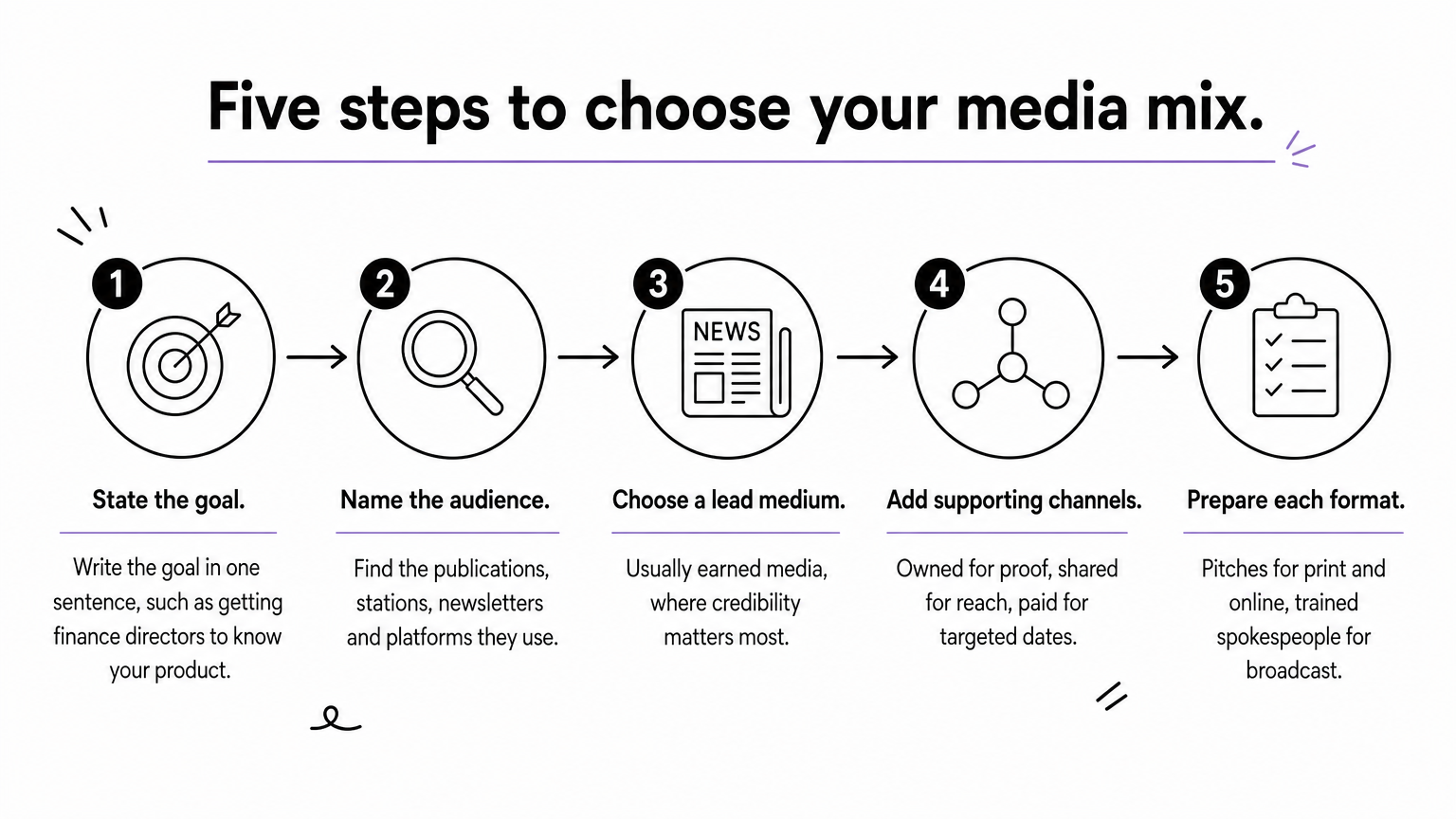
A five-step selection process
Work through these steps before you write a single pitch:
- State the goal in one sentence, such as "get finance directors to know our new product".
- Name the audience and find where they get information: which publications, stations, newsletters and platforms.
- Choose a lead medium. This is usually earned media, where credibility matters most.
- Add supporting channels. Use owned media for proof, shared media for reach, and paid media when you need to hit a date or a narrow group.
- Prepare for each format: a pitch and release for print and online, a trained spokesperson for broadcast, and approved posts for social.
Then measure against the goal. Track the coverage you secured, the quality of the outlets, the traffic that coverage sent to your website, and the engagement on your LinkedIn posts.
A worked example: launching a product
Take a mid-sized South African software company launching a payments tool for finance directors. The lead medium is earned. You send a press release and a tailored pitch to business titles and online news sites, and you offer the CEO for a business radio interview.
Owned media then supports the launch with a product page and a customer case study. The CEO shares the coverage on LinkedIn with a short comment, which is shared media. A small promoted post aimed at finance directors in launch week adds the paid element. Each piece backs up the others, and the paid spend stays small and targeted.
Choose the audience first, the lead medium second, and the supporting channels last.
Match the medium to the message
The types of media in public relations split by format into print, broadcast and online, and by control into earned, shared, paid and owned. Each type trades credibility against control, which is why strong campaigns mix them instead of relying on one. Start with your audience, lead with earned media, and use owned, shared and paid channels to extend the story.
If you want help working out which media will reach your audience and how to get your story there, speak to Purple Word Box about your PR and media relations plan.