

The short answer to what is the role of a PRP in media relations is this: a public relations practitioner (PRP) manages an organization’s relationship with journalists. They find stories worth telling, pitch them to the right media, prepare spokespeople, answer press enquiries and protect the organization’s reputation when coverage turns difficult.
Media relations is one practice inside the wider field of public relations. PR builds mutually beneficial relationships between an organization and its publics. Media relations narrows that to a single audience, the press, and the PRP stands between the two sides. They earn coverage rather than buy it.
This article explains why the role matters, how a PRP earns coverage step by step, and how they manage reputation and day-to-day media communication. It also shows how to judge their results and what to ask before you work with one. Purple Word Box is a South African PR agency, so the advice reflects what businesses need when they want coverage without agency complexity.
Why the PRP role in media relations matters
A PRP matters because journalists decide what gets published, and they only use stories from sources they trust. The practitioner builds that trust for you, so your news reaches the right reader with your message intact. Without one, organizations tend to stay silent or speak in several conflicting voices.
Earned coverage carries weight advertising cannot
Coverage is earned media: an editor ran it because it was relevant, not because someone paid. Readers know this, so an article or interview carries third-party credibility that an advertisement lacks. The PRP’s task is to make your story qualify for that editorial decision.

For a small or mid-sized business, this is often the fastest route to being seen as an authority. A feature in a trade publication or a business section can reach decision-makers who would never open your brochure.
Journalists publish what matters to their readers, so the PRP’s real job is to make your news matter to them.
How public relations and media management fit together
Public relations is the strategy: who you need to reach, what you want them to understand and what you will say. Media management is the daily handling of the press side of that strategy, including pitches, interview requests, statements and monitoring. A PRP does both, which is why the role goes far beyond sending out press releases.
The PRP’s media duties at a glance
| Duty | What it looks like in practice |
|---|---|
| Story finding | Spotting news in launches, research, appointments and milestones |
| Pitching | Tailoring each story to a journalist’s beat |
| Spokesperson preparation | Agreeing key messages and rehearsing interviews |
| Press office | Answering enquiries and supplying quotes, images and data |
| Monitoring | Tracking coverage and correcting factual errors |
| Reputation protection | Preparing holding statements and managing a crisis response |
How a PRP earns media coverage step by step
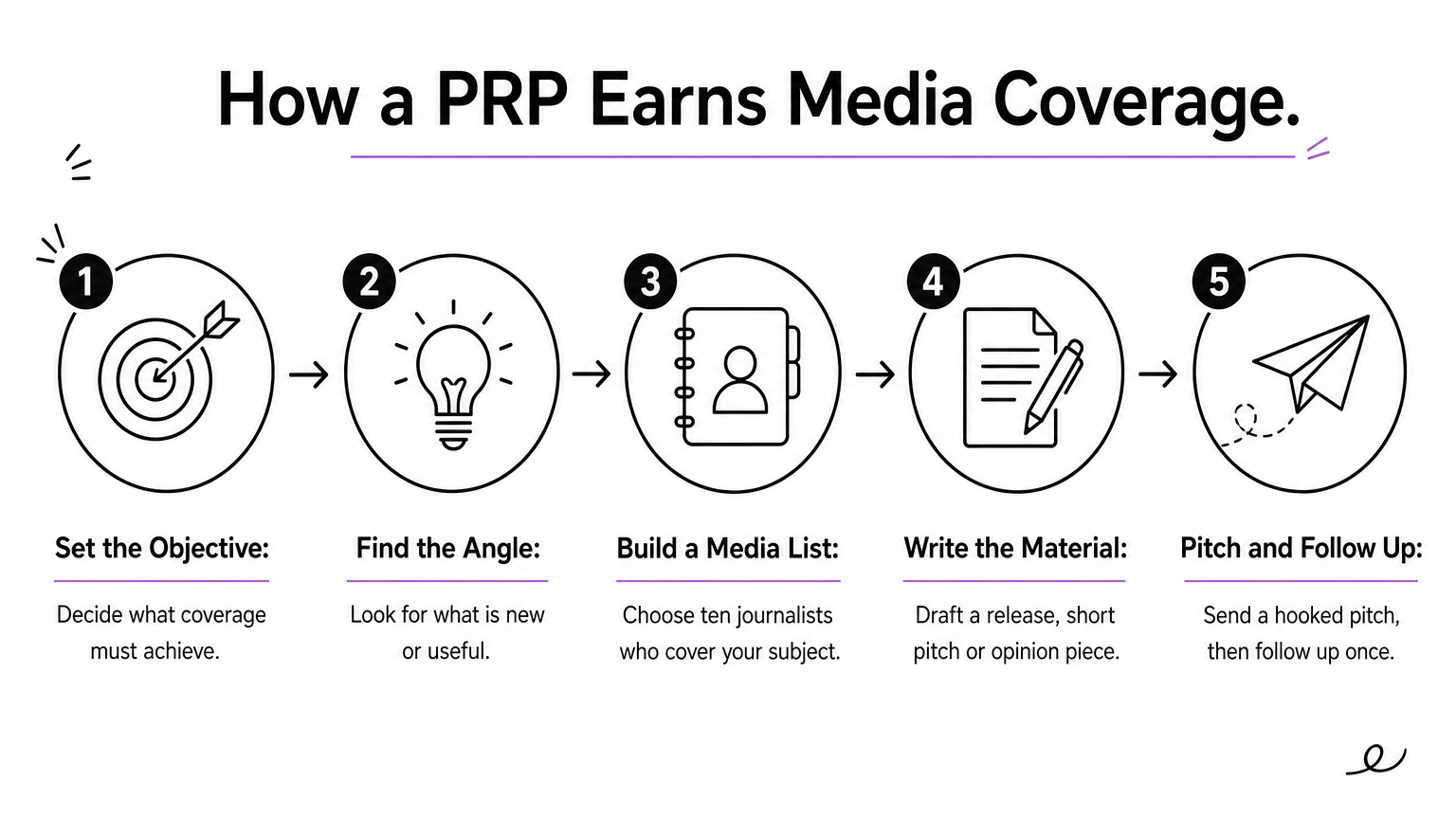
A PRP earns coverage by matching a genuine news angle to a specific journalist at the right moment, then following through professionally. The process is repeatable, and each step has a clear output.
The seven steps
- Set the objective. Decide whether you want credibility in your industry, leads, or recognition among a wider audience.
- Find the angle. Look for what is new, useful, surprising or tied to a wider trend. A product launch alone is rarely news. What it changes for customers might be.
- Build a targeted media list. Choose journalists who cover your subject. Ten relevant names beat 200 random ones.
- Write the material. Draft a press release, a short pitch, or an opinion article.
- Pitch and follow up. Send the pitch with a clear hook, then follow up once, politely.
- Support the interview. Brief your spokesperson and supply anything the journalist needs fast.
- Keep the relationship going. Thank the journalist, share useful information later, and respect their deadlines.
What a good pitch looks like
A pitch is short, specific and written for one reader. You can adapt this structure:
Subject: [Specific news hook] + [why it matters to your readers]

Hi [First name],

[One sentence stating the news.]
[One sentence on why your readers care, with one fact or figure.]
[One sentence on who is available to comment, and when.]

I can send a short release, images and supporting data on request.

Regards,
[Name, role, phone number]
Why relationships matter more than lists
A media list is a starting point. The relationship is what makes journalists open your next email. A PRP reads what each journalist writes, avoids mass-mailing and never pushes a story that does not fit. They also act as a reliable source even when there is nothing to sell, perhaps by connecting a journalist with an expert.
A pitch gets read because the journalist trusts the sender, and trust builds over many small, useful exchanges.
How a PRP manages reputation and media communication
A PRP manages reputation by controlling what the media hears from you, who says it and how fast you respond. Most of this work happens before any problem appears.
Preparing spokespeople
Interviews go wrong when people improvise. The PRP agrees two or three key messages with the spokesperson, anticipates difficult questions and rehearses the answers. Purple Word Box offers media training for leaders and subject matter experts for exactly this purpose, helping them stay on message. A good practitioner also limits the number of people allowed to speak to the press, so the organization sounds consistent.

Handling enquiries and crises
When a journalist calls, a PRP responds quickly, checks the facts and supplies an accurate answer or a clear holding statement. In a crisis the same discipline applies at higher speed. Confirm what you know, say what you are doing about it, and name one spokesperson.
The practitioner should have a crisis plan in place long before it is needed. Writing a statement while the story is already spreading costs hours you do not have.
A crisis plan works like a seatbelt, because it has to be fastened before anything goes wrong.
Monitoring coverage
The PRP tracks where the organization is mentioned and what is being said. They flag emerging issues early, request corrections when facts are wrong and note which messages journalists actually repeat. This monitoring feeds back into the next pitch.
How to measure a PRP’s media relations work
Measure a PRP by whether coverage moves your business goals, not by how many clippings they collect. Counting mentions is easy, but it tells you little about reach, message or results.
Output, quality and outcome
Use three layers together.
| Layer | What it tells you | Example |
|---|---|---|
| Output | How much coverage was secured | Number of articles, interviews, quotes |
| Quality | Whether it was the right coverage | Outlet fit, accuracy, key messages included |
| Outcome | What it led to | Website visits, enquiries, LinkedIn engagement |
A worked example
Say your goal for a quarter is to be recognized as an expert in your sector. Your PRP secures six pieces: three in trade publications, two in business press and one radio interview. Four of the six carry your key message and name your spokesperson. Website visits from two articles rise, and two enquiries mention reading about you.
Six pieces is the output. Four on-message pieces is the quality. The visits and enquiries are the outcome. That picture is far more useful than "six hits".
Be cautious with advertising value equivalent, which converts coverage into the cost of equivalent ad space. It is widely criticized because editorial coverage and advertising are not the same thing.
Judge media relations by what the coverage changed for your business, not by how many places your name appeared.
How to work with a PRP and what to ask
Work with a PRP by giving them access to news and decision-makers, and ask them to explain how they will earn coverage before you sign anything. The relationship works best when both sides are clear about goals.
In-house or agency
An in-house PRP knows your business deeply and is always available. An agency brings existing media relationships and a broader view of what editors want. Smaller companies often find a senior agency practitioner more practical than a full-time hire. Large organizations frequently use both.
Questions to ask before you hire
- What experience do you have in my industry and with the journalists who cover it?
- How do you find stories when there is no obvious news?
- Who will actually do the work, and who will I speak to day to day?
- How will you report results, and against which goals?
- How do you handle a negative enquiry or crisis?
What you owe the practitioner
A PRP can only pitch what they know about. Share upcoming launches, hires, research and customer wins early. Make spokespeople available at short notice, because journalists work to deadlines and will move on if you are slow. Approve drafts quickly and accept honest advice when a story is not strong enough yet.
The best PRP results come from clients who share news early and answer quickly.
Getting media relations right
A PRP’s role in media relations comes down to four things: finding stories that deserve attention, earning journalists’ trust, preparing people to speak well and protecting the organization’s reputation. When those four work together, coverage becomes a steady result of good practice rather than a lucky break.
If you want senior, hands-on support with this, talk to Purple Word Box about PR and media relations for your organization. You will deal directly with an experienced practitioner who can tell you honestly which stories are worth pitching. Every project differs in scope, so contact Purple Word Box with your goals and we will send you a tailored quote.