

You can post on LinkedIn every day, work on social profile building for your leaders, run a slick website, and still struggle to get anyone outside your own network to notice your business. That’s the gap media coverage fills. If you’ve ever wondered how a single article in the right publication can do more for your credibility than months of self-promotion, you’re asking the right question, and this piece will explain why the media is important to public relations.
Here’s the short answer: media relations builds trust that paid advertising simply can’t buy. When a journalist writes about your business, readers see it as independent validation, not a sales pitch. That third-party endorsement is what turns a name people vaguely recognise into a brand they actually believe in, which is exactly why the importance of media relations in public relations keeps coming up in every serious communication strategy.
In the sections ahead, we’ll unpack how media coverage shapes public perception, why it drives measurable business results like website traffic and lead quality, and what it takes to build the kind of media relationships that deliver consistent, credible coverage rather than a one-off mention.
Why media relations matter to public relations success
Most business owners assume PR is about writing a nice press release and hoping someone reads it. That’s not quite right. Media relations is the engine room of PR because journalists and editors act as gatekeepers of public attention, and getting through that gate is worth far more than shouting into your own channels. When you understand why media relations is important, you start treating journalist relationships as a business asset, not an occasional favour you ask for.
The credibility advertising money can’t buy
Advertising tells people what you want them to hear. Media coverage tells them what an independent source thinks is worth reporting. That distinction is the whole reason the importance of media relations shows up in nearly every serious communications strategy. A client of ours once described it perfectly: nobody trusts a billboard, but everyone trusts a story their favourite news site chose to run. That’s not marketing spin, it’s how human psychology works around information.
People trust what journalists choose to report far more than what brands choose to say about themselves.
This is precisely why why the media is important to public relations isn’t a rhetorical question, it’s a practical one with a measurable answer: coverage changes buyer behaviour in ways self-published content rarely does.
Reach that your own channels can’t match
Owned channels, your website, your LinkedIn page, your newsletter, only reach people who already follow you. Media coverage puts your name in front of readers who’ve never heard of your business and weren’t looking for it. A trade publication with 40,000 monthly readers introduces your brand to an audience you couldn’t build organically in years. This is where media coverage helps build brand awareness and why it matters at a scale that outpaces almost any other communication tactic available to a small or mid-sized company.
It compounds over time
One article rarely changes everything. What changes everything is a pattern. Journalists who’ve quoted you before are more likely to call you again when a relevant story breaks. Readers who’ve seen your name in three different publications over six months start to assume you’re an established authority, even if your company is five years old and ten people strong. Quality coverage also earns backlinks from high-authority news sites, which strengthens your search visibility long after the story has scrolled off the homepage. Strategic media relations turns single mentions into a durable reputation asset, which is the outcome every PR strategy is ultimately built to deliver.
Media coverage versus paid advertising
Seeing the two side by side makes the case clearer than any explanation can.
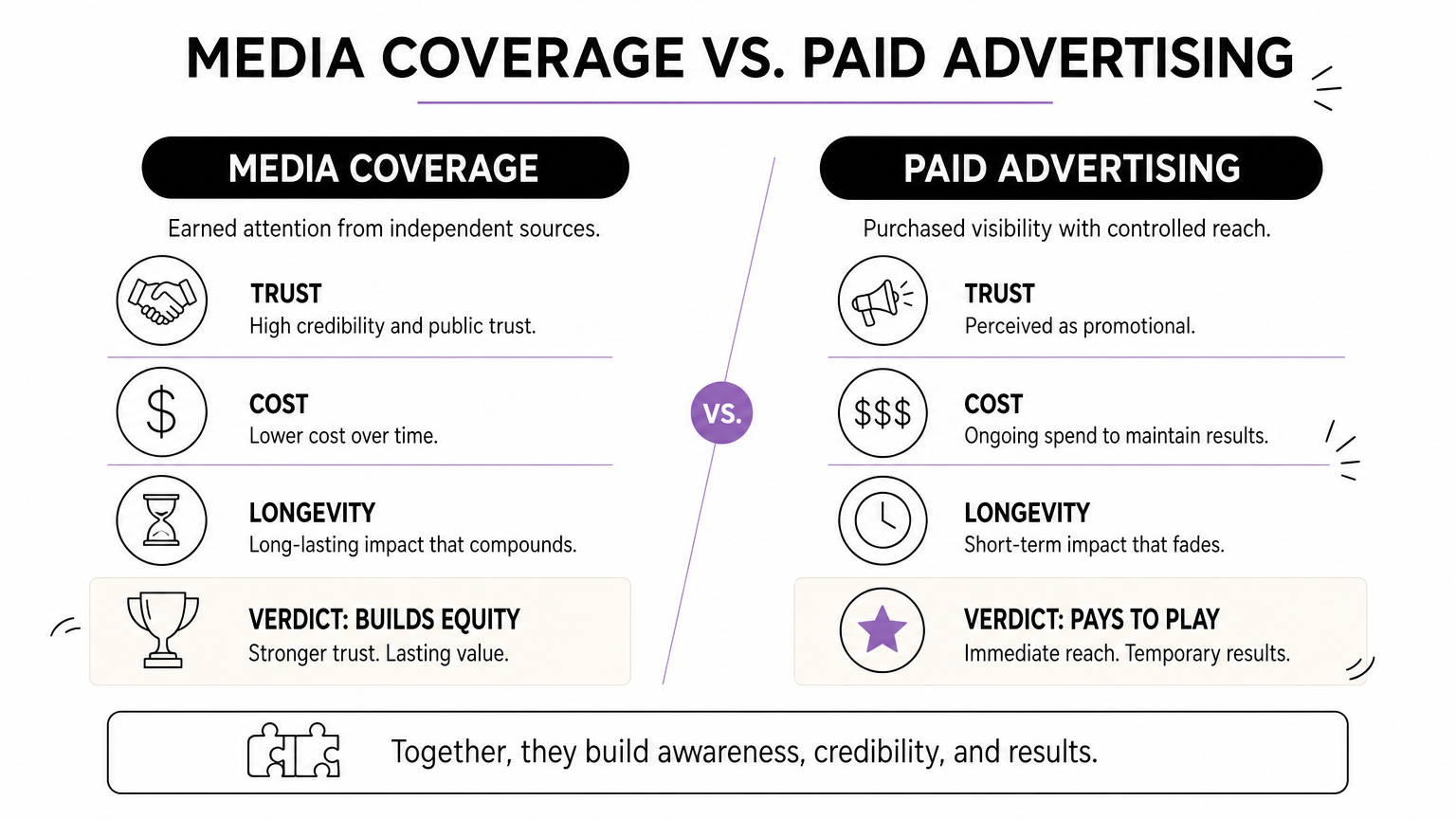
| Factor | Media coverage (earned) | Paid advertising |
|---|---|---|
| Perceived credibility | High, third-party validated | Lower, self-promotional |
| Cost per placement | Time and relationship investment | Direct cash spend, repeats each cycle |
| Longevity | Indexed, searchable, cited for years | Disappears when budget stops |
| Audience trust | Borrowed from the publication | Built from scratch, slowly |
| Control over message | Shared with the journalist | Full control |
Neither replaces the other completely. Advertising gives you control; media coverage gives you credibility you can’t buy at any price. Together they’re strong, but if your budget forces a choice, credibility usually wins new customers faster than control does.
Trust is the real business outcome
Ultimately, every reason behind the importance of media relations in public relations comes back to trust. Trust shortens sales cycles because prospects arrive already believing you’re legitimate. Trust makes investors and partners take your calls. Trust gives your spokespeople authority when they’re quoted rather than merely promoted. Businesses we’ve worked with, from financial services firms to tech scale-ups, have consistently found that a well-placed media mention does more for a pitch meeting than another slide in the deck. That’s the practical, unglamorous truth behind why media relations deserves a real seat in your communication strategy, not an afterthought squeezed in when there’s spare time.
How to build strong media relations for your business
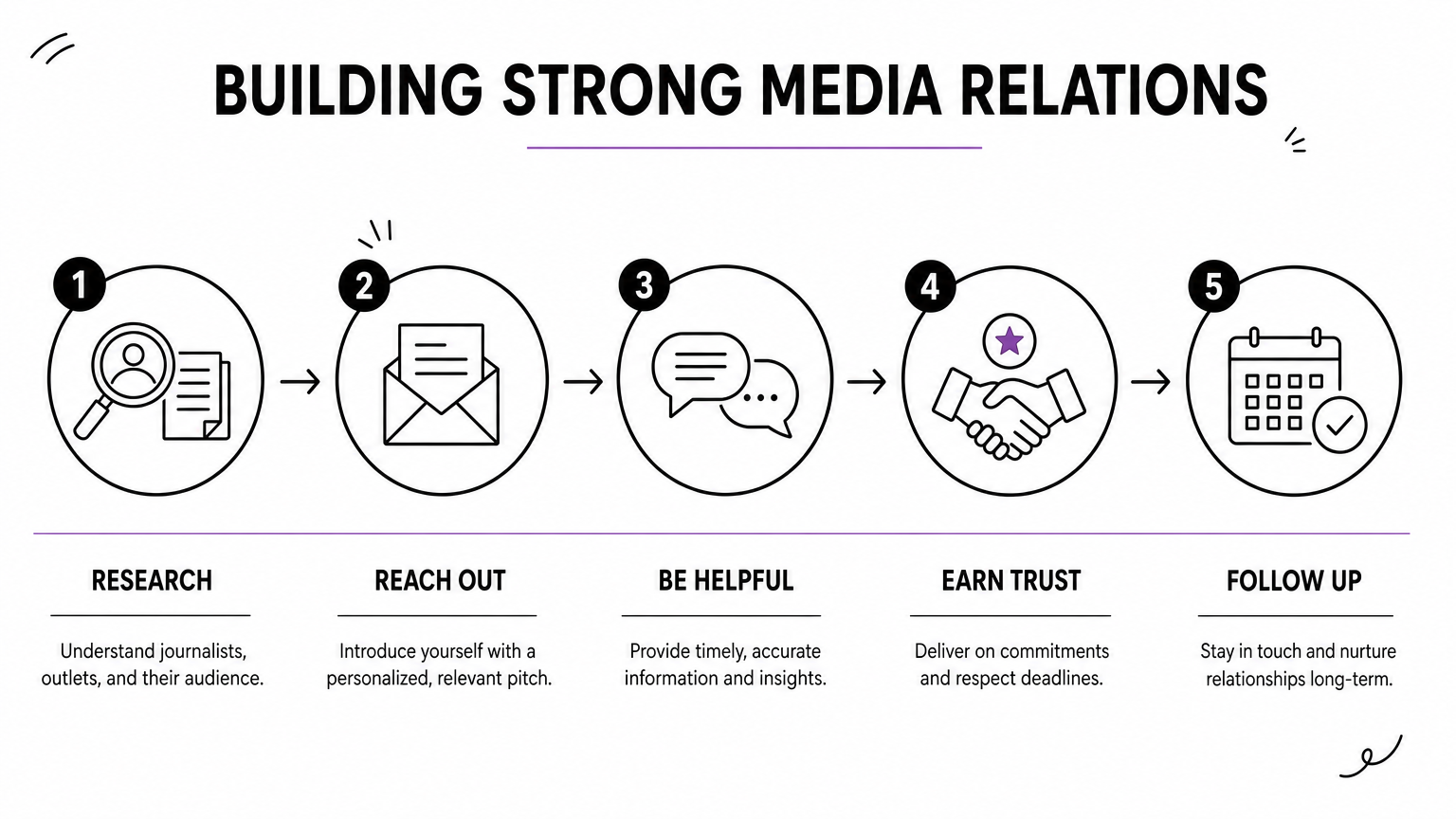
Building real media relationships takes patience, not a mail-merge press release blasted to two hundred contacts you’ve never spoken to, which is often the point where businesses start weighing up doing PR in-house versus bringing in an agency. Strong media relations for your business starts with treating journalists as people with deadlines, specific beats, and no patience for irrelevant pitches. Get that mindset right and the rest of the work becomes much easier.
Research before you reach out
Before you send a single email, know who covers your industry and how they actually write about it. Read the last ten articles a journalist published, not just their bio. Notice their tone, their sources, the angles they favor. A pitch that matches what a reporter already covers gets opened; a generic one gets deleted in three seconds. This groundwork is unglamorous, but it’s the difference between a coverage plan that works and one that gets ignored month after month.
A journalist who trusts your judgment will call you before the story even breaks.
Give journalists what they actually need
Most pitches fail because they’re written from the business’s point of view instead of the reporter’s. Journalists need a clear angle, a quotable spokesperson, and facts they can verify quickly, not a paragraph of company history. Structure every pitch around what makes their job easier:
- A newsworthy hook in the first sentence, not the third paragraph
- A named, available spokesperson with relevant expertise
- Data, statistics, or a real example that supports the story
- Contact details that get a response within hours, not days
Skip any of these and you’ll watch good pitches sit unanswered, no matter how important the news feels to you internally.
Play the long game
One good pitch builds a lead. Consistency builds a relationship. Keep in touch with journalists between stories, not just when you need coverage. Share a useful data point, congratulate them on a piece that impressed you, or flag a trend before they’ve asked about it. That ongoing contact is what separates businesses that get called for expert comment from those that only appear when they’re pushing their own news.
Set realistic expectations from the start
Timing matters more than most business owners expect. A journalist working on a same-day story needs a response within the hour, not by end of week. Understand each publication’s lead times, respect embargoes, and never chase a reporter twice in one day. Businesses that respect these unwritten rules build reputations as easy, reliable sources, and that reputation gets you covered again.
Most small and mid-sized businesses don’t have the time to build these relationships from scratch while running daily operations, which is exactly why Purple Word Box’s PR services exist: to bring senior-level relationships and pitching experience to businesses that need results without hiring a full internal PR team.
Key media relations activities every PR strategy needs
A PR strategy without a clear set of media relations activities is just good intentions. Every effective PR strategy needs a handful of concrete, repeatable activities that keep your business in front of journalists and, in turn, in front of the public. Skip any one of these and you’ll end up with sporadic coverage instead of a steady, credible presence.
Press releases that earn coverage
A press release only works if it announces something a journalist’s readers actually care about. Newsworthy announcements, a funding round, a product launch, a notable hire, a survey with original data, give reporters a reason to write. Vague company updates dressed up as news get ignored, no matter how well they’re formatted. Keep releases short, lead with the news in the first line, and attach quotes that add insight rather than praise.

Targeted media pitching
Pitching is different from issuing a release: it’s a direct, personal ask to a specific journalist about a specific story. Targeted media pitching means matching your angle to a reporter’s beat and recent work, then explaining in two sentences why their audience should care right now. This is where most of the coverage in a mature PR program actually comes from, not from mass press release distribution.
Coverage doesn’t come from being loud, it comes from being relevant to the right person at the right time.
Building and maintaining a media list
You can’t pitch well without knowing who to pitch. A working media list tracks the journalists, editors, and freelancers who cover your industry, along with notes on their preferences and past coverage. Treat it as a living document, not a spreadsheet you build once and forget:
- Name, outlet, and beat for every contact
- Preferred contact method and response speed
- Notes from past interactions or coverage
- Recent articles that show current interests
A stale media list wastes time on journalists who’ve moved beats or outlets entirely.
Spokesperson preparation
Journalists want quotable, confident voices, not rehearsed corporate lines. Preparing your spokesperson means running through likely questions, tightening key messages, and practicing answers that stay on point under pressure, which is precisely what media training for executives and spokespeople is built to do. Without this preparation, even a strong pitch can fall apart the moment a reporter asks a follow-up question that wasn’t in the script.
Monitoring coverage and measuring impact
Once a story runs, the work isn’t finished. Tracking where your business gets mentioned, how the story was framed, and what traffic or engagement it drove tells you what’s working and what to adjust. This is also where the importance of media relations becomes measurable rather than theoretical: you can point to specific coverage, specific reach, and specific business outcomes tied back to a relationship you built deliberately.
Common media relations mistakes that hurt your PR efforts
Even businesses that understand the importance of media relations trip over the same avoidable mistakes. Most of these errors come from treating journalists like an advertising channel instead of independent professionals with their own standards. Fixing them is often less about effort and more about changing the habits your team has picked up along the way.
Blasting the same pitch to everyone
Sending one generic email to fifty journalists at once is the fastest way to get ignored. Mass-blasted pitches ignore beat, tone, and audience, and reporters notice immediately when a pitch clearly wasn’t written for them. A single tailored email to the right person consistently outperforms a hundred copy-paste attempts, because relevance is what earns a reply, not volume.
A pitch written for everyone gets read by no one.
Chasing coverage only when you need it
Businesses that only contact journalists when they have news to push come across as transactional, and reporters remember that pattern. Treating media relations as a one-off task rather than an ongoing relationship means you start every pitch from zero trust. Consistent, low-pressure contact between stories builds the goodwill that gets your calls answered when something genuinely newsworthy happens.
Ignoring deadlines and follow-up etiquette
Journalists work against the clock, and businesses that don’t respect that lose credibility fast. Common missteps include:
- Following up multiple times in the same day
- Missing a promised response window for a same-day story
- Sending information after the journalist has already filed
- Pitching a story angle the outlet has already covered that week
Repeating any of these signals that you don’t understand how newsrooms actually operate, and that reputation sticks.
Overselling instead of informing
Pitches stuffed with marketing language rarely land, because journalists are trained to spot self-promotion instantly. Overselling a story, exaggerating numbers, or hiding weak spots in an announcement damages trust the moment a reporter checks the facts. Honesty about what’s genuinely newsworthy, even when it means admitting a story is smaller than you’d like, keeps the relationship intact for the next pitch.
Skipping measurement entirely
Running media relations without tracking outcomes means you repeat what doesn’t work and abandon what does. Skipping measurement leaves you guessing whether a placement actually moved traffic, leads, or brand perception, instead of knowing for certain. Businesses that review coverage regularly adjust their pitching faster and waste far less time on angles that never land with journalists in the first place.
The bottom line on media relations and PR
Media relations isn’t a nice-to-have bolted onto your marketing plan. It’s the mechanism that turns a good business into a trusted one, because journalists lend you credibility no ad budget can buy. Why the media is important to public relations comes down to one simple fact: people believe stories more than they believe slogans, and that belief drives real business decisions.
Getting there takes research, patience, and consistent contact with the right journalists, not a single well-written press release. Skip the shortcuts, respect the newsroom’s rules, and measure what actually lands. Do that consistently and coverage stops being lucky and starts being predictable.
If building those relationships yourself feels like one more job you don’t have time for, that’s exactly the gap Purple Word Box fills. Take a look at our media relations support for businesses and let a senior practitioner handle the pitching while you run your business.