
Brand awareness, recognition and recall describe how well people know your business. Brand awareness is the umbrella term: how far your market knows your brand exists. Brand recognition is the narrower skill of identifying you when people see your name, logo or colors. Brand recall is the strongest of the three. It means naming you from memory, with no prompt, when a need comes up.
People mix these terms up because they overlap, yet the difference changes what you measure and where you spend your budget. A company can be recognized by everyone in its industry and still never get a call, because nobody thinks of it when a real need arises.
Purple Word Box is a South African PR and communication agency, and building memory in a market is the daily work of media relations, content and spokesperson profiling. This article explains why the three concepts matter to sales, how they differ, how to measure each with a simple survey, and how to build recognition and recall in your own market.
Why brand awareness, recognition and recall matter
Brand awareness, recognition and recall matter because they decide which brands a buyer considers at all. People rarely compare every option. They choose from a short list built on memory and familiarity, and a business that is not on that list never gets to compete on price or quality.
Awareness decides who makes the shortlist
Before a prospect compares quotes, reads reviews or visits a website, they have already narrowed the field. Familiar brands pass that filter. Unfamiliar ones are dropped without a second look, because choosing an unknown name feels riskier. Familiarity works as a shortcut for trust.

That is why a company with excellent service but low awareness often loses to a louder competitor. The better provider was never in the room when the decision was made.
Where recognition and recall show up in a purchase
Recognition and recall do their work at different moments. Recognition helps when options are in front of the buyer: a supplier list, a search results page, a shelf, a LinkedIn feed. Recall helps when the buyer starts from nothing, such as a finance director who needs a new payroll provider and either types a name into Google or asks a colleague for one.
For a consumer product on a shelf, recognition carries more weight. For a service that people must go looking for, which describes most B2B work, recall carries more. Most businesses need both, but knowing which one drives your category tells you where to focus first.
Recognition gets you chosen from a list, and recall gets you onto the list.
What awareness cannot do on its own
Awareness is necessary but not sufficient. People can know your brand well and still avoid it because of a bad experience or a weak reputation. That is brand perception, which measures what people think of you rather than whether they know you.
Treat awareness, recognition and recall as the foundation, and check perception alongside them. Otherwise you risk building familiarity around a reputation that sends buyers elsewhere.
How brand awareness, recognition and recall differ
The difference comes down to how much help the person gets. Recognition needs a cue, recall needs none, and awareness is the overall result of both. Survey researchers call these aided and unaided awareness, so you will see the terms used loosely.
The three terms side by side
The table below separates them by what the person does and what you ask in a survey.
| Term | What the person does | Help given | Typical survey question |
|---|---|---|---|
| Brand recognition (aided awareness) | Identifies your brand when shown it | Name, logo or a list of brands | "Which of these brands have you heard of?" |
| Brand recall (unaided awareness) | Names your brand from memory | None | "Which payroll providers come to mind?" |
| Top-of-mind recall | Names your brand first | None | Same question, counting only the first answer |
| Brand awareness | Overall familiarity with your brand | Both | The combined results of the above |
Top-of-mind is the sharpest version of recall. The first name a buyer gives is usually the first one they call, so top-of-mind position is worth more than simply appearing somewhere in the list.
How the three build on each other
Recognition usually comes first. A person sees your name on a news article, a LinkedIn post and an event banner until it looks familiar. Recall takes more, because memory has to link your name to a specific category or need. A business with recognition but no recall is a familiar face with no job attached to it.
Picture a Cape Town accounting firm that sponsors a local running event. Runners recognize its banner, but if nobody connects the firm to small-business tax help, none of them name it when they need an accountant. The fix is not more banners. It is repeated, consistent messaging that ties the name to one clear service.
Recognition says "I have seen you," and recall says "I think of you for this."
How to measure brand awareness, recognition and recall
Measure them with a short survey of your target market, repeated on a schedule, and fill the gaps with search and social data. The survey gives you direct numbers. Everything else is an indirect signal.
Run a recall and recognition survey
Order matters. Ask the unaided questions first, because showing a list of brands early would contaminate the recall answers. A workable sequence looks like this:
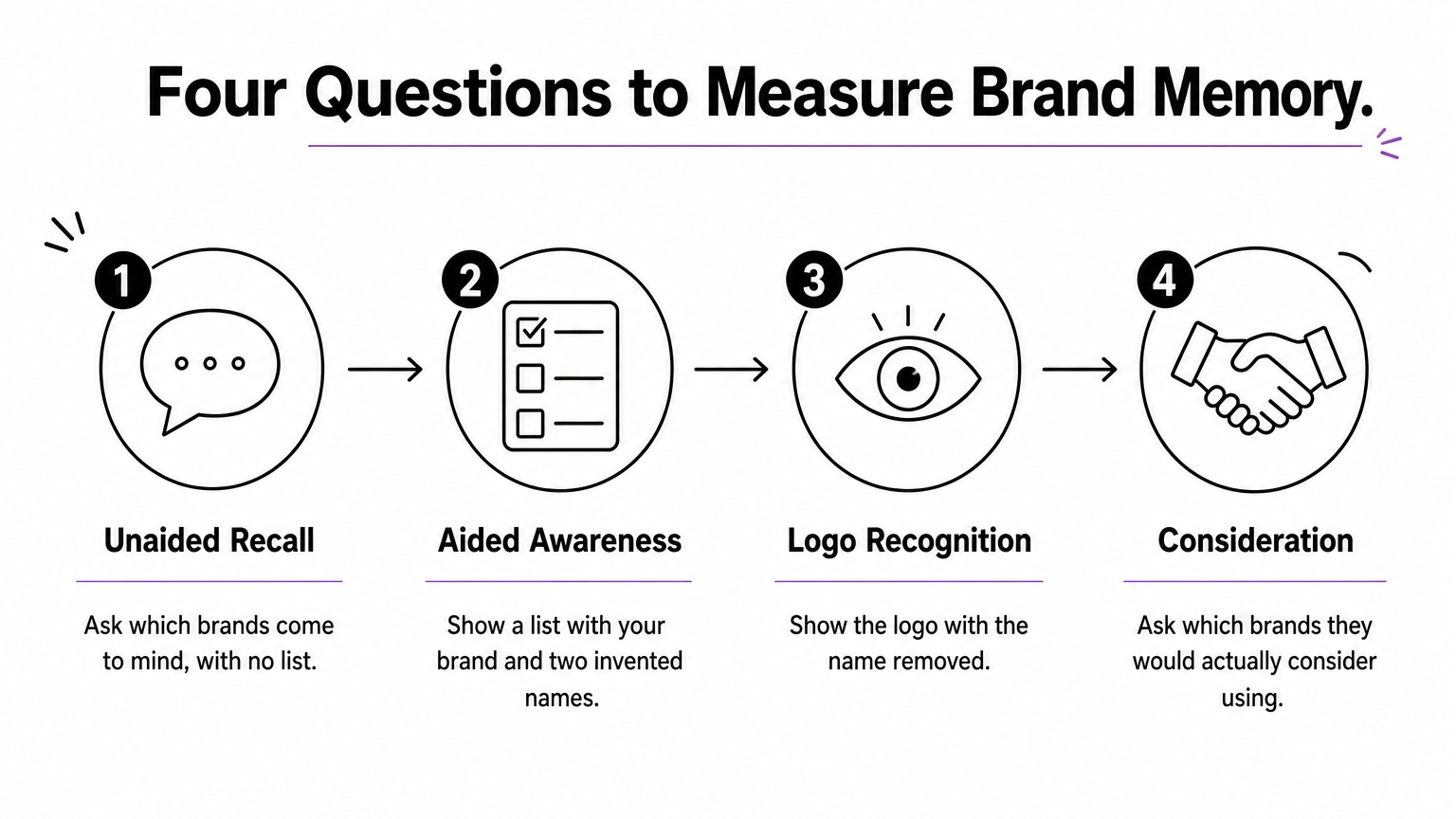
- Unaided recall: "When you think of [your category], which brands come to mind?" Use an open text box with no list. Count how many respondents name you, and how many name you first.
- Aided awareness: Show a list that includes you, your competitors and one or two brands that do not exist. Ask which they have heard of. The invented names expose people who tick everything.
- Logo recognition: Show your logo with the name removed and ask which brand it belongs to.
- Consideration: Ask which of the brands they would consider using. This links awareness to purchase intent.
Your recall rate is a simple percentage.
Recall rate = (respondents who named your brand / total respondents) x 100
Survey people who actually buy in your category, and aim for a few hundred responses if you can. A handful of friendly clients tells you very little, because they already know you.
Track proxy signals between surveys
Surveys are slow, so use brand awareness measurement tools to watch these signals in the months between them:
- Branded search: Queries that contain your company name, visible in Google Search Console and compared over time in Google Trends.
- Direct traffic: People typing your address or opening a bookmark, which points to recall.
- Social and media mentions: Tagged posts, LinkedIn follower growth and the number of articles that name you.
- Source questions: A "How did you hear about us?" field on enquiry forms.
These move with awareness but can also be pushed by campaigns or seasonality. Read them as direction, not a score.
Read the results
A recall rate of 12% means little alone, so compare yours with two or three competitors and with your own previous result. Then look at the gap between aided and unaided numbers. High aided awareness with low unaided recall means people know you but do not link you to the category, which is a messaging problem. Low numbers on both mean a reach problem.
Keep the audience, wording and timing identical from one round to the next, ideally once or twice a year. Otherwise you cannot tell whether the market changed or your survey did.
A recall score only means something when you can compare it with a competitor and with your own last result.
How to build recognition and recall in your market
Build recognition through consistency and recall through repetition tied to one clear idea. Recognition needs a familiar look. Recall needs a familiar reason to think of you.
Make your brand easy to recognize
Use the same name, logo, colors and tone everywhere your audience meets you: website, LinkedIn, email signatures, press releases and event materials. Consistency is what turns repeated exposure into familiarity. A company that looks different on every channel resets its audience’s memory each time.

A one-page brand sheet helps. It lets staff, freelancers and partners follow the same rules without asking, so every touchpoint reinforces the last one.
Tie your name to one need
Recall grows when your name is repeatedly attached to a specific problem. Pick the one thing you want to be remembered for and say it in every channel. Earned media helps more than advertising alone here. When a trade publication quotes your spokesperson on a topic, readers connect you with that topic, and a third-party voice adds credibility.
Practical moves that compound over time:
- Offer expert comment to trade and business media on news in your field.
- Publish opinion pieces under a named leader rather than the company name.
- Keep leadership LinkedIn posts to two or three recurring themes.
- Coordinate media attention around events so the coverage outlasts the day.
People remember a brand that keeps saying one thing, not one that says many things once.
The short version
Brand awareness is the overall picture. Recognition is identifying you when prompted, and recall is naming you when nobody helps. Recall is harder to earn, and it is the one that puts you on the shortlist in categories where buyers must go looking.
Measure all three with a short, consistently run survey, back it with branded search and mention data, and use the gap between aided and unaided results to decide whether you need more reach or sharper messaging.
If you want help turning a familiar name into one that buyers remember, talk to Purple Word Box about media coverage and brand visibility for your business.