

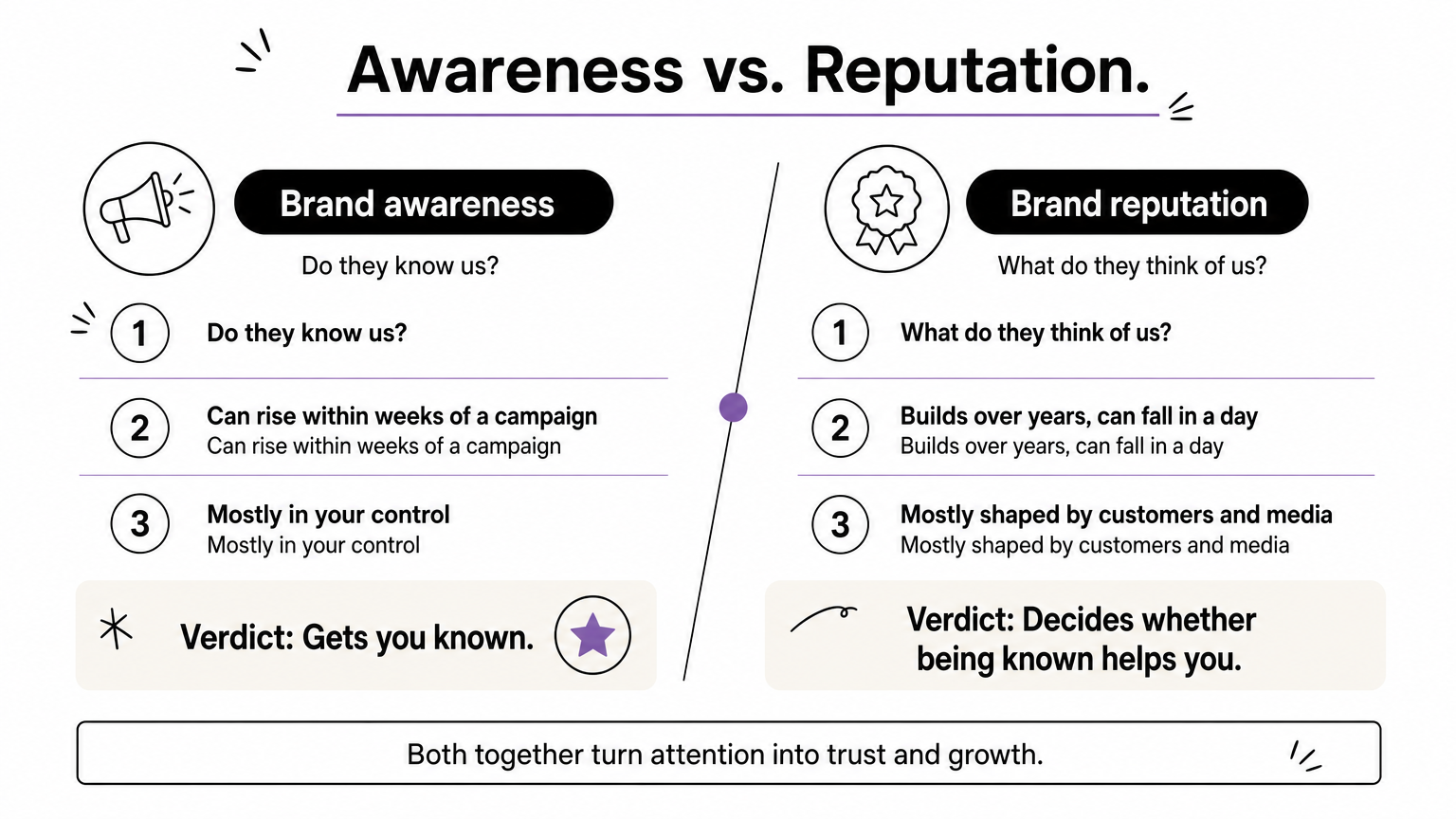
Brand awareness and reputation describe two different things. Brand awareness is how familiar your target audience is with your business: whether they recognize your name or logo and think of you when your category comes up. Brand reputation is what those people believe about you, shaped by their own experience, reviews, media coverage and what others say. Awareness gets you known. Reputation decides whether being known helps you.
At Purple Word Box, a South African PR and communication agency, we work on both every day. Media coverage, thought leadership and a clear message raise awareness, but the same activity also shapes how credible you look. That overlap is why the two ideas are so often confused.
This article explains why both matter for customer trust and growth, how they differ and feed each other, how to build them together, and how to tell whether your efforts are working.
Why brand awareness and reputation matter for growth
Awareness and reputation matter because customers only buy from businesses they know and trust, and you need both before a stranger becomes a client.
Awareness gets you considered, reputation gets you chosen
Buyers can only choose from the businesses they can think of. Brand awareness puts your name on that list, whether the buyer is a procurement manager searching for a supplier or a consumer asking friends for a recommendation. If your name never comes up, the quality of your work never gets judged.
Reputation does the judging. Brand reputation is the accumulated answer to one question: can I trust this business? People check Google reviews, ask colleagues, scan your LinkedIn page and read what the press has said about you. A strong reputation supports referrals, repeat business and less pressure to discount, while a weak one slows every sale.
What happens when one is missing
Each combination of the two creates a different problem, which tells you where to invest first.
| Situation | What it looks like | Result |
|---|---|---|
| High awareness, weak reputation | Many people know you, and many have complaints | Visibility works against you |
| Low awareness, strong reputation | Clients rate you highly, but few outside that circle have heard of you | Growth depends on slow word of mouth |
| Low awareness, weak reputation | Unknown and unproven | Every sale is a hard sell |
| High awareness, strong reputation | Known and trusted | You are shortlisted and chosen |
Many small and mid-sized businesses sit in the second row. They do good work, but the market around them has never heard about it. That is a PR problem as much as a marketing one.
Awareness gets you onto the shortlist, and reputation decides whether you stay on it.
How brand awareness and reputation differ
Brand awareness measures how well people know you, while brand reputation measures how they judge you. The first is largely in your hands, and the second is decided by other people.
Side-by-side comparison
The table shows where the two concepts split, which matters because they need different work and different metrics.
| Brand awareness | Brand reputation | |
|---|---|---|
| Core question | Do they know us? | What do they think of us? |
| Made of | Recognition and recall | Experience, reviews, coverage, word of mouth |
| Built mainly through | Media coverage, content, social media, events, advertising | Service quality, consistent delivery, feedback, how you handle problems |
| Speed | Can rise within weeks of a campaign | Builds over years and can fall in a day |
| Who controls it | Mostly you | Mostly your customers and the media |
| Measured by | Branded searches, reach, recall surveys | Ratings, sentiment, referrals, trust scores |
Speed and control are the differences that matter most in practice. You can buy or earn attention quickly, but you cannot buy a good name.
How they feed each other
Awareness exposes your reputation to more people, so a business with a weak reputation that raises awareness simply spreads the problem faster. A strong reputation does the opposite. It makes every awareness effort convert better, because people who meet your name already have reasons to trust it.
Media coverage is the clearest bridge between the two. A story about your business in a respected publication builds recognition and also acts as third-party endorsement. That is why PR sits between marketing and reputation management rather than inside either one.
Awareness spreads whatever your reputation already is, so fix the reputation before you amplify it.
How to build brand awareness and reputation together
Build both by deciding what you want to be known for, repeating that message through credible channels, and delivering on it every time someone deals with you.
Decide what you want to be known for
Write down three things: who you serve, what you do better than the alternatives, and the proof you have. Keep claims you can back with results, such as client outcomes or years of experience, and drop the generic ones. A message that is specific and true is easier for people to remember and harder for competitors to copy.
Earn visibility through media and thought leadership
Paid reach rents attention, while earned coverage builds credibility at the same time. Look for the stories in your business that a journalist would want: a market insight, a client result, an expert opinion on a news event. Then package them professionally and pitch them to the right media. This is how Purple Word Box helped TreasuryONE gain mainstream media recognition in its market.

Put your leaders in front of people as well. Opinion articles, LinkedIn posts and interviews let executives show expertise, which builds recognition and trust together. Spokespeople need practical media training first, because one poor interview can undo months of work.
Back it up with consistent delivery
Reputation is built by what happens after the promise. Four habits cover most of it:
- Ask for a Google review after every completed project or sale.
- Reply to every review, good or bad, within a few days.
- Brief your staff so what they say matches your marketing.
- Prepare a holding statement for problems before you need one.
You build reputation in the delivery, and PR makes sure the right people hear about it.
How to measure brand awareness and reputation
Measure awareness with reach and recall signals, measure reputation with sentiment and trust signals, and review both quarterly so you see which one needs attention.
Signals that show where you stand
You do not need expensive software to start. These sources are enough for most businesses.

| Signal | Where to find it | What it tells you |
|---|---|---|
| Branded search volume | Google Search Console, Google Trends | More people are looking for you by name |
| Direct website visits | Your analytics tool | People remember and return without a prompt |
| Unaided recall | A short survey: "Which suppliers in this field come to mind?" | Whether you are on the shortlist |
| Review ratings and themes | Google Business Profile, industry sites | What customers praise and complain about |
| Tone of media coverage | Your own coverage log | Whether the press frames you positively |
| Referral and win rate | Your CRM or sales records | Whether trust turns into revenue |
Read the numbers together
Never read one metric alone. Imagine a company runs a three-month media campaign, and branded searches rise from 200 to 320 a month. That is a 60% increase in awareness. If its Google rating holds at 4.6, the reputation is carrying the extra attention well.
If the rating drops while searches climb, the campaign is working on awareness but exposing a delivery problem. Fix the service issue before you spend more on promotion.
Rising awareness with falling ratings is a warning, not a win.
Make the name you build worth knowing
Brand awareness gets people to recognize you, and reputation gives them a reason to trust you. They differ in speed, control and measurement, but they work as a pair, and media coverage, clear messaging and consistent delivery strengthen both at once.
If you want senior-level help earning the coverage and credibility that supports both, you can talk to Purple Word Box about PR and media relations.