

In plain terms, public relations social media work means using platforms such as LinkedIn, Facebook, X, Instagram and YouTube to build trust, share news and protect your reputation with the people who matter to your business. Public relations earns attention and credibility through journalists, partners and your own expert voice. Social media gives you a direct channel to share that story, extend its reach and hear how people respond. Used together, each makes the other stronger.
This article explains why social media matters in PR, how to build it into a PR strategy step by step, and what each major platform is good for. You will also see which tactics support media relations, how to handle reputation and crisis moments, how to measure results, and which mistakes to avoid.
We write this as a PR agency, not a platform vendor. Purple Word Box is led by Maria Joubert, who has more than 20 years of PR experience, and we work with South African businesses on both media relations and social profile-building. The advice below comes from that daily work, so it favors what a busy business can realistically run over what looks impressive in theory.
Why social media matters in public relations
Social media matters in public relations because it connects you directly with the audiences PR has always tried to reach, without waiting for a newsroom to decide your story is worth running. It also makes your reputation visible, searchable and fast-moving, which raises the stakes for how you communicate.
How social media changed PR
Before social platforms, a PR plan depended on a small group of gatekeepers: newspapers, broadcasters and trade titles. A well-placed story still carries weight, but you now have owned channels that reach customers, investors and employees directly. News you release in the morning can be shared, questioned and challenged by lunchtime.
Three shifts matter most for anyone using social media for public relations:
- Speed. Messages travel in minutes, and so do rumors. You need to be ready to respond the same day.
- Two-way conversation. People reply, tag and comment in public. You can no longer issue a statement and walk away.
- Longer life for coverage. A feature that ran once in a publication can be shared again for weeks, to audiences the publication never reached.
Each shift is an opportunity and a risk. The speed that helps a product launch also helps a complaint travel. The business that treats social media and public relations as one joined-up job copes with both far better than the one that treats them as separate departments.
How PR and social media marketing differ
The two overlap, but they do different jobs. Public relations builds reputation and credibility with a wide set of audiences. Social media marketing drives awareness, leads and sales, mostly among customers and prospects. The table sets out the practical differences.
| Question | Public relations | Social media marketing |
|---|---|---|
| Main goal | Trust, credibility, reputation | Leads, sales, engagement |
| Typical audience | Journalists, investors, partners, employees, customers | Customers and prospects |
| Tone | Informative, measured, credible | Conversational, promotion is accepted |
| Typical success measure | Quality of coverage, sentiment, share of voice | Clicks, conversions, follower growth |
| Time horizon | Long term | Campaign by campaign |
In practice a single post can serve both. A LinkedIn post that shares your CEO’s interview on a business radio show builds credibility (PR) and sends readers to your website (marketing). The distinction matters when you set goals. If the goal is to be trusted as an expert, count quality and sentiment, not only likes.
Why journalists and stakeholders check your profiles
Journalists, investors and potential partners routinely look at a business’s social profiles before they respond to a pitch, book an interview or take a meeting. A profile that has been silent for a year, or that contradicts your press release, raises questions you will never hear asked. Your profiles are research material for the people you most want to impress.
This applies to individuals too. If your executives are the faces of the business, their LinkedIn profiles need a clear headline, a current photo and recent activity that shows what they know. Consistency between your website, your press material and your profiles is a quiet trust signal.
Your social profiles are part of your press kit, whether you planned it that way or not.
How to use social media in a PR strategy
To use social media in a PR strategy, start with a PR objective, choose the audiences and platforms that serve it, then run a simple, repeatable rhythm of content and conversation. Platforms come last, not first. Most weak social PR comes from starting with "we should be on TikTok" instead of "who do we need to convince, and of what?"
Set objectives that PR can own
Write each objective so that it names an audience and a behavior you can observe. "Increase brand awareness" is too loose to guide a single post. Better examples are "get our managing director quoted in two trade publications this quarter and extend each piece on LinkedIn" or "be the first place journalists look for comment on our sector."
Then map your audiences. List the groups that shape your reputation, such as journalists, customers, investors, employees and industry bodies. Next to each, note where they spend professional time and what they would find useful. That map decides your platforms, and it usually shows that two channels are enough.
Choose platforms and content themes
Pick one primary platform and one supporting platform, then plan content around a few repeatable themes. A small business that tries to run six channels usually runs all of them badly. The platform guide later in this article helps you choose.
Four content themes cover most PR needs:
- News: launches, appointments, awards, partnerships and event announcements.
- Expertise: opinion, insights, answers to questions customers keep asking, and commentary on industry developments.
- People: spokespeople, team members and behind-the-scenes moments that make the business human.
- Proof: media coverage, client results shared with permission, and event highlights.
Keep the balance in favor of expertise and proof. If most of your posts are announcements about yourself, followers learn to scroll past you.
Build a simple weekly rhythm
Consistency beats volume. A rhythm you can sustain for a year is worth more than a burst of activity you abandon after a month. This is a realistic starting point for a small team:

- Monday: one expertise post from a named spokesperson.
- Wednesday: one news or proof post, such as new coverage or a client milestone shared with permission.
- Friday: one people post, such as a team story or event preview.
- Daily, 15 minutes: reply to comments and messages, and check for mentions of your brand.
The daily conversation time matters as much as the posts. Audiences judge you by how you answer, not only by what you publish.
Assign roles and approvals
Social media PR fails quietly when nobody owns it. Name one person who runs the accounts day to day, one person who approves sensitive posts, and the spokespeople who may speak for the business. Agree how fast questions must be answered. A same-working-day response is a sensible standard for most businesses.
Decide in advance what needs escalation, such as a complaint that mentions legal action, a journalist’s query, or anything involving staff or safety. Pre-agreed rules save you from improvising when it matters.
Decide who may speak for the business, and how fast, before anyone asks them to.
What each platform does for PR
Each platform serves a different PR purpose, so choose by audience and goal, not by popularity. LinkedIn suits credibility and B2B audiences, Facebook suits community and broad reach, X suits news and journalists, Instagram and TikTok suit visual storytelling, and YouTube suits depth. The table summarizes where each fits.
Platform-by-platform guide
| Platform | Best PR use | Watch out for |
|---|---|---|
| Thought leadership, executive profiles, sharing coverage, B2B credibility | Corporate jargon and posts that read like adverts | |
| Community building, customer questions, events, paid targeting | Limited organic reach, so budget for promotion | |
| X | Breaking news, conversations with journalists, short statements | Fast-moving tone and quick escalation of mistakes |
| Visual stories, events, behind-the-scenes, creator partnerships | Needs a steady supply of good images and video | |
| TikTok | Short, informal video for younger audiences | A video-first mindset and a genuine fit with your brand |
| YouTube | Interviews, explainers, executive talks, searchable long-form content | Production effort, and the need for captions and clear titles |
Treat the table as a starting point, not a rule. A B2B software company may find LinkedIn does nearly all of the work, while a retailer may get far more from Facebook and Instagram. Look at where your own customers and journalists are already active.
How to choose for a South African business
For most South African B2B businesses, LinkedIn is the first channel to get right. It reaches decision-makers, executives and the journalists who cover business and technology, and it rewards the expertise-led content that PR produces. Businesses that sell directly to consumers usually add Facebook and Instagram, where customers already ask questions and share opinions.
Do not try to be everywhere. Start with one or two platforms, run them well for three months, and review what the numbers and the conversations tell you. Adding a channel later is easy, but abandoning a neglected one in public looks careless.
Choose platforms by where your audiences already pay attention, not by what is fashionable.
Social media tactics that support media relations
The most effective tactics use social media to research journalists, extend the life of your coverage, and show your expertise between media moments. Social platforms do not replace media relations. They make each pitch better informed and each result last longer.
Research and pitch journalists
Follow the journalists you want to reach and read what they post for a few weeks before you pitch. Social profiles show what they are covering now, which angles they dislike, and when they ask for sources or comment. That is more current than any media list.
Before you pitch, check these points:
- What they have published or shared in the past month.
- Whether they have asked for experts or case material publicly.
- How they prefer to be contacted, as many state this in their bio.
- Whether your story fits their audience, not only their topic.
Engage genuinely before you pitch, for example by commenting thoughtfully on their work. Do not send pitches through social direct messages unless the journalist has said that is welcome. Email remains the norm for most newsrooms.
Amplify your coverage
When coverage lands, share it quickly and well. Tag the journalist and the publication, add one sentence on why the piece matters to your audience, and link directly to the article. A pull quote or a short video clip from the interview often performs better than a bare link.

Then reuse the coverage. Share a different insight from the same piece a few weeks later, add it to your email signature or newsletter, and feature it on your website. Coverage that is shared once is wasted compared with coverage that is worked for a month.
Thought leadership on LinkedIn
Thought leadership means sharing knowledge that helps your audience, not promoting yourself. A founder who explains how a new regulation affects their customers, or an engineer who explains a trend in plain language, builds credibility that no advert can buy. It also gives journalists a reason to quote you.
This is where many busy leaders struggle: they have the expertise but not the time to write. Our Social & Profile service covers LinkedIn profile management and thought leadership posts, and our PR work then connects those posts to media pitches and placed articles. Whoever writes the posts, they must sound like the person whose name is on them.
Influencers and user content
Creators and customers can carry your story to audiences that follow them more closely than they follow you. Choose people whose audience matches yours, give them room to speak in their own voice, and avoid scripting them tightly. Smaller creators with a niche following often suit local and specialist businesses better than very large names.
Paid and gifted relationships must be disclosed clearly. In South Africa the Advertising Regulatory Board’s code applies to social media content, and its guidance expects paid or gifted endorsements to be identifiable. Disclosure protects both you and the creator, and audiences react badly when hidden arrangements surface.
Social media does not replace media relations. It makes every pitch better informed and every result last longer.
Reputation, listening and crisis response
Social media gives you an early warning system for reputation problems if you actually listen, and a fast, public way to respond if a crisis hits. Speed matters, but accuracy matters more. A quick wrong answer does more harm than a slightly slower correct one.
Listen before you need to respond
Social listening means tracking what people say about you, your spokespeople, your products and your competitors. Set it up on the first day. Search for your business name and common misspellings, your executives’ names, your product names, and the hashtags your industry uses. Free tools such as Google Alerts and the native search on each platform are enough to start, and paid monitoring tools add depth later.
Review what you find weekly. Look for repeated questions, which suggest content you should publish, and repeated complaints, which suggest an operational problem PR cannot fix with a post. Patterns matter more than single comments, and they often reach you through social channels before they reach customer service.
A crisis response in five steps
When something goes wrong in public, work through the same sequence each time. A written version of it, agreed in advance, stops people improvising under pressure.
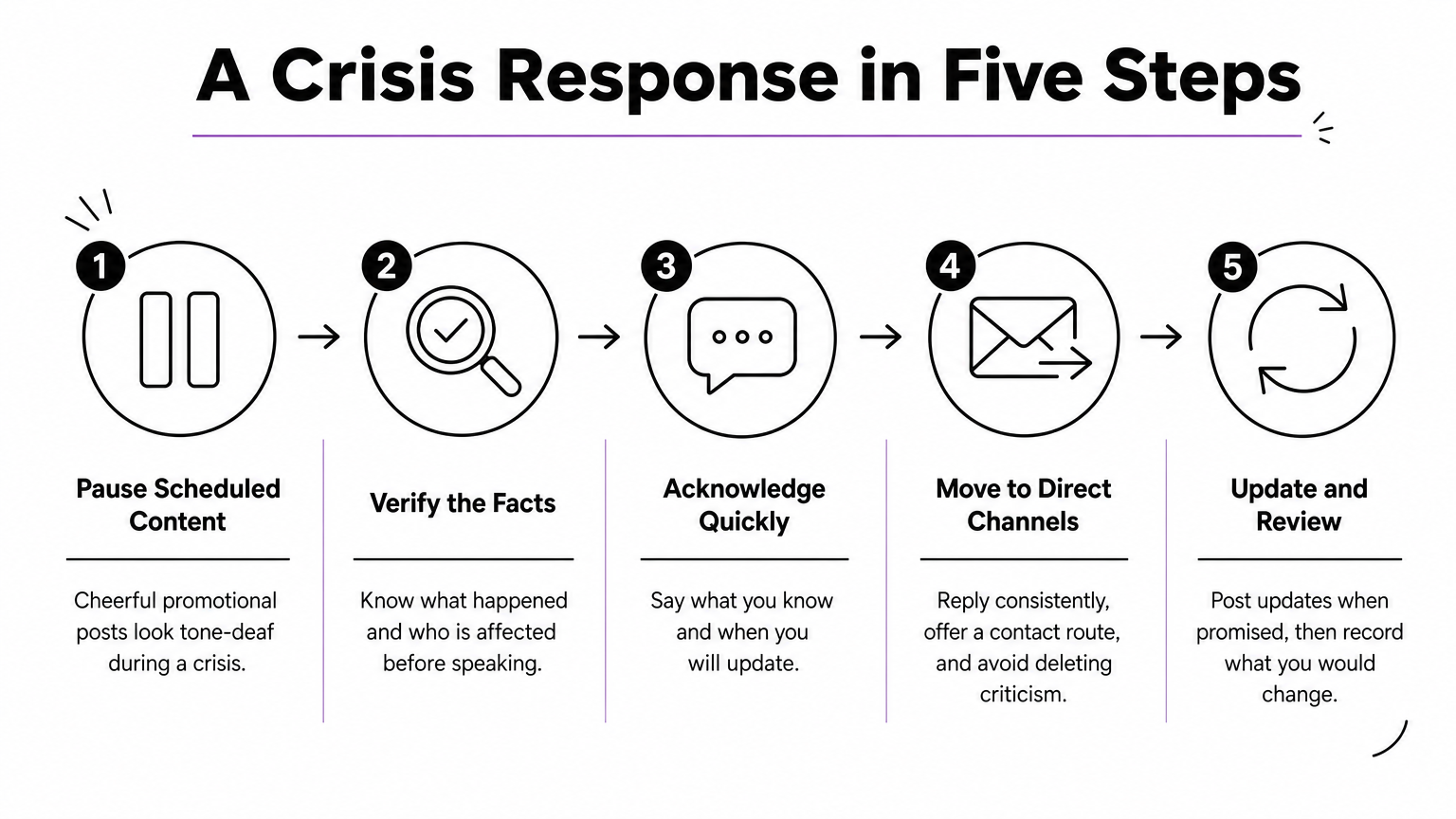
- Pause scheduled content. A cheerful promotional post in the middle of a crisis looks tone-deaf.
- Verify the facts internally. Know what happened, who is affected and what you can say before you say anything.
- Acknowledge quickly. Say what you know, what you are doing and when you will update people. Do not speculate.
- Move detailed conversations to a direct channel. Reply to comments consistently, offer a contact route, and avoid deleting criticism unless it is abusive or unlawful.
- Update and review. Post updates at the time you promised, and afterwards record what you would change.
The same speed that makes social media dangerous in a crisis also makes it useful. A calm, factual statement posted early often shapes how journalists frame the story.
In a crisis, a calm and accurate first statement beats a perfect one that arrives late.
How to measure social media PR results
Measure social media PR against your PR objectives, not against follower counts. The right metrics show whether the right people saw your message, engaged with it and acted on it. Choose a handful, track them monthly, and compare each period with the last.
Metrics that matter
Group your metrics by the goal they serve:
| Goal | Metric | Where to find it |
|---|---|---|
| Awareness | Reach, impressions, branded search interest | Platform analytics, Google Search Console |
| Engagement | Comments, shares, saves, engagement rate | Platform analytics |
| Reputation | Sentiment of mentions, tone of coverage | Social listening, manual review |
| Media outcomes | Coverage secured, journalist replies, inbound media requests | Your own log |
| Business impact | Referral traffic, enquiries after posts | Website analytics, enquiry forms |
Likes are the weakest signal on that list. A smaller number of comments from journalists, customers or partners is usually worth more than a large number of casual reactions.
A worked example
Take a South African software company that earns a feature in a trade publication, and the managing director shares it on LinkedIn. Over 14 days the post records 8,000 impressions and 240 reactions, comments and shares. That gives an engagement rate of 240 divided by 8,000, which is 3.0 percent. It also records 96 link clicks, a click rate of 1.2 percent, and two enquiries that mention the article.
Now compare. If the company’s usual posts earn about 1.8 percent engagement, the coverage post performed well above normal. The two enquiries show a business effect, even though two is a small number. Trends over several months matter more than any single result, so record the figures each time and look for the pattern.
Measure what your PR objective set out to change, and ignore numbers that merely look large.
Mistakes to avoid in social media PR
The most damaging mistakes in social media PR are treating platforms as noticeboards, going silent after a launch, and reacting without checking facts. Most of them come from rushing, and most can be avoided with a short checklist.
Common mistakes
Watch for these patterns, which we see most often:
- Pasting press releases straight into posts. Rewrite for the platform and lead with what matters to the reader.
- Posting everywhere and answering nowhere. Fewer channels, answered promptly, beat many channels left to run themselves.
- Over-automating. Scheduling is fine, but an unattended account looks careless the moment someone comments.
- Jumping on news without thought. Join a topical conversation only if you have something useful to add and it is not insensitive.
- Deleting criticism. Answer it, or take it offline, unless it is abusive.
Legal and ethical checks
Check facts before you post. Misinformation spreads quickly, and a business that shares an unverified claim, even in good faith, damages its own credibility. Name sources, and correct errors openly and promptly.
Get permission before you use a client’s name, logo, quote or image. If you run competitions or collect people’s details through social channels, treat that information in line with South Africa’s data protection law, POPIA. Disclose paid and gifted partnerships, as covered earlier. When in doubt, ask for advice before you publish, not after.
Putting it into practice
Social media and public relations work best as one plan. PR earns the credibility and the stories, and social media carries them to the right people, gives you a voice between media moments, and shows you how audiences react. Start with a clear objective, choose one or two platforms, keep a rhythm you can sustain, and measure what your objective was meant to change.
You do not need to do everything at once. A single well-run LinkedIn presence, a clear approval process and a habit of sharing every piece of coverage will put you ahead of most businesses in your market.
If you would like senior-level help with the plan, the content or the media relations behind it, talk to Purple Word Box about your PR and social media needs.