The best press release for event example is one that answers who, what, when, where and why in its first paragraph, adds a quotable line, and ends with a media contact. Match the format to the stage of your event. Use an announcement if you want registrations, a conference release if you have a speaker line-up, a post-event recap if something newsworthy happened, and a media invitation if you want journalists in the room.
Most people searching for an example already know what a press release is. What they lack is a finished model to adapt, and generic advice about "being newsworthy" does not help at 4pm when the release is due. This article gives you four formats, each with a short guide to when it fits and a fill-in sample you can copy straight into a document.
At Purple Word Box, we write press releases and support PR-focused events, from media coordination to branded event materials. The samples below follow the structure that journalists respond to in practice: a headline that states the news, facts up front, and detail in descending order of importance.
1. Upcoming event announcement
An announcement tells journalists and your audience that an event is happening, why it matters and how to attend. It suits any upcoming event where you want coverage before the day, from a client breakfast to a roadshow.
When to use it
Send it three to four weeks before the event, then a short reminder a week out. Journalists need time to plan, and your audience needs time to register.
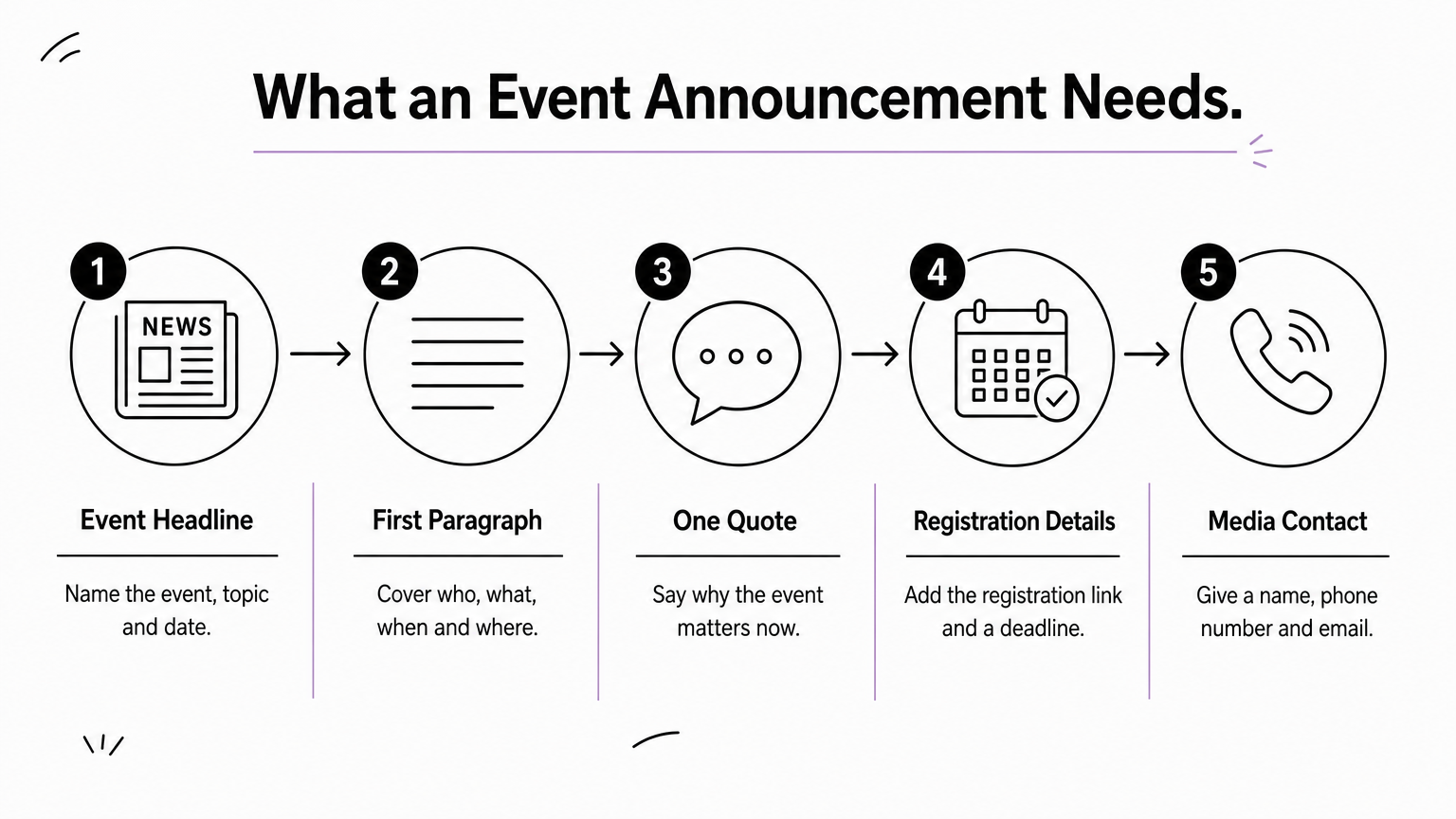
Include these elements:
- A headline with the event name, topic and date
- A first paragraph covering who, what, when and where
- One quote on why the event matters now
- Registration details and a deadline
- A media contact
Sample text
Replace each bracket with your own details:
FOR IMMEDIATE RELEASE

[Company name] to host [event name] on [date] in [city]

[City, Province], [release date] - [Company name] will host [event name], a [format, e.g. half-day breakfast] for [audience], on [date] at [venue], from [start time] to [end time].

The event will explore [topic], including [two or three specific themes]. [Speaker name], [title] at [organization], will open with [talking point].

"[Quote explaining why the event matters now]," said [name, title].

Attendance is [free / by registration / R amount per ticket]. Register at [link] before [deadline].

About [Company name]
[Two sentences on the company.]

Media contact: [name, phone, email]
How to adapt it
Write the headline last. State the news, not the name. "Cybersecurity breakfast for SME owners on 12 March" gives a journalist more to work with than "Annual Breakfast announced."
Keep the release to one page. Give the registration link and deadline their own line so a reader can act without hunting for them.
A good announcement lets a journalist answer who, what, when, where and why from the first paragraph alone.
2. Conference press release
A conference release carries more detail than a single-event announcement, because the theme, speakers and expected delegates are the news. Use this version for any multi-session event with a published program.
When to use it
Issue it when you have a confirmed speaker line-up or a clear theme, and again when a major speaker is added. If you are writing from scratch, gather this first:
- The theme and why it matters this year
- Two or three named speakers with titles
- Expected delegate numbers and sectors
- Ticket tiers and early-bird deadlines
- How accredited media can request passes
Sample text
This structure works for a conference press release example of any size:
[Conference name] returns on [dates] with [number] speakers and a focus on [theme]

[City, Province], [release date] - [Conference name], the [annual / biennial] gathering for [industry] leaders, will take place at [venue] on [dates]. This year's theme is [theme].

Keynote speakers include [name, title] and [name, title]. The program covers [three session topics], with [number] delegates expected from [sectors].

"[Organizer quote on why this year's theme matters]," said [name, title].

Early-bird tickets are available until [date] at [link]. Accredited media can request passes from [contact name and email].

About [Conference name]
[Two sentences on the conference history and audience.]
How to adapt it
Speaker names earn coverage, so lead with the strongest name or the freshest theme. A line such as "Conference to examine how AI is changing client reporting" beats "Conference returns."
Do not paste the full agenda. Link to it, and keep the release to the three points a trade journalist would put in a news brief. Add a separate media section with accreditation details, since reporters scan for it.
In a conference release, the speakers and the theme are the story, and the schedule is just a link.
3. Post-event recap
A post-event release turns a finished event into news by reporting what was said, found or decided. It works when something happened worth reporting, such as a panel debate, a survey reveal or a launch.
When to use it
Send it within 24 to 48 hours of the event. After that, the moment has passed and journalists have moved on.
Gather these before you write:
- An attendance figure
- The single most newsworthy finding or statement
- A quote from a speaker or attendee
- Two or three photos with captions
- The date of your next event
Sample text
Use this post event press release example as your skeleton:
[Event name] draws [number] attendees and highlights [key finding]

[City, Province], [release date] - [Company name] hosted [event name] on [date] at [venue], where [number] [audience] heard from [speaker names] on [topic].

Key takeaways from the day:
- [Takeaway one, with a number or specific claim]
- [Takeaway two]
- [Takeaway three]

"[Quote reflecting what was learned or decided]," said [name, title].

[Company name] will host the next [event] on [date]. Photos and speaker highlights are available at [link].

Media contact: [name, phone, email]
How to adapt it
Do not write a thank-you note. Lead with insight, not attendance. "Event draws 200 guests" is a footnote, while "Panel warns that most local SMEs have no incident plan" is a headline.
Attach two or three high-resolution photos with captions that name the people shown, left to right. Trade titles and local outlets often run a recap only when a usable image comes with it.
A recap earns space only when it reports something that was said or found, not the fact that you held an event.
4. Media invitation for a launch or briefing
A media invitation is a short, scannable notice that asks journalists to attend in person or online. It is the right format for product launches, media briefings and executive interviews, where you want reporters present rather than just informed.
When to use it
Send it one to two weeks ahead, then follow up with a personal email or call a few days before. Keep it under 150 words and make it easy to answer yes.
Include these elements:
- What, when, where, who and why in labeled lines
- Which spokespeople are available for interviews
- Photo or video opportunities
- An RSVP deadline and contact
- Any embargo terms
Sample text
Here is a press release for an upcoming event example in invitation form:
MEDIA INVITATION

[Company name] invites media to the launch of [product or topic] on [date]

What: [One-line description of the event]
When: [Day, date, start and end time]
Where: [Venue, address, or online link]
Who: [Spokespeople available for interview]
Why it matters: [One-sentence news hook]

Journalists are invited to attend, photograph the launch and interview [names]. Please RSVP to [name, email, phone] by [date].

Embargo: [Details, or "None"]
How to adapt it
The "why it matters" line does the selling. Write it as a finding or a first, such as "the first locally built payment tool for informal traders," rather than "an exciting new product."
If a journalist cannot attend, offer an interview slot or a briefing note instead. That keeps the story alive for people who cannot be in the room.
An invitation is not a short press release, it is a reason for a journalist to clear a slot in their diary.
Pick the format, then write it
Match your release to the stage of the event. Announce early to drive registrations, issue a conference release once speakers are confirmed, invite media a week or two out, and send the recap within two days. In every version, put the news and the key facts in the first paragraph, add one real quote, and make the media contact easy to find.
If you would rather hand the writing to someone who does it every day, Purple Word Box writes press releases and supports events with media coordination and branded materials, with senior PR guidance throughout.