

The definition of public relations most professionals agree on is this: PR is the planned management of communication and relationships between an organization and the groups of people whose opinions affect it, with the aim of earning understanding, trust and support. It is about reputation. You build it through what you do, what you say and what others say about you, not by buying ad space.
Professional bodies word the idea differently. PRSA calls PR a strategic communication process, IPRA calls it a management practice, and CIPR calls it the discipline that looks after reputation. This article puts those definitions side by side, explains why the wording matters to a business, shows how to apply PR in practice and separates it from advertising and marketing.
Purple Word Box is a South African PR and communication agency led by Maria Joubert, who has more than 20 years of PR experience. The explanations below reflect how PR works when you do it for real businesses, with real media and real deadlines.
Why the definition of public relations matters
The definition matters because it decides what you expect from PR, what you pay for and how you judge the results. A business that treats PR as free advertising will be disappointed. A business that treats it as relationship management gets lasting credibility.
It sets realistic expectations
PR earns attention instead of buying it. A journalist covers your story because it is useful to their audience, not because you paid. You do not control the headline, the angle or the timing. In return, readers trust coverage more than an advert, and the results build over months as your relationships grow.

The word "publics" in nearly every definition also tells you that PR is not only about the media. Your publics include customers, employees, investors, partners, regulators and your local community. The media is a channel to those groups, not the goal itself.
PR is earned trust with specific audiences, so you cannot buy it and you cannot rush it.
What a vague definition costs you
Businesses that think PR means press releases tend to send out announcements nobody cares about. They then judge the work by the wrong measure, such as expecting a sales spike within 30 days of one article. Better measures are the quality and relevance of coverage, how often your spokespeople are quoted in your industry, and enquiries from people who have read about you.
The same mistake leads companies to hire PR only when a crisis hits. Definitions describe a "sustained" and "planned" effort for a reason. The reputation you build before a problem is what protects you when one arrives.
How professional bodies define public relations
The best-known professional definitions come from PRSA in the US, IPRA internationally and CIPR in the UK. All three describe relationships and reputation, but each stresses something different.
Three definitions side by side
| Body | How it defines PR | What it stresses |
|---|---|---|
| PRSA (Public Relations Society of America) | "A strategic communication process that builds mutually beneficial relationships between organizations and their publics" | Strategy and mutual benefit |
| IPRA (International Public Relations Association) | "A decision-making management practice tasked with building relationships and interests between organisations and their publics" | Management and decision-making |
| CIPR (Chartered Institute of Public Relations) | "The discipline which looks after reputation, with the aim of earning understanding and support and influencing opinion and behaviour" | Reputation and influence on behaviour |
An older definition that is still widely quoted calls PR the "deliberate, planned and sustained effort to establish and maintain mutual understanding between an organization and its publics." Its wording is dated, but it shows how consistent the core idea has stayed.
What every definition has in common
Read past the wording and the same four ideas appear every time:
- Planned effort: PR is deliberate, not a reaction to events.
- Relationships: the work is about ongoing connections, not one-off announcements.
- Publics: you communicate with defined groups, each with its own concerns.
- Understanding and trust: success means people see your organization accurately and support it.
Put simply, PR is how an organization earns the trust of the people who matter to it, by communicating honestly and behaving in ways worth talking about. The differences between the bodies are about emphasis. PRSA leans on strategy, IPRA on management responsibility and CIPR on reputation.
Every definition describes planned, honest relationship-building with specific audiences, not publicity alone.
How to apply public relations in practice
You apply PR by deciding who needs to trust you, finding the story that matters to them, and reaching them through credible channels, consistently. The definition then becomes a set of concrete activities.
The main activities of PR
Most PR programs combine a handful of activities, chosen to suit the audiences you need to reach:
- Media relations: building working relationships with journalists and editors in your industry.
- Press releases and pitches: announcing news and offering stories to the right outlets.
- Thought leadership: opinion articles and interviews that show your expertise.
- Spokesperson preparation: media training so leaders stay on message.
- Profile building: LinkedIn and other social content for the company and its leaders.
- Events: media coordination and branded materials for launches and conferences.
- Issues and crisis communication: clear, honest responses when something goes wrong.
A five-step example
Take a mid-sized software company launching a new product. A sound PR approach follows these steps:
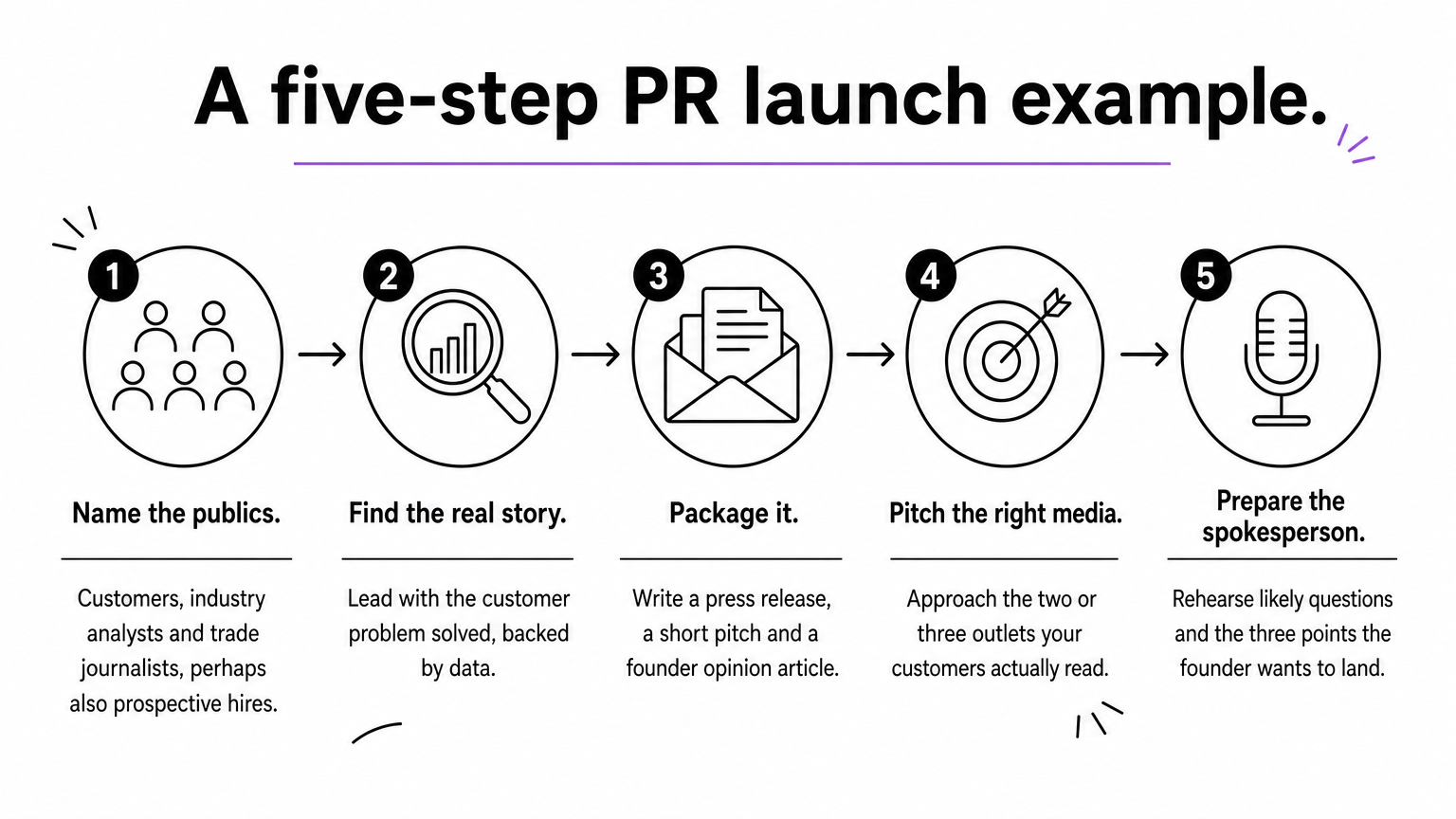
- Name the publics. Customers, industry analysts and trade journalists, perhaps also prospective hires.
- Find the real story. The launch itself is rarely news. The problem it solves for customers, backed by data, usually is.
- Package it. Write a press release, a short pitch and an opinion article from the founder.
- Pitch the right media. Approach the two or three outlets your customers actually read, not every inbox you can find.
- Prepare the spokesperson. Rehearse likely questions and the three points the founder wants to land.
A story the media wants, told by a prepared spokesperson, beats any number of unplanned announcements.
Purple Word Box handles this work through its PR & Media Relations service, which covers PR strategy, press releases, media pitches, thought leadership articles and content placements. Its Media Training service prepares leaders and executives for interviews.
How public relations differs from advertising and marketing
PR earns attention through credibility, advertising pays for attention, and marketing is the wider activity that includes both. Confusing them leads to mismatched budgets and the wrong goals.
PR compared with advertising
| PR | Advertising | |
|---|---|---|
| How you get placed | Earned by pitching a relevant story | Bought as space or airtime |
| Control of the message | Limited, as the media choose the angle | Full |
| Credibility with audiences | Usually higher, because a third party vouches | Usually lower, because people know it is paid |
| Time to results | Builds over months | Can start when the campaign goes live |
| What you pay for | Expertise and time, not placement | Space, time or impressions |

You give up control with PR, and that is exactly why people believe it. An advert says what you want. Coverage says what an independent outlet decided was worth reporting.
Where PR sits within marketing
Marketing aims to promote products and drive sales. PR has a broader brief, because it also protects your reputation with people who may never buy from you, such as regulators, employees and investors.
The two work best together. A feature article earned through PR can be shared on LinkedIn, added to your website and used in sales conversations. Treat PR as the source of credible content that your marketing then puts to work.
Putting the definition to work
Public relations is the planned, sustained effort to build understanding and trust between an organization and the people who matter to it. PRSA, IPRA and CIPR stress different things, but they agree on relationships, reputation and honest communication. That is why PR differs from advertising and why it rewards patience.
Apply it by naming your publics, finding stories worth telling, and preparing the people who will tell them. If you want senior-level help doing that, talk to Purple Word Box about your PR.