

Public relations for marketing is the practice of earning attention, credibility and trust from the people who influence your market, mainly journalists, industry voices and the wider public, so that your marketing is believed when it reaches buyers. Marketing promotes what you sell. PR shapes what people think of the business behind it.
The distinction matters because a claim lands differently depending on who makes it. When you say you are the best, that is advertising. When a respected publication quotes your expert, that is evidence. Public relations in marketing is the discipline that produces the second kind of proof. It works slowly, but the results compound over time.
This guide explains why PR matters to your marketing, how the two functions differ and overlap, how to build PR into your plan step by step, and how to tell whether it is working. Purple Word Box is a South African PR and communication agency that works with start-ups, SMEs and large corporations, so the advice here comes from day-to-day practice.
Why public relations matters for marketing
Public relations matters because it builds the trust, awareness and reputation that make every other marketing channel work harder. Without it, your ads, emails and website ask buyers to take your word for everything.
It earns trust that advertising cannot buy
Buyers discount what a company says about itself. Third-party coverage, such as a news article, an interview or an expert quote in an industry publication, carries more weight because an independent party chose to publish it. This is earned media, and it is the main thing that separates PR from paid promotion.

Trust also shortens the path to a sale. A prospect who has already seen your name in credible media arrives warmer, asks fewer basic questions and is less likely to see you as an unknown risk. That helps most in B2B and professional services, where buying is a judgement about people as much as product.
Advertising tells people what you want them to believe, and PR gives them a reason to believe it.
It builds awareness and protects your reputation
PR builds brand awareness among audiences that ads reach poorly: journalists, investors, partners and future employees. Coverage also stays findable in search results long after a campaign ends, so one good placement keeps working.
PR also protects the reputation you have built. When something goes wrong, a business with existing media relationships and a prepared spokesperson can respond quickly and accurately. A business with no groundwork has to introduce itself to journalists in the middle of a problem.
How public relations and marketing differ and overlap
Marketing aims to create demand and drive sales, while PR aims to build understanding, trust and reputation. The strongest results come when public relations and marketing share one message and one calendar.
The core differences
The table below sets the two functions side by side.
| Aspect | Public relations | Marketing |
|---|---|---|
| Main goal | Reputation, trust, understanding | Demand, leads, sales |
| Audience | Journalists, investors, employees, community, customers | Prospects and customers |
| Typical channels | Press coverage, interviews, expert commentary, events, leader profiles | Ads, email, website, social campaigns, collateral |
| Control over the message | Lower, because the journalist decides | Higher, because you control the content |
| Time to results | Slower, builds over months | Faster, easier to attribute |
| Cost model | Effort, expertise and relationships | Often media spend |
The control row is the one people underestimate. In marketing you write the copy and pay for the space. In PR you offer a story and the journalist decides whether it is worth telling, which is exactly why the result is trusted.
Where marketing and public relations meet
The two functions share a lot of raw material. A case study, whitepaper or newsletter can serve as marketing collateral for your sales team and as source material for a story pitched to a trade publication. Thought leadership posts on LinkedIn support both brand visibility and media interest, because journalists look at who is already speaking credibly on a subject.
Problems start when the functions work apart. Marketing runs a cheerful campaign while PR is handling a complaint, or the press release promises one thing and the website says another. A shared calendar and one core message prevent most of this.
How to apply public relations in your marketing plan
You apply PR by tying it to a commercial goal, finding real news and expertise to share, pitching the right media, and then reusing the coverage in your marketing.
A five-step process
Follow these steps in order. Each one depends on the one before it.
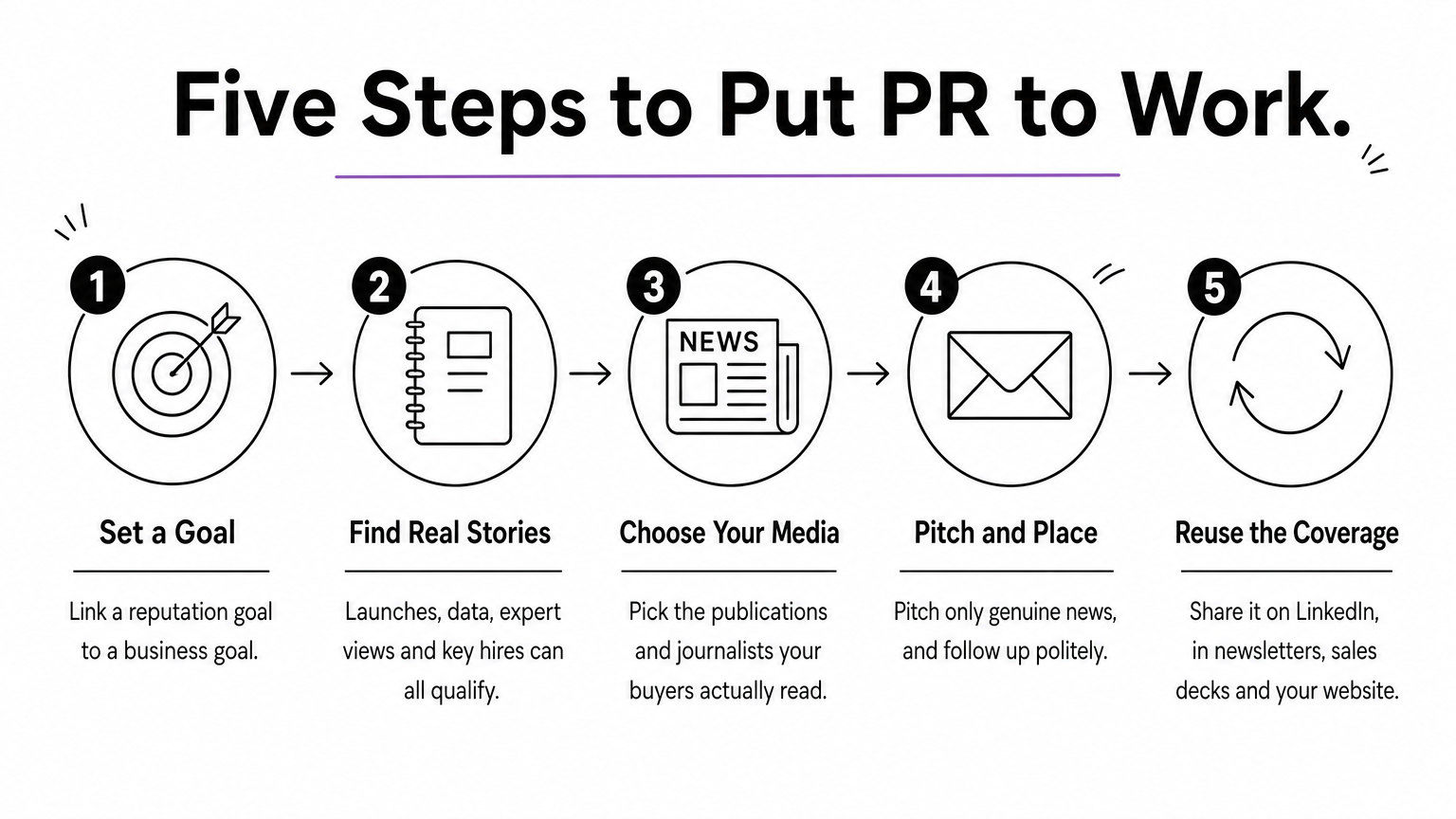
- Set a reputation goal linked to a business goal. For example, "be known as a credible voice in logistics software among finance directors" is more useful than "get more press."
- Find your real stories. Product launches, original data, an expert’s view on industry news, a client result you have permission to share and key hires all qualify. A story needs news value, not just a company announcement.
- Choose your media and audiences. Pick the publications, journalists and platforms your buyers actually read, and ignore the rest.
- Pitch and place. Send a press release only when you have genuine news. Otherwise, write a tailored pitch or offer an opinion article. Follow up politely and respect deadlines.
- Reuse the coverage. Share it on LinkedIn, add it to your newsletter, put it in sales decks and link it from your website so marketing benefits from the credibility.
PR works when you start with a story worth telling and end by putting the resulting coverage to work in your marketing.
A worked example
Take a mid-sized South African software company launching a new product. Marketing builds the landing page, runs search and LinkedIn ads and sends an email to existing customers. PR works in parallel. It identifies the story, such as a problem local businesses face that the product solves. It then pitches that angle to relevant business and technology media, offers the founder for interviews and places an opinion article on the topic.
Two months later, the company has paid reach from the campaign and independent coverage that sales can send to prospects. The coverage lifts the credibility of the ads, and the ads send more people to the content. That is how public relations and marketing compound each other.
If you want hands-on help with this, our PR and media relations service covers PR strategy, press releases, media pitches and content placements.
How to measure public relations in marketing
You measure PR by looking at the quality and effect of coverage, not just the volume. Track a small set of signals, and judge them over months rather than days.
Measures that matter
These are the signals worth tracking:

- Quality of coverage: Did the right publications, with the right readers, run the story?
- Message pull-through: Did the coverage include your key messages, or only your name?
- Referral traffic: Do visits to your website arrive from articles and mentions?
- Branded search: Are more people searching for your company name after coverage runs?
- Enquiries: Do new leads mention that they saw you in the media?
- Social engagement: Do leaders and company pages gain followers and interaction when coverage is shared?
One article in a publication your buyers read is worth more than ten mentions where they never look.
Measures to treat with caution
Be careful with advertising value equivalency, which converts coverage into what the same space would cost as an ad. It is easy to calculate, but it says nothing about whether anyone believed or acted on the story. Raw counts of mentions have the same weakness.
Instead, compare before and after on the signals above, and record what you did and when. PR rarely produces a single clear spike. It shows up as steadier enquiries, warmer conversations and stronger responses from the media.
Making PR part of your marketing
Public relations for marketing comes down to one idea: marketing makes the offer, and PR makes it believable. Treat them as partners with one message, build your PR around real stories, reuse every placement, and measure the signals that show trust is growing.
If you are a South African business that wants clear, honest PR advice from a senior practitioner, you can talk to Purple Word Box about PR that supports your marketing. Maria Joubert, who has more than 20 years of PR experience, leads the work directly.