

The practical way to approach how to enter the South African market is to test it before you commit. Pick an entry route (agent, distributor or local company), register that structure with the Companies and Intellectual Property Commission (CIPC) and the South African Revenue Service (SARS), clear import and product rules, then build local credibility. Most foreign companies start with a partner and add their own entity once sales justify it.
The problem is that the information is scattered. Trade departments, law firms and advisers each cover one slice. Most guides skip the part that often decides success: whether anyone in South Africa has heard of you. Foreign brands regularly get the legal setup right, then wait months for sales because buyers, partners and journalists do not know them.
This guide follows the order in which you will actually do the work. It starts with the decisions to make before you spend money, then walks through four steps. We are a South African PR agency founded by Maria Joubert, who worked at UK agencies for 11 years before returning home in 2011, so the last step covers what most market entry guides leave out. Rules and thresholds change, so confirm every figure with SARS and a South African adviser before you act.
Before you start: decisions to make first
Before you choose a route, settle three things: where you will sell first, whether your product is regulated, and how much you can spend before the first rand of revenue arrives. These answers shape every step that follows.
Choose where you will sell first
South Africa is not one market. Gauteng, home to Johannesburg and Pretoria, is the corporate and government hub. Western Cape around Cape Town is strong in technology and finance, and KwaZulu-Natal is anchored by the port of Durban. Business is done in English, so you do not need to translate your offer to start selling.
Pick one segment and one region for your first year. The country runs on South African Standard Time (UTC+2, with no daylight saving), which overlaps comfortably with UK working hours. That makes live calls with a European team easy.
Answer three screening questions
Work through these before you contact a single partner:
- Is your product regulated? Electrical equipment, food and health products, among others, can need approval before they are sold.
- Will you sell to government or large corporates? If yes, your supplier’s B-BBEE status (South Africa’s black economic empowerment rating) will come up in tenders and vetting.
- How much can you spend before revenue? A partner route costs far less up front than a registered subsidiary with staff.
Decide who you sell to and what rules apply to your product before you decide how to sell.
Step 1. Choose your entry route
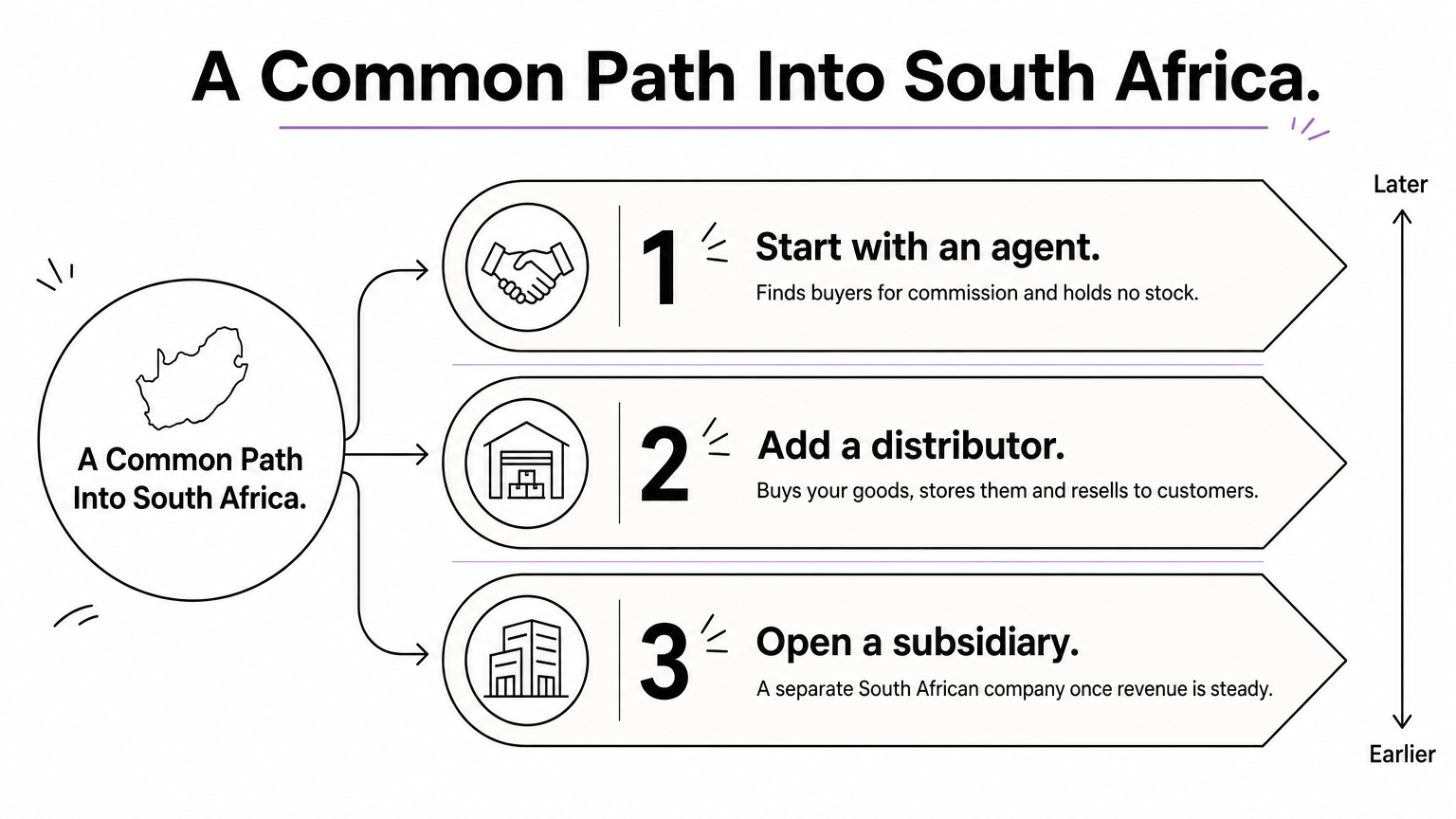
Your realistic options are an agent, a distributor, a branch of your foreign company, or a South African subsidiary. For most first-time entrants, an agent or distributor is the lowest-risk way in, because you learn the market before you build anything permanent.
Compare the four routes
| Route | How it works | Best for | Main trade-off |
|---|---|---|---|
| Agent | Finds buyers and earns commission on orders. Holds no stock. | Testing demand cheaply | Less control over how your brand is presented |
| Distributor | Buys your goods, stores them and resells to customers | Physical products that need stock and after-sales | You give up margin and some pricing control |
| External company (branch) | Your foreign company registers locally and trades as itself | Firms that want a presence without a new company | The parent is directly exposed to local liabilities |
| Pty Ltd subsidiary | A separate South African company, with foreign ownership allowed | Long-term operations, hiring, selling to corporates | More setup cost and ongoing admin |
A common path is agent first, distributor second, subsidiary once revenue is steady. If you sell software or services, you can often skip the distributor stage and go from agent to subsidiary.
Vet and contract your partner
Look for a partner with a track record in your sector, financial references and a reputation you can verify with their other suppliers. Visit in person if you can. Trade shows such as Mining Indaba or Hostex are efficient places to meet several candidates in a week.
Put everything in a written agreement. At minimum, cover territory, sales targets, the length of any exclusivity, after-sales obligations and how either side exits. Tie exclusivity to performance, so a partner who misses targets loses it.
Never grant exclusivity to a partner you have not seen perform.
Step 2. Register your business and tax status
If you trade through your own presence, register it with CIPC and SARS. A South African private company (Pty Ltd) is the usual choice for a subsidiary, while a branch registers as an external company. Registration can be done online.
Pick a Pty Ltd or an external company
A Pty Ltd needs at least one director and one shareholder, and foreign shareholders are allowed. It is a separate legal entity, which limits your parent company’s exposure. An external company registers your existing foreign company to trade locally, so there is no new entity to shield you. The Companies Act sets a deadline for registering after you begin conducting business, so ask CIPC or your adviser for the current period.
CIPC also links to SARS, so a newly incorporated company is passed to the tax authority for a tax number. Budget for annual returns to CIPC too, since a missed filing can see your company deregistered. Open a local bank account early, because partners and customers will want to pay in rand.
Understand the main taxes
The main taxes you will meet are these:
- Corporate income tax: 27% for resident companies.
- VAT: 15%. Registration is compulsory once taxable turnover passes R1 million in any 12 months, and voluntary registration is possible from R50,000.
- Employer taxes: PAYE, plus the skills development levy and Unemployment Insurance Fund contributions once you hire.
Here is a quick VAT example. You invoice a customer R100,000 excluding VAT. VAT of R15,000 is added, so the customer pays R115,000, and you pay the R15,000 over to SARS after deducting VAT you paid on your own costs. If a double tax agreement exists between your home country and South Africa, it should prevent the same profit being taxed twice.
Hire a South African accountant before you invoice your first customer.
Step 3. Clear import, product and compliance rules
Compliance in South Africa comes down to four checks: customs, product approval, foreign payments and local ownership rules. Handle them before stock ships, because a consignment stuck at the port costs money and goodwill with your first customer.
Customs, product approval and payments
Anyone importing goods needs to be registered with SARS Customs, and many foreign suppliers rely on a distributor that already holds an importer code. For regulated goods, the National Regulator for Compulsory Specifications (NRCS) may require a Letter of Authority before products can be sold. Ask the NRCS whether your product category falls under it.

Money moving in and out of the country is governed by South African exchange control, administered through the Reserve Bank and handled day to day by authorised dealer banks. Talk to your bank about paying royalties, dividends or intercompany charges before you structure them.
B-BBEE, data and trademarks
B-BBEE is scored on ownership, management control, skills development, enterprise and supplier development, and socio-economic development. It matters most when you sell to government or large corporates. Small businesses with annual turnover of R10 million or less are classed as exempted micro enterprises and can generally use a simplified sworn affidavit. Larger firms need a verified certificate.
The Protection of Personal Information Act (POPIA) governs how you handle customer data, so appoint an information officer. Register your trademark with CIPC as well, so a local partner cannot claim your brand first.
Use this pre-launch checklist:
- Importer code held by you or your distributor
- NRCS requirement confirmed for each product line
- Exchange control route agreed with your bank
- B-BBEE status or affidavit ready for tenders
- POPIA compliance and an information officer in place
- Trademark filed with CIPC
Check the rules for your product category first, because they decide your timeline.
Step 4. Build local trust and visibility
Legal readiness does not create demand. Buyers in South Africa favor suppliers they know or that peers recommend, so credibility has to be built deliberately, and public relations is the fastest way to do it.
Get your story into local hands
Most foreign brands announce themselves with a global message that means little here. Adapt it. Explain what problem you solve for South African customers, name your local partner or office, and put a named spokesperson on the ground. Journalists at national business titles, sector trade publications and online tech outlets want a local angle, not a copy of your head office press release.
Local relationships matter just as much as coverage. Introduce yourself to industry bodies, attend two or three trade events and publish views on LinkedIn from your South African lead.
Run a 90-day launch plan
Use this sequence once your entity or partner is in place:
- Month 1: Localize your messaging, prepare a South African case study or data point, and train your spokesperson for interviews.
- Month 2: Issue a launch press release naming your local partner or office, then pitch selected editors with expert commentary.
- Month 3: Publish an opinion article under your local lead’s name, share it on LinkedIn and follow up with journalists who showed interest.
We manage PR for UK and US brands that want to launch in Africa, and we are open about one limit: no agency can guarantee coverage, because editors decide what runs. What you can control is the quality of your story and the consistency of your outreach.
A well-registered company nobody has heard of will still struggle to sell.
Your next step into South Africa
Entering South Africa works best in stages. Choose a route that matches your risk appetite, register and tax your structure correctly, clear import and product rules before you ship, then build the local reputation that makes buyers say yes. Each stage protects the next one.
If you are a UK or US company preparing for launch and want help with the visibility step, talk to Purple Word Box about your South African PR plans. We will help you shape the story and get it in front of the right media.