
When a buyer needs a service, they rarely start with a long list of options. They name one or two companies they already know, and that shortlist is formed long before they search. That is what brand awareness top of mind is about, and it is why some businesses get the call while equally capable competitors never hear about the job.
Top-of-mind awareness means your brand is the first one a person names unprompted when they think of your category. It differs from aided recall, where people recognize you only after seeing your name, and from general familiarity, where they know you exist but would not think of you first, so it helps to be clear on what brand awareness means in the first place. You measure it by asking open questions, such as "Which accounting software providers can you name?", and counting how often your brand comes first.
Below, we explain how to run that survey on a small budget, how to read the results, and how to build recall through consistent media coverage, leadership visibility, and clear messaging. These are the same methods we use with South African businesses at Purple Word Box.
Why top-of-mind awareness matters for your business
Most buying decisions start from memory, not research. A procurement manager who needs a payroll provider, or a founder who needs a PR agency, first asks themselves who they already know. Brand awareness top of mind decides whether your name is part of that first answer. If it is not, you begin the race behind.
It builds the shortlist before anyone searches
A buyer in a hurry rarely compares twenty vendors. They ask a colleague, scroll LinkedIn, or search for the two or three names they already half trust. The brand remembered first gets the first conversation, and usually the benefit of the doubt in it.
Picture two IT support firms in Cape Town with similar services and prices. One has been quoted in a local business publication, and its director posts on LinkedIn every week. The other has a decent website and nothing else. When a company’s server goes down on a Monday morning, only one name comes to mind. That firm gets the call, even if the other is slightly better.
If buyers cannot name you, they cannot choose you.
It makes every other marketing effort work harder
Awareness also acts as a multiplier. People who already recognize your name open your emails, accept your calls, and read your proposals with less suspicion. Your ads, your sales team, and your website all start from a warmer position.
In practice, strong recall tends to show up in four places:
- Shorter sales cycles: prospects arrive already knowing what you do.
- Better leads: people contact you because they chose you, not because you were the cheapest quote.
- Firmer pricing: familiar brands get compared on trust, not only on price.
- More referrals: nobody can recommend a company they cannot remember.
Why it matters even more for small and mid-sized businesses
Large brands buy memory with big advertising budgets. You probably cannot, and you do not need to. Smaller South African companies can earn recall through credible media coverage, a visible leadership voice, and a clear message repeated in the same places, which is the reason media counts so much in public relations. A single well-placed article in a trade title your buyers read can do more than months of unfocused posting.
Keep one caution in mind. Top-of-mind awareness will not show up in this month’s revenue. It is a slow-building asset, and it fades when you stop feeding it. Businesses that treat it as a one-off campaign tend to be forgotten within a season, while those that show up steadily, quarter after quarter, become the default name in their category.
Top of mind vs. other types of brand recall
Marketers use "brand recall" as a catch-all term, but it covers different depths of memory. Brand awareness top of mind is the deepest level, and knowing where your brand sits on that scale tells you what kind of work comes next.
The three levels at a glance
Each level answers a different survey question, and each shows a different strength of memory. The table uses a payroll software example.
| Level | Survey question | What the person does |
|---|---|---|
| Top of mind | "Name a payroll provider." | Names your brand first |
| Unaided recall | "Name a payroll provider." | Names your brand, but after others |
| Aided recall | "Which of these have you heard of?" | Recognizes your name from a list |
Why the gap between them is so large
Unaided recall covers any brand a person names without help. Top of mind is simply the first name on that list. Every top-of-mind brand therefore has unaided recall, but the reverse is not true.
Aided recall is the most flattering number and the least useful one. Imagine a survey where 70% of your market recognizes your name, yet only 5% name you first. Those 70% will still reach for whichever brand came to mind first when the need arises.
Recognition helps when buyers see your name, while top of mind helps when they do not.
What this means for service businesses
Product brands on a shelf can live off recognition, because the buyer sees the pack. Service firms have no shelf. A buyer who asks a colleague or types a query into Google must produce a name from memory, so recall matters more than recognition for consultancies, agencies, and professional firms.
In practice, ask both aided and unaided questions in your research and track the gap between them. A wide gap usually means people know you exist but do not link you to your category. That is a messaging problem, not a reach problem, and it changes what you fix first.
How to measure top-of-mind awareness
You do not need a research agency to get a useful reading, and the same approach applies to tracking how well your brand name is known. A short survey, a clear question, and an honest sample are enough to put a number on brand awareness top of mind for your category. The method is simple, but the details decide whether the result is worth trusting.
Ask the questions in the right order
Order matters, because every question you ask shapes the next answer. Always ask the unaided question first, before any question that names a brand. Use this sequence:
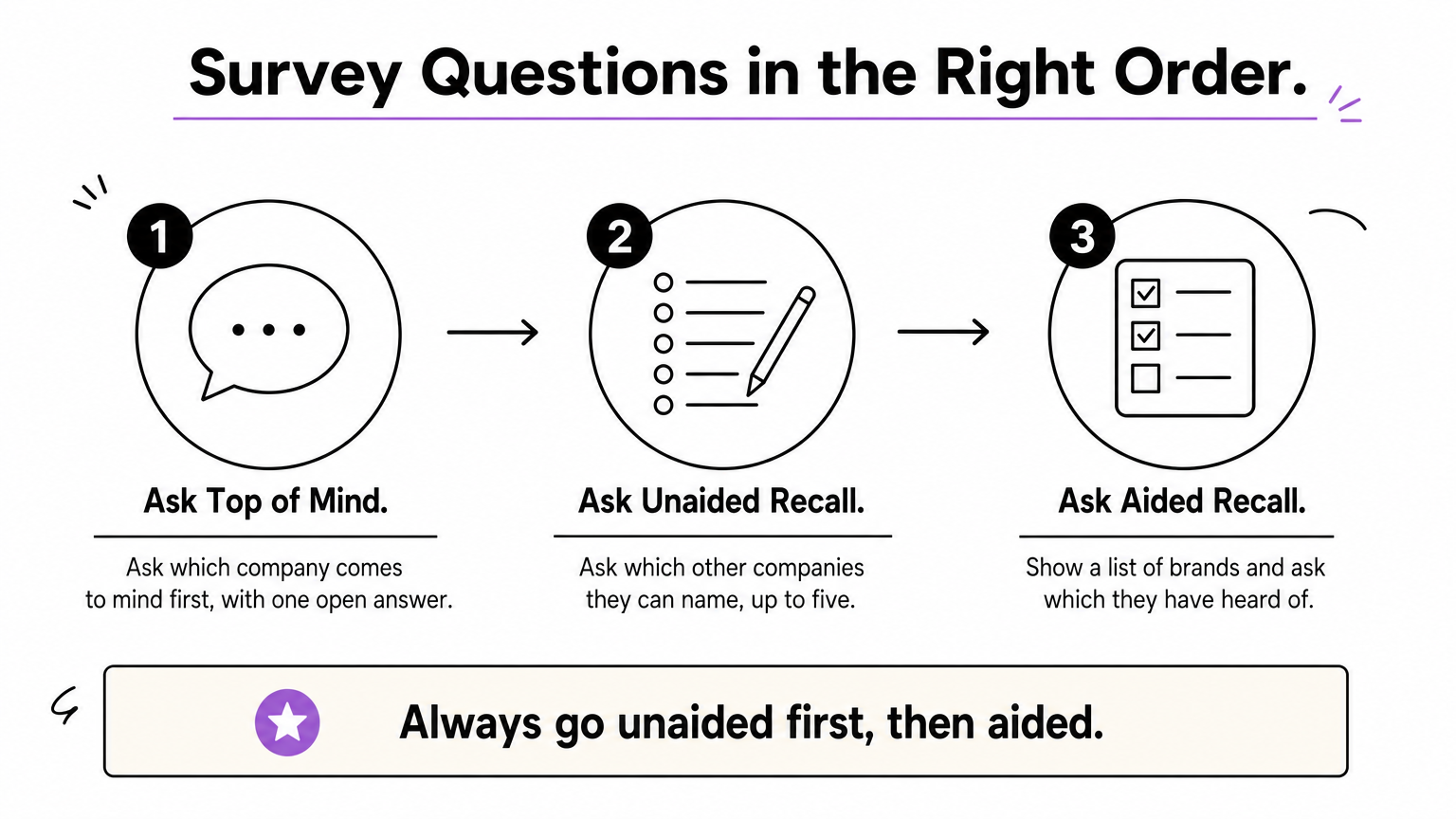
- "When you think of [your category], which company comes to mind first?" (open text, one answer)
- "Which other companies can you name?" (open text, up to five answers)
- "Which of these have you heard of?" (a list that includes you and your competitors)
The first answer gives you your top-of-mind score. The second gives you unaided recall, and the third gives you aided recall. Together they show exactly where your brand sits on the scale from the previous section.
Choose the right people to ask
Sample quality decides whether the result means anything. Survey your actual target buyers, not your staff, friends, or only existing clients, who will name you far too often. Aim for at least 50 to 100 responses. A free tool such as Google Forms works fine, and a LinkedIn post or an email to a wider industry list will usually reach enough people.
Keep the survey to three or four questions. Short surveys get finished, and long ones fill up with rushed answers.
Calculate and track your score
Scoring takes one line of arithmetic. Divide first-place mentions by total respondents.
Top-of-mind score = (people who name you first / total respondents) x 100
Example: 12 / 80 x 100 = 15%
Run the same count for your top three competitors, because a score only means something next to theirs. A 15% result is strong in a crowded category and weak in a small niche. Then repeat the survey every six to twelve months with the same wording and a similar audience.
A single score tells you little, but the trend and the gap to your competitors tell you where to act.
If your score rises after a media campaign or a run of consistent LinkedIn activity, you have evidence the work is paying off. If it stays flat, you know where to look next.
How to build top-of-mind awareness for your brand
Building brand awareness top of mind comes down to two things: being seen often, and being linked to one clear idea. Every tactic below serves one of those two goals, and sits alongside other practical ways to grow awareness for your business, so you can start with what your budget allows.
Pick one position and repeat it
Start by deciding what you want to be the first name for. "The tax adviser for freelancers" sticks in memory, while "a full-service financial firm" slides straight out of it. Narrow positioning gives buyers something to hold on to. Then use the same line on your website, LinkedIn, press releases, and proposals, because repetition is what turns a message into a memory.
Show up where your buyers already look
Next, choose channels your target buyers actually trust. For most South African B2B companies, three work best:

- Earned media: bylined articles, expert comments, and press releases placed in trade titles and business media, which is how media relations works day to day. Third-party coverage carries credibility that paid ads cannot buy.
- Leadership visibility: a founder or director who posts on LinkedIn weekly, is available as a media spokesperson, and gets help with building a leader’s online profile.
- Events and partnerships: speaking slots, panels, and media briefings and round-tables that put your name beside respected peers.
You do not need all three on day one. Pick the one your buyers pay most attention to and do it well for a full quarter.
Stay consistent, then measure again
Consistency beats intensity. A steady rhythm, such as one media placement and a few LinkedIn posts every month, builds more recall than a loud launch followed by silence. Memory fades quickly when you stop, so plan your activity by the quarter, not by the campaign.
Top-of-mind awareness is built by repetition, not by one big moment.
Finally, close the loop. Repeat the survey from the previous section after six to twelve months and compare your first-place score with your baseline. If it has moved, keep going. If it has not, check whether your message is unclear or your channels are wrong for your buyers.
Common top-of-mind mistakes and how to avoid them
Most brands that never become the first name in their category are not short on effort. They repeat a handful of predictable errors. Spotting these early saves months of work and budget, especially when brand awareness top of mind is your goal and your budget is limited.
Mistakes in how you build it
Spreading the message too thin is the most common error. A company that talks about five services, three audiences, and two taglines gives buyers nothing to hold on to. Pick one position and repeat it. If you cannot state it in a single sentence, your buyers will not be able to either.
Stopping too early is the second. Recall fades quickly, so a three-month burst followed by silence erases most of the gains. Plan for at least 12 months of steady activity and treat visibility as an ongoing habit, not a campaign with an end date.
One clear message repeated for a year beats five messages shouted for a month.
Mistakes in how you measure it
Bad measurement leads to bad decisions, and a few errors account for most of the damage. Watch for these four:
- Surveying friends and existing clients only: they name you far too often. Ask your actual target buyers.
- Asking the aided question first: a list of brand names contaminates every answer that follows. Always go unaided first.
- Changing the wording between rounds: you can no longer compare results. Keep the questions identical.
- Judging too soon: one month of activity will not move the score. Wait six to twelve months before you decide.
Fix these and your score becomes a number you can trust. You will also know whether the next rand should go into sharper messaging or wider reach.
Staying first in your customers’ minds
Brand awareness top of mind comes down to one test: when buyers think of your category, do they name you first? You now know how to measure it with an unaided survey, how it differs from aided recall, and why it pays off in shorter sales cycles and better leads. The work is not complicated. Pick one clear position and repeat it where your buyers look, then keep going for at least a year.
Most brands fail because they stop too soon or say too many things, not because they lack budget. Earned media, a visible leader, and steady messaging will move your score, and your next survey will show it.
If you want senior-level help building that visibility, talk to Purple Word Box about PR and media relations for your business and become the name your market remembers first.