

Brand awareness tracking is the practice of measuring, at regular intervals, how many people in your target market know your brand and how easily they remember it. You do it by combining a repeated survey that measures aided and unaided awareness with behavior data you already own, such as branded search, direct website visits and social mentions. A single reading tells you little. The same measures taken again every quarter or half year show a trend you can act on.
This article covers why tracking is worth the effort, how to set up a tracker step by step, which metrics deserve a place on your dashboard, and which survey and analytics methods feed them. It ends with a worked example that shows how to read two waves of data without fooling yourself.
Purple Word Box is a South African PR and communication agency, so visibility is the work we do every day. Visibility only counts when you can show it moving. The approach below is deliberately simple enough for a small or mid-sized business to run in-house.
Why brand awareness tracking matters
Brand awareness tracking matters because it is the earliest measurable sign that your marketing and PR are working. Revenue lags, and gut feel misleads. A tracked awareness number gives you evidence while there is still time to change course.

It shows whether visibility work is paying off
Without tracking, a press release, a LinkedIn push or an event gets judged by how busy it felt. With a baseline taken before the activity and a repeat reading after it, you can see whether more of your market now knows your name. Sales are a poor test of this. A buyer may hear about you today and only need your service in eight months. Awareness moves before revenue does, so it is the first place your effort shows up.
Awareness is the first number in the buying journey to move, so it is the first proof that your visibility work is working.
It catches problems before sales do
A slide in awareness appears months before a slide in revenue. A new competitor with a large advertising budget, a quiet year without media coverage or a rebrand that confused people will all show up as falling recall long before your pipeline thins. Tracking also exposes a common gap: people recognize your logo when they see it but do not think of you unprompted when they need what you sell. Those two problems need different fixes, and you only see the difference if you measure both.
How it differs from full brand tracking
Brand tracking is the wider programme. It covers awareness, perception, preference, usage, loyalty and advocacy, and it often includes a Net Promoter Score. Awareness is the first layer of that programme. For most small and mid-sized businesses, the sensible start is awareness plus one follow-on measure such as consideration, which asks whether people would shortlist you. A forty-question study that nobody has time to repeat is worth less than a ten-question tracker you run on schedule.
How to set up a brand awareness tracker
Set up your tracker in three decisions: what you are tracking and for whom, when you take the first reading, and how you keep the method identical every time after that. Get these right and the rest is routine.
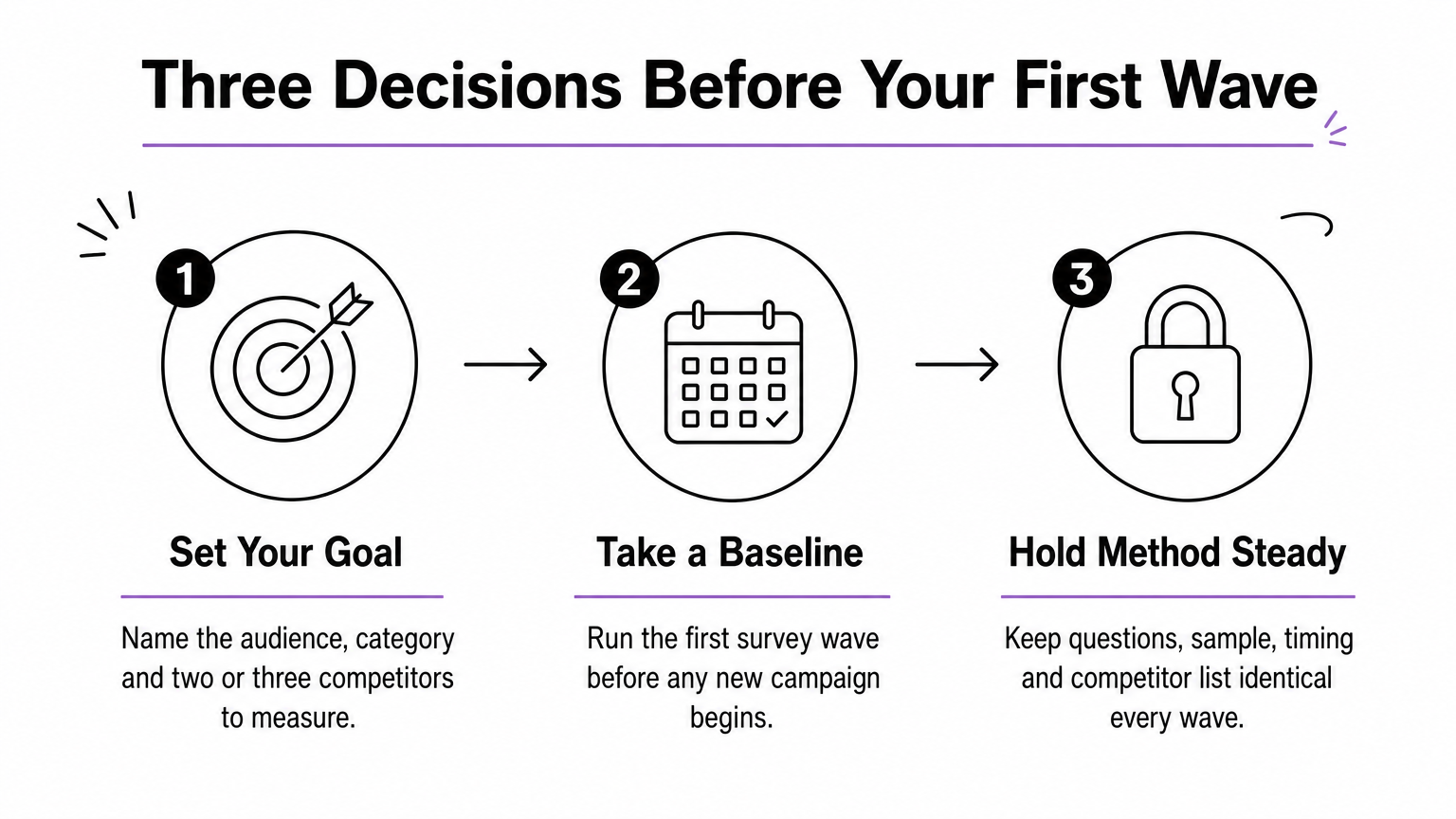
Start with a goal, an audience and a category
Write one sentence that states your goal, for example: "We want more finance directors at mid-sized South African companies to name us when asked about treasury software." That sentence fixes your target audience and your category, the two things every survey question depends on. Awareness among everyone is a vanity number. Awareness among the people who could buy from you is the one that predicts business. Decide too which two or three competitors you will measure alongside yourself, because a score of 20% means little without a comparison.
Take a baseline, then repeat on a fixed schedule
Run your first wave before any new campaign starts. That reading is your baseline, and every later wave is judged against it. Most businesses repeat the survey once or twice a year. Move to quarterly if your market changes fast or you run large campaigns, and read before and after each campaign. Add an extra wave after a major event, such as a product launch, a rebrand or a competitor entering your market. Cheap behavior data, such as branded search and direct traffic, can be checked monthly because it costs nothing to collect.
Keep the method identical between waves
Trends are only trustworthy when the method does not change. Lock these in at the start and write them down:
- The exact wording and order of your questions
- The audience definition and where respondents come from
- The sample size, ideally 300 or more per wave
- The time of year you run each wave
- The list of competitor brands shown in aided questions
If you change the question, the sample or the season between waves, you are no longer tracking awareness. You are comparing two different studies.
The metrics to track
Track a small set of metrics in two groups: survey metrics that capture what people know, and behavior metrics that show what people do. The survey tells you the truth about memory. The behavior data tells you every month whether interest is building.

Survey metrics: recall and recognition
Unaided awareness, also called brand recall, asks an open question with no prompt: "When you think of [category], which brands come to mind?" It is the hardest measure to move and the one most tied to being chosen. Aided awareness, or brand recognition, shows a list of brands and asks which ones the respondent has heard of. Add one or two invented brand names to the list. Anyone who claims to know a fake brand is inflating their answers, and you can remove or adjust for those responses.
Add a short follow-on question to each wave, such as "Which of these would you consider using?" It turns awareness into consideration and shows whether being known is actually helping you.
Behavior metrics from data you own
Behavior metrics are weaker proof than a survey, but they are free and continuous. Use them as a monthly pulse between survey waves. Media coverage belongs here too, because earned coverage is the activity a PR programme moves most directly.
| Metric | What it tells you | Where it comes from |
|---|---|---|
| Unaided recall | Whether people think of you without a prompt | Survey, open question |
| Aided recognition | Whether people know you when they see your name | Survey, brand list |
| Branded search queries | How often people search for you by name | Google Search Console |
| Share of search | Your search interest relative to competitors | Google Trends |
| Direct website sessions | People who type your address or use a bookmark | Google Analytics |
| Social mentions and reach | How much people talk about you and where | Social listening, LinkedIn analytics |
| Media coverage count | How often the press names you | Google Alerts, coverage log |
Survey and analytics methods that feed your tracker
Use one survey method for what people remember and a few free analytics tools for what they do. Together they cost little and cover the metrics above.
Surveys: reaching people who do not know you yet
Your customer email list is the wrong audience for an awareness survey, because those people already know you. You need respondents drawn from your wider market, so use a survey panel or a paid audience from a survey platform and screen them to match your target audience. For a South African business, that usually means screening by country, industry or job role, and company size. Keep the survey short, around five to ten questions, and put unaided questions first. If you show a list of brands before you ask the open question, every answer is contaminated.
Analytics and search tools
Google Search Console shows the queries people used to find your site. Filter the performance report for queries that contain your brand name, including common misspellings, and note the monthly total. Google Trends compares relative search interest between your brand and competitors on a scale of 0 to 100. It shows direction, not absolute volume. Google Analytics reports direct sessions. Treat that number as directional, because direct traffic can include visits that could not be attributed elsewhere.
Social listening and media monitoring
Google Alerts is a free way to log press and web mentions of your brand name and your spokespeople. Keep a simple spreadsheet with the date, outlet, headline and whether the mention was positive, neutral or negative. For social, LinkedIn page analytics show follower growth and post reach. If conversation volume grows, a paid social listening tool can track mentions and sentiment across platforms.
Surveys tell you what people remember, analytics tell you what they do, and you need both to trust the trend.
How to read the results and report them
Read each wave by comparing it to your baseline, checking whether the change is bigger than the sampling noise, and reporting only a few numbers to leadership. A change that falls inside the noise is a direction, not a result.
A worked example with two waves
Imagine a South African B2B software company that surveys 300 decision makers in its target segment, six months apart, with a PR and LinkedIn push in between. The illustrative results:
| Metric | Wave 1 | Wave 2 | Change |
|---|---|---|---|
| Unaided recall | 5% | 8% | +3 points |
| Aided recognition | 15% | 25% | +10 points |
| Branded searches per month | 400 | 520 | +30% |
| Direct sessions per month | 1,200 | 1,380 | +15% |
With 300 respondents per wave, a difference of under about 6 points in aided recognition could be chance. The 10 point gain clears that bar. The 3 point gain in unaided recall sits inside a noise band of roughly 4 points at that level, so treat it as encouraging but unproven. The behavior data points the same way, which raises confidence in the overall story.
Avoiding false readings
Seasonality can fake a trend, so compare wave to the same wave a year earlier where you can. A single campaign rarely explains a whole change, so say "consistent with" rather than "caused by". Report three or four numbers to leadership, always against the baseline and one competitor, and add one sentence on what you will do next. A one-page summary that gets read beats a thirty-slide deck that does not.
A tracked number is only useful when you can say how big a change must be before it counts as real.
Start with a baseline
Brand awareness tracking comes down to one repeated habit: ask the same people the same questions on a fixed schedule, and back the answers with search, traffic and coverage data. Set your goal and audience first, take a baseline before any campaign, and keep the method identical from wave to wave. Then read each result against the noise before you report it.
If your baseline shows low awareness, the next question is how to raise it. Media coverage, thought leadership and a credible LinkedIn presence are the usual levers, and they are the work we do. Talk to Purple Word Box about PR and media coverage that builds the visibility you want to measure.