
Ask ten business owners what brand name awareness means and you will get ten different answers. Most people think it means being liked. It actually means being recognised, recalled, and trusted enough that a buyer chooses you before they have even compared prices. If your company is doing solid work but still gets overlooked for tenders, media coverage, or new business, weak brand awareness is usually the real problem, not your product.
This article gives you a working definition of brand awareness you can actually use, plus the reasoning behind why is brand awareness important in marketing for South African businesses specifically. We will walk through what separates strong online brand awareness from noise, and how it differs from reputation or simple visibility.
You will also get practical, no-fluff guidance on brand awareness development, from media relations and press coverage to consistent messaging across LinkedIn and other channels. We cover the metrics worth tracking, how marketing and brand awareness work together in a real campaign, and what to prioritise first if you are starting from limited budget and no in-house PR team.
Why brand awareness matters in marketing
Why awareness comes before trust
Marketing funnels all start the same way: a person has to know you exist before they can trust you, compare you, or buy from you. This is the core reason brand awareness in marketing gets so much attention from strategists rather than just being a vanity metric. When a procurement officer shortlists suppliers for a tender, or a journalist decides who to quote on an industry story, they reach for names they already recognise. Nobody has time to research every unfamiliar company from scratch, so familiarity becomes a shortcut for credibility.
If buyers don’t recognise your name, they can’t trust it, and if they can’t trust it, they won’t choose it.
The cost of being invisible
Companies underestimate how much revenue leaks away simply because a competitor is more visible, not more capable. I have seen technically stronger businesses lose pitches to weaker competitors purely because the client had heard of the other company before. That is the practical cost of low awareness: you are not just missing exposure, you are losing deals to businesses you could easily outperform on delivery. This is why leadership teams that want to increase brand awareness treat it as a growth lever, not a nice-to-have marketing task. Media coverage, consistent messaging, and public commentary all compound over time, gradually shifting who gets remembered when a buying decision comes up.
Brand awareness vs reputation and visibility
These terms get used interchangeably, but they measure different things. Visibility is about reach, how many people see your name at all. Awareness is about retention, whether they remember it afterwards. Reputation is a judgment layered on top of both, whether what they remember is positive. You can have high visibility with poor awareness (people scroll past your ads without registering the name), and you can have strong awareness with a shaky reputation (everyone knows the name but for the wrong reasons). Good brand reputation management assumes awareness already exists; you cannot manage what people don’t yet recognise.
It helps to think about awareness in three distinct layers, because each one requires different tactics:
- Recognition – the buyer sees your logo or name and knows they’ve encountered it before, even without full context.
- Recall – the buyer can name your business unprompted when thinking about your category or service.
- Top-of-mind status – your business is the very first name that comes up, ahead of every competitor.
Most South African small and mid-sized businesses are stuck at recognition. Getting to recall and top-of-mind is where consistent media relations, spokesperson visibility, and repeated online visibility across trusted platforms start paying off, because it is repetition and third-party validation, not a single campaign, that moves a business up this ladder.
How to build brand awareness step by step
Building brand name awareness is not a single campaign, it is a sequence of decisions that reinforce each other over months, not days. Start with the fundamentals before touching tactics, because a scattered message undoes even the best media placement.
Get your positioning right first
Decide what you want to be known for before you decide how to say it. A construction firm that wants to be remembered for safety compliance needs different proof points than one chasing a reputation for speed. Write this down as a single sentence you can hand to a journalist, a new hire, or a client, and test whether everyone in your leadership team would describe the business the same way.
A brand that tries to be known for everything ends up being remembered for nothing.
Build a repeatable action plan
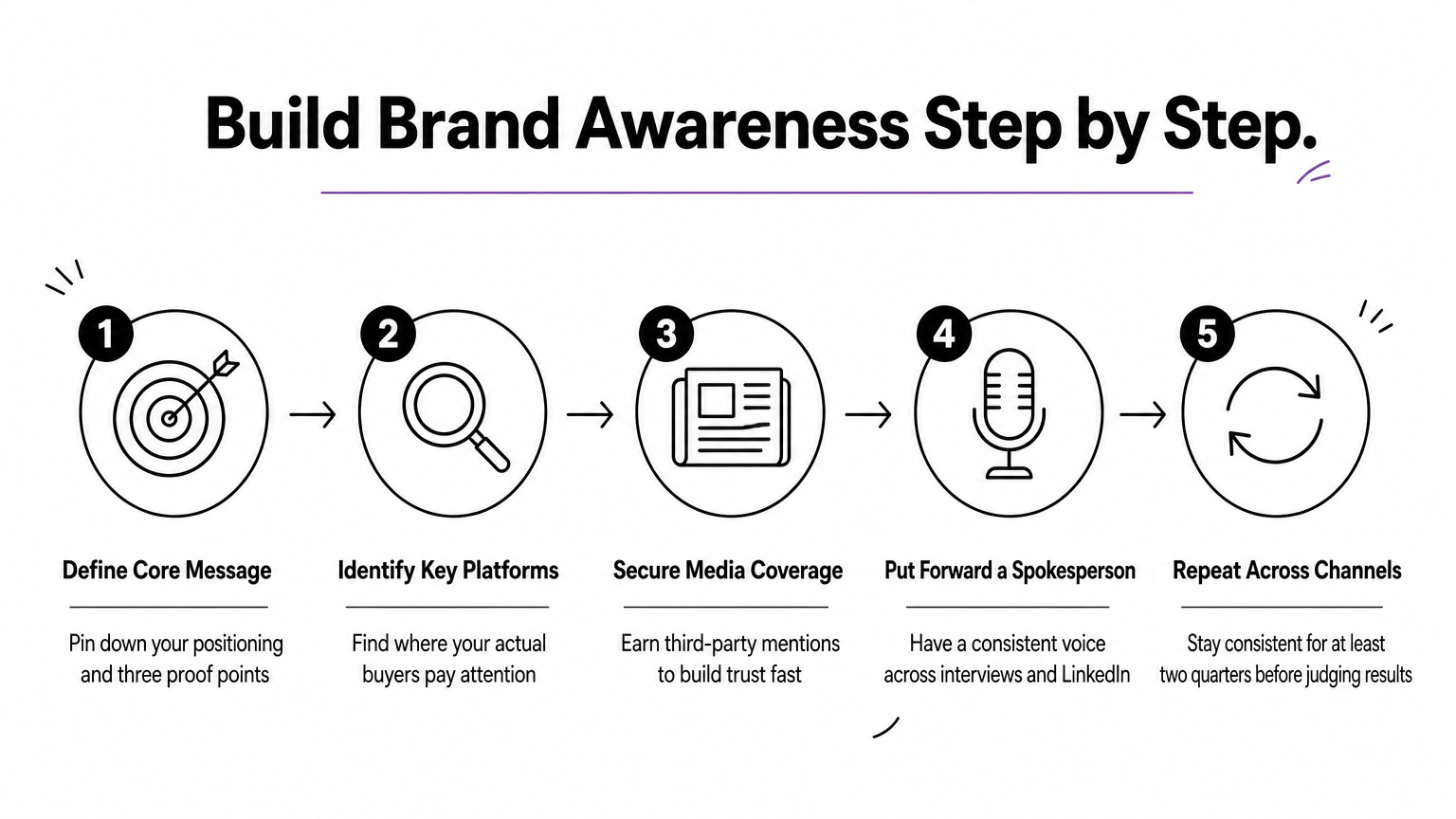
Once positioning is settled, work through a practical sequence rather than jumping straight to social media posting:
- Define your core message and the three proof points that support it.
- Identify the media and platforms your actual buyers pay attention to, not the ones that feel prestigious.
- Secure consistent media relations coverage, since third-party mentions build trust faster than paid ads, and it helps to know what media relations actually involves before you start.
- Put a spokesperson forward who can speak confidently and consistently in interviews and on LinkedIn.
- Repeat the message across every channel for at least two quarters before judging results.
Prioritise earned media early
Press coverage and expert commentary do more for genuine recognition than most paid campaigns, because readers trust journalists more than adverts. This is where a lot of South African businesses waste budget, they pour money into ads before they have secured a single credible media mention. If you have limited resources, spend them on media pitches, press releases, and spokesperson positioning first, then layer paid promotion on top once the groundwork is visible. That order matters more than the size of your budget.
How to measure brand awareness effectively
You can’t manage what you don’t measure, and brand awareness is one of the easiest metrics to ignore because it doesn’t show up neatly on an invoice. Still, there are concrete signals you can track every month that tell you whether your name is actually sticking with the people you want to reach.
Watch branded search volume
Google Search Console and Google Trends show you how often people search your company name directly, rather than a generic category term. A steady rise in branded searches means your PR and content work is landing, because people only search a name once they’ve already encountered it somewhere else. If branded search stays flat despite months of activity, your messaging isn’t cutting through.
Rising branded search is the clearest sign that people remember your name without being prompted.
Track share of voice in your industry
Share of voice compares how often your business gets mentioned in media, industry publications, and social conversation versus your direct competitors. Tools like Google Alerts and basic media monitoring give you a rough count; a dedicated media relations partner can track it more precisely across print, broadcast, and online coverage.
| Metric | What it tells you | Where to track it |
|---|---|---|
| Branded search volume | Direct recall of your name | Google Search Console, Google Trends |
| Share of voice | Standing versus competitors | Media monitoring, press clippings |
| Social mentions and tags | Organic word-of-mouth | LinkedIn, X, Instagram analytics |
| Direct website traffic | People typing your URL from memory | Google Analytics |
Ask directly through surveys
Sometimes the simplest method works best: ask your existing customers or a sample of your target market whether they’ve heard of you, and whether they can name you unprompted in your category. Combining this with online brand awareness data from social platforms and website analytics gives you a full picture, not just a digital snapshot. Reviewing all four signals together, rather than any single number in isolation, is what separates a business tracking real progress from one guessing at it.
Growing brand awareness online and through digital channels
Digital channels have changed how brand awareness in digital marketing gets built, but the principle stays the same: repetition plus credibility wins. Social platforms, search results, and website content now do the job that print alone used to handle, so your business needs a presence across all three, not just one polished channel that nobody actually visits.
Show up consistently on the platforms your buyers use
Every platform reinforces the others, but only if the message stays consistent. Posting on LinkedIn one week and going quiet for a month teaches people to forget you, not remember you. Businesses that treat online brand awareness as a steady drip, not a campaign, see recall build faster because familiarity comes from frequency, not from one viral moment.
Consistency beats intensity when you’re building recall online.
Make LinkedIn your credibility engine
For South African B2B companies especially, LinkedIn does more heavy lifting than any other platform. A spokesperson who comments on industry news, shares client wins, and engages with journalists builds recognition faster than a company page ever will alone, which is why profile building for leaders is worth the effort. Pair that personal visibility with press coverage you can share back onto the platform, and you get a compounding effect: media validates the spokesperson, and the spokesperson amplifies the media.
Turn earned coverage into owned content
Every press mention, interview, or guest article is raw material for further reach. Repurpose it across channels instead of letting it disappear after publication:
- Share the article link with a short LinkedIn post from the spokesperson
- Add a quote or excerpt to your website’s news or media page
- Reference the coverage in your next media pitch as proof of credibility
- Include it in a client newsletter or sales deck
This is where marketing and brand awareness genuinely overlap: the media relations work creates the material, and the digital distribution stretches its value far beyond the original publication date. If you want structured help turning coverage into consistent digital visibility, the PR support Purple Word Box offers builds that pipeline for you rather than leaving it to chance.
Keeping your brand top of mind
Building brand name awareness isn’t a single push, it’s a habit you keep up long after the first press mention lands. Recognition fades fast if you go quiet, so treat media relations, consistent messaging, and digital visibility as an ongoing rhythm rather than a project with an end date. Companies that stay top of mind are rarely the loudest, they’re just the most consistent, showing up in the same trusted places month after month until their name becomes the automatic answer in their category.
Getting there takes more than good intentions. It takes steady media relationships, a spokesperson who shows up consistently, and someone tracking whether the work is actually moving the needle. That’s exactly the gap Purple Word Box fills for South African businesses that want senior-level PR guidance without the overhead of a big agency. If you’re ready to stop being overlooked, speak to the Purple Word Box team and start building awareness that actually sticks.