A press release, sometimes searched as press and release, is a short, official statement that an organization sends to journalists to announce something newsworthy. That could be a product launch, a senior appointment, a partnership or an event. It is also called a media release. Its standard format is one page with a headline, dateline, lead paragraph, body, quote, company boilerplate and contact details, written so a reporter can use the facts without chasing you.
In marketing, a press release is an earned media tool. You do not pay for placement, as you would with an advert. A journalist or editor decides whether your news is worth covering, so the release has to read like a news story, not a sales brochure. Today it usually lives in two places at once: in a reporter’s inbox and on your website, where customers, partners and search engines can find it.
This article covers why press releases matter, the standard format element by element (with a template you can copy), how to write and send one, and how a digital press release differs from the old paper version. At Purple Word Box we write and pitch press releases for businesses, so the advice below comes from that work.
Why a press release matters
A press release matters because it is the most direct, low-cost way to put a verified story in front of journalists. It also leaves a public record of your announcement that anyone can find later.
What a press release does for your business
Coverage that comes from a release carries more weight than advertising, because a third party has chosen to report it. Readers treat a news article as independent, and that borrowed credibility is hard to buy. A release also saves journalists time. When you give them the who, what, when, where and why in a clear structure, your story is easier to run than one they have to piece together.
A release also works as a permanent, linkable record on your website. Customers, investors, recruiters and partners often check a company’s news page before they decide to deal with it. A steady archive of well-written releases shows that the business is active and has something to say.
A press release earns attention by being useful to a journalist first and to your marketing second.
When a press release is worth sending
Send one when you have real news. These triggers usually qualify:

- A new product, service or major update
- A senior appointment or a significant promotion
- A partnership, acquisition or funding announcement
- Original research, survey results or company milestones
- An event, award or sponsorship with a clear date
Skip the release when nothing has changed. A routine update, a vague "we are excited" announcement or a minor feature rarely gets covered. A byline article, a media pitch or a LinkedIn post suits that kind of content better.
The standard press release format
A standard press release runs about one page, or 300 to 500 words, and follows a fixed order: headline, dateline, lead, body, quote, boilerplate and contact details. Journalists scan dozens of these a day, so a familiar structure helps them find the news in seconds.
The elements, in order
Each part has one job. Put the most important information at the top, because editors often stop reading after the first paragraph.
| Element | What it contains | Typical length |
|---|---|---|
| Release status | "For immediate release" or an embargo date and time | One line |
| Headline | The news stated plainly, with no hype | One line, ideally under 12 words |
| Dateline | City and date, opening the first paragraph | A few words |
| Lead paragraph | Who, what, when, where and why it matters | 1 to 2 sentences |
| Body | Supporting facts, context and figures in order of importance | 2 to 4 short paragraphs |
| Quote | A named spokesperson adding opinion or insight | 1 to 2 sentences |
| Boilerplate | A standard "about the company" paragraph | 2 to 3 sentences |
| Media contact | Name, phone number and email address | One line |
| End mark | "-ENDS-" or "###" | One line |
An embargo asks journalists not to publish before a stated time, for example "Embargoed until 06:00 on 12 March". Use it only when you have a reason, such as a coordinated announcement.
A template you can copy
Replace the bracketed text with your own details and delete anything that does not apply.
FOR IMMEDIATE RELEASE

[Headline: one line stating the news]

[City], [Day Month Year]: [Lead paragraph: who did what, when and where, and why it matters, in one or two sentences.]

[Body paragraph 1: the key detail or evidence behind the news.]

[Body paragraph 2: context, such as a figure, a customer need or background.]

"[Quote that adds insight, not a repeat of the facts]," said [Name], [Title] at [Company].

[Optional final paragraph: availability, date, or a link for more information.]

About [Company]
[Two or three sentences: what you do, who you serve, where you operate.]

Media contact
[Name], [Phone number], [Email address]

-ENDS-
Put the news in the first two sentences, and everything after them is support.
How to write and send a press release
To write a press release, find the news angle, draft the headline and lead first, fill in the body, quote and boilerplate, edit out the hype, and send it to journalists who cover your subject. Releasing it well matters as much as writing it.
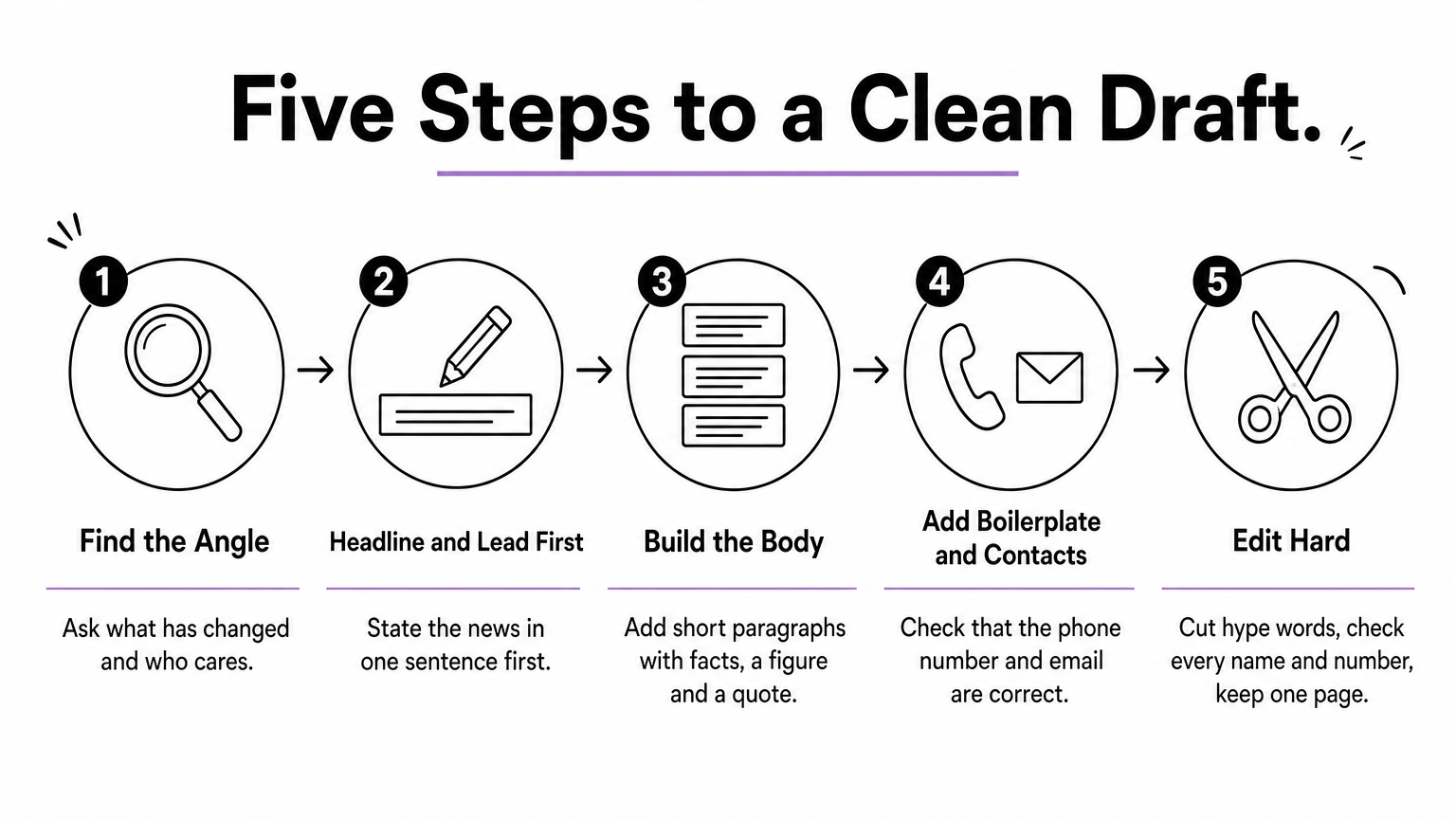
Five steps to a clean draft
- Find the angle. Ask what has changed and who cares. "We launched a platform" is a fact. "Small businesses can now do X in half the time" is news.
- Write the headline and lead first. If you cannot state the news in one sentence, you are not ready to write the rest.
- Build the body. Add two or three short paragraphs with the facts, a figure and the context a reader needs. Then add a quote that sounds like a person speaking.
- Add the boilerplate and contact details. Check that the phone number and email address are correct and that someone will answer.
- Edit hard. Cut adjectives such as "innovative" and "leading", check every name and number, and keep it to one page.
Here is how a strong lead reads in practice: "Cape Town, 12 March 2027: Acme Logistics has launched a same-day delivery service for small retailers in Gauteng, cutting typical delivery times from three days to under eight hours." The company, place, date and benefit all sit in one sentence. (Acme Logistics is an invented example.)
Releasing it: sending and follow-up
Releasing a press release means choosing the right journalists and sending a short personal email. Build a small list of reporters and editors who have covered your topic recently, and write one or two lines explaining why the story suits them. Paste the release into the email body instead of attaching it, because many reporters will not open attachments. Link to images or a media folder instead of attaching large files.
Send it early in the working week, and follow up once after a day or two with a brief note. Do not mass-blast one generic email to every contact you have. A targeted send to ten relevant journalists beats a blast to a thousand.
A well-written release sent to the wrong people is wasted, so choose your recipients before you write.
Digital press releases and common mistakes
A digital press release is the same news document, published online as well as emailed, with links, images and wording that work on a web page and in search results. Most of the craft is unchanged, but a few details matter more online.
What makes a press release digital
Publish every release on a news or media page on your own website, with its own web address, so journalists and customers can link to it. Write a headline that makes sense on its own in a search result, and add a clear summary line. Link to sources, your product page and any report you cite, so readers and journalists can check your claims.

Add images with descriptive alt text, and video where you have it. Include a link to a media folder with high-resolution photos and spokesperson headshots. Then share the release on LinkedIn, so staff and partners can pass it on. Online, the release serves customers as well as the press.
Mistakes that get a release ignored
Most releases fail for the same few reasons:
- No real news: the release announces something nobody outside your company cares about.
- Buried lead: the key fact appears in paragraph four.
- Hype and jargon: claims such as "world-class" with no evidence.
- Excess length: two pages of background where one page of facts would work.
- Missing contact details: the journalist cannot reach anyone for a comment.
- Poor targeting: a technology story sent to a lifestyle editor.
Journalists forgive a plain release, but they delete a vague one.
Where to go from here
A press release is a short, structured news document that gives journalists the facts and gives your business credible coverage. The format is simple: a clear headline, the news up front, a quote, a boilerplate and contact details, all on one page. What makes the difference is a genuine news angle and a tight, targeted send.
Start with one announcement that you can state in a single sentence, fill in the template above and cut anything that sounds like an advert. If you would rather have an experienced practitioner shape the story and pitch it to the right media, talk to Purple Word Box about writing and placing your press release.