

Public relations or marketing comes down to one question: do you need people to act, or do you need them to believe you? Marketing promotes your products and services to win customers and sales. Public relations (PR) manages your reputation, mostly by earning coverage and trust from journalists, stakeholders and the public. Both are communication, but they do different jobs, and most businesses need both in a sensible order.
The confusion starts because the two share channels. Social media, blogs, events and even press releases can serve either one, so people often treat marketing or public relations as interchangeable. They are not, and the difference decides where your budget goes and how you judge the results.
This article explains why the difference matters, how to decide which one your business needs, and how the two compare side by side. It also covers where they overlap and which career path suits you. We have worked on PR and marketing communication for start-ups, SMEs and multinationals, so the examples come from practice, not theory.
Why the difference between PR and marketing matters
The difference matters because each discipline buys a different result, and confusing them wastes budget and sets the wrong expectations. When you ask whether you need public relations or marketing, you are really asking whether you need people to act or people to trust you.
Two jobs, two kinds of result
Marketing is built to produce an action you can count: a click, an enquiry, a download or a sale. You control the message, the placement and the timing, and you usually pay for the reach. PR is built to produce belief. A journalist, an analyst or a community leader decides whether your story is worth sharing, so you cannot dictate the outcome.

Because a third party speaks for you, earned coverage builds credibility that advertising struggles to buy. That credibility then lifts your marketing, since prospects who already recognize your name are far more likely to respond to your offer.
Marketing asks people to buy, while PR gives them a reason to trust you first.
What goes wrong when you mix them up
Four mistakes appear again and again when businesses blur the two:
- Expecting a press release to generate sales the same week.
- Running ads to fix a trust problem that only credible third-party coverage can ease.
- Judging PR by clicks and conversions instead of coverage quality and message pickup.
- Handing a media pitch to someone with no journalist relationships, or a lead target to someone who only does media.
Each one comes from treating a discipline as a substitute for the other. Fix that, and you stop paying for results the chosen tool was never designed to deliver.
How to decide whether you need PR, marketing or both
Pick the discipline that matches the outcome you need in the next six to twelve months. Choose marketing for demand you can measure, PR for credibility you have to earn, and both when you are launching something new.
Match your goal to the discipline
Start with your goal, not with the tactic you have heard of. The table below maps common business goals to the right starting point.
| Your goal | Start with | Why |
|---|---|---|
| Sell more of an existing product this quarter | Marketing | You control the message, timing and spend |
| Become known and trusted in a new market | PR | Independent coverage builds credibility faster than your own claims |
| Launch a new product | Both | PR creates the announcement and coverage, marketing turns attention into leads |
| Respond to bad press or a crisis | PR | It manages the story and your media relationships |
| Grow qualified leads from your website | Marketing | Search, email and ads are measurable |
| Position a founder as an expert | PR | Media commentary, opinion articles and LinkedIn content do this work |
If you can only afford one, ask whether people already know and trust you. If they do, marketing converts existing awareness. If they do not, marketing spend meets resistance, and PR should come first.
A worked example
Say you run a 25-person IT services company that sells to mid-sized businesses. You have a website and a LinkedIn page but no media profile, while competitors offering the same service keep getting quoted in trade publications. A sensible plan runs in three steps:
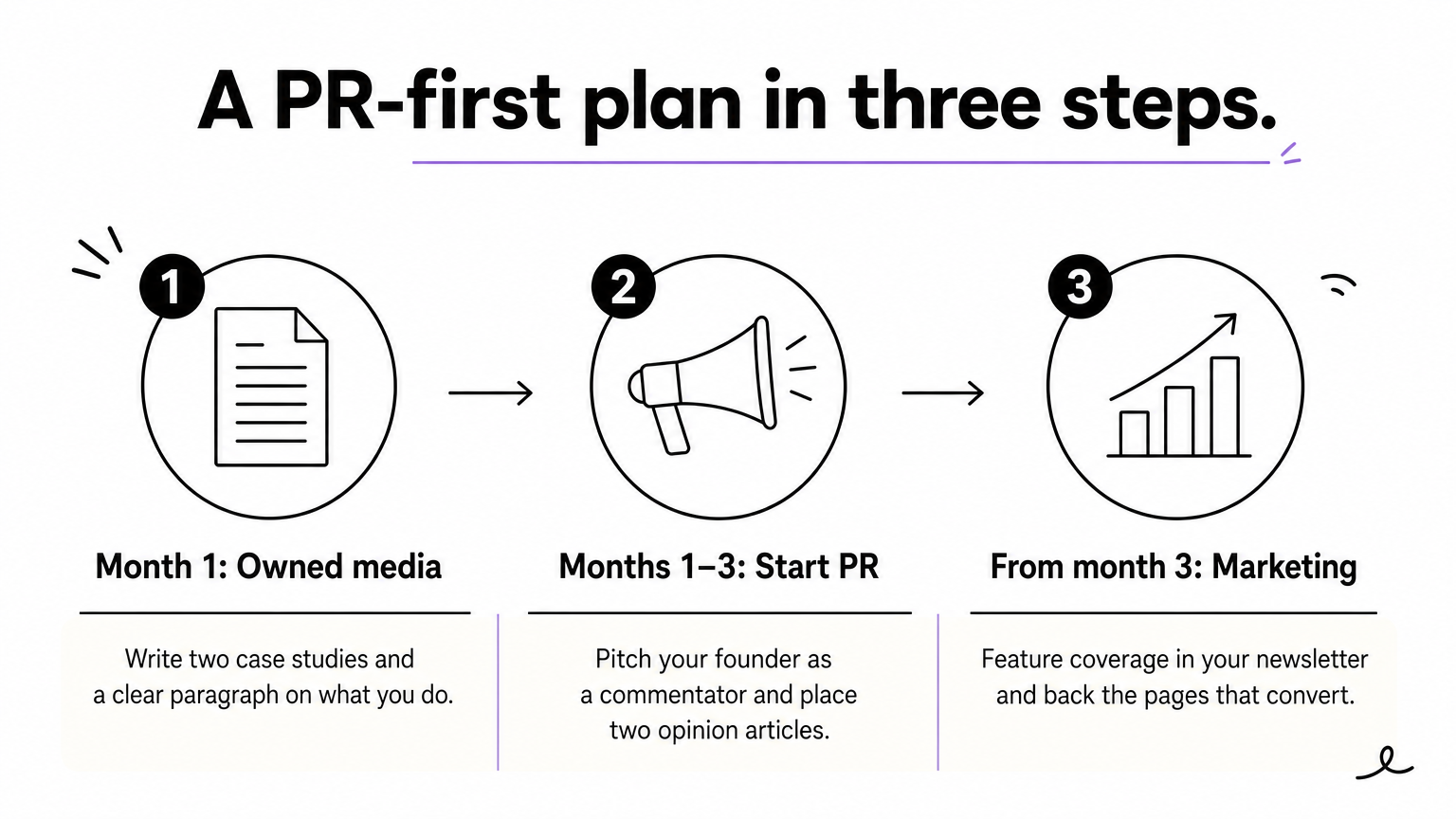
- Month 1: Tighten your owned media. Write two case studies and a clear paragraph on what you do and who you do it for.
- Months 1 to 3: Start PR. Pitch your founder as a commentator on topics journalists already cover, and place two opinion articles.
- From month 3: Bring in marketing. Feature the coverage in your newsletter and on LinkedIn, and put paid budget behind the pages that convert.
The result is one story told twice. The media tells it first and earns trust, then you tell it and capture the lead. Coverage is never guaranteed, because journalists decide, so build the plan around stories that deserve to be told.
Fix the trust gap with PR first, then let marketing harvest the attention it creates.
How public relations and marketing differ side by side
Public relations and marketing differ in goal, audience, media type, control and timing, even when they use the same channels. Seeing the differences in one place makes it easier to brief the right person and measure the right thing.
The differences at a glance
| Public relations | Marketing | |
|---|---|---|
| Main goal | Reputation, credibility, trust | Leads and sales |
| Main audience | Journalists, stakeholders, employees, the public | Customers and prospects |
| Media type | Mostly earned | Mostly paid and owned |
| Control of the message | Shared, journalists decide | Full |
| Time to results | Builds over months | Can show in days or weeks, especially paid |
| Typical measures | Coverage quality, message pickup, sentiment | Leads, conversion rate, cost per acquisition |
| Typical output | Press releases, pitches, expert commentary, media training | Campaigns, ads, email, landing pages, collateral |
A useful lens is the three kinds of media. Marketing leans on paid media such as ads and sponsored posts, and on owned media such as your website and email list. PR leans on earned media, which is coverage you did not pay for. Owned media is the shared space where both teams publish.
If you can buy it, it is marketing; if someone else has to choose to publish it, it is PR.
Where the two overlap
Four areas are claimed by both teams, and the difference lies in intent:
- Press releases: PR uses them to announce news and win coverage, marketing uses them to support a launch.
- Blogs and thought leadership: Marketing wants search traffic and leads, PR wants to show expertise and credibility.
- Social media: Marketing runs campaigns and ads, PR monitors conversations and responds to issues.
- Events: Marketing collects leads at the stand, PR works the media and the brand story.
Some textbooks treat PR as one part of marketing communication, and in a small business one person often does both. That is fine. Just measure each activity against the goal it was meant to serve.
Choosing between marketing or public relations as a career
Choose PR if you enjoy writing, building relationships and thinking fast under pressure. Choose marketing if you prefer data, testing and shaping offers. Both reward clear writing, and the skills transfer more than most people expect.
What the work looks like day to day
A PR practitioner spends the week writing press releases and opinion articles, pitching stories to journalists, following up, preparing spokespeople for interviews and monitoring coverage. Crisis response lands on the PR desk too, which means calm judgment matters as much as writing.

A marketer plans campaigns, researches customers, writes copy, manages channels such as email and paid search, and reads analytics to see what worked. The week is more numbers-driven, and success is tied to leads and revenue.
How to choose, and how to move between them
If you are unsure, start in a role that touches both, such as communications or content, and notice which tasks you would happily do on a Friday afternoon. Strong writing is the common core, and a PR person who understands conversion is worth more, just as a marketer who understands journalists writes better content.
Weighing marketing or public relations is rarely a permanent choice. Plenty of people begin in one and move across within a few years once they see how the other side works.
Pick the discipline whose daily tasks you would choose even without the title.
Decide on the outcome first
Public relations and marketing are not rivals. Marketing turns attention into sales, and PR earns the trust that makes people willing to buy. Decide which outcome you need most right now, then start with the discipline built for it. If people do not know you, begin with credibility. If they do, focus on conversion.
At Purple Word Box we work on both sides: PR strategy, media relations and thought leadership, alongside marketing collateral such as case studies and whitepapers. If you are not sure which one your business needs first, you can talk through your communication goals with us and get honest, practical advice.