

Thought leadership content marketing is the practice of publishing original, expert-backed ideas so that the right people trust your business before they ever speak to you. It is a specific type of content marketing. General content answers questions and supports sales. Thought leadership takes a position, backs it with evidence, and puts it in front of the people who shape your market.
This article explains why it matters, how to build a strategy around it, and how it differs from everyday content marketing. It also covers the formats that work, a worked example you can copy, how to measure results, and when it makes sense to bring in an agency.
Purple Word Box is a South African PR and communication agency led by Maria Joubert, who has more than 20 years of PR experience. Thought leadership articles, opinion pieces and executive LinkedIn content are part of the work we do for clients. The advice below comes from that practice.
Why thought leadership content marketing matters
It matters because credibility cannot be bought, and in most B2B markets credibility decides who gets shortlisted. Two businesses can offer the same service at a similar price. The one whose thinking the buyer has already read and agreed with usually wins the conversation.
It earns trust before the sales conversation
Buyers research before they call. A prospect comparing three firms with near-identical websites will lean toward the one that has shown how it reasons about their problem. A service page lists what you do. Published thinking shows how well you do it, and that is what builds trust before a sales call.
This is why thought leadership business strategies suit companies with real expertise but a small public profile. If most of your work arrives through referrals and word of mouth, your reputation lives in a few heads. Publishing your views moves it into public view, where strangers, journalists and future hires can find it and judge it.
It makes you easier to quote, recommend and find
People who need an expert need one they can describe in a sentence. A clear position on a narrow topic makes you that person. Over time this becomes thought leadership branding: your name or company is linked to an idea, not a list of services.

It also helps with search and AI answers. Google’s own guidance on helpful, people-first content asks for first-hand experience, clear authorship and demonstrated expertise. Named authors with a visible track record are what thought leadership produces by design.
Different audiences notice you in different ways:
- Journalists looking for a quotable view on a news story
- Prospects building a shortlist of suppliers
- Event organisers filling speaker slots
- Candidates deciding where they want to work
- Partners and referrers deciding whether to recommend you
Credibility cannot be bought, only demonstrated, one useful and defensible idea at a time.
How to build a thought leadership marketing strategy
Build the strategy in four moves: pick a narrow position, take a real point of view, support it with proof, and plan distribution before you write a word. Each move removes a common failure. Skipping any of them leaves you with a blog that nobody remembers.
Pick one audience and one narrow topic
Start with the people you need to convince, such as finance directors at mid-sized companies or school principals. Then choose the one subject where you can say something they have not heard. Narrow beats broad. "Cyber security" is a category. "How a mid-sized firm should rehearse a ransomware incident" is a position.
Look for the overlap between what you know first-hand and what your audience worries about. Ask your sales team which questions prospects raise again and again. Those questions are your topics, and your answers to them are your raw material.
Build every piece on a point of view and proof
A piece counts as thought leadership when it passes three tests:
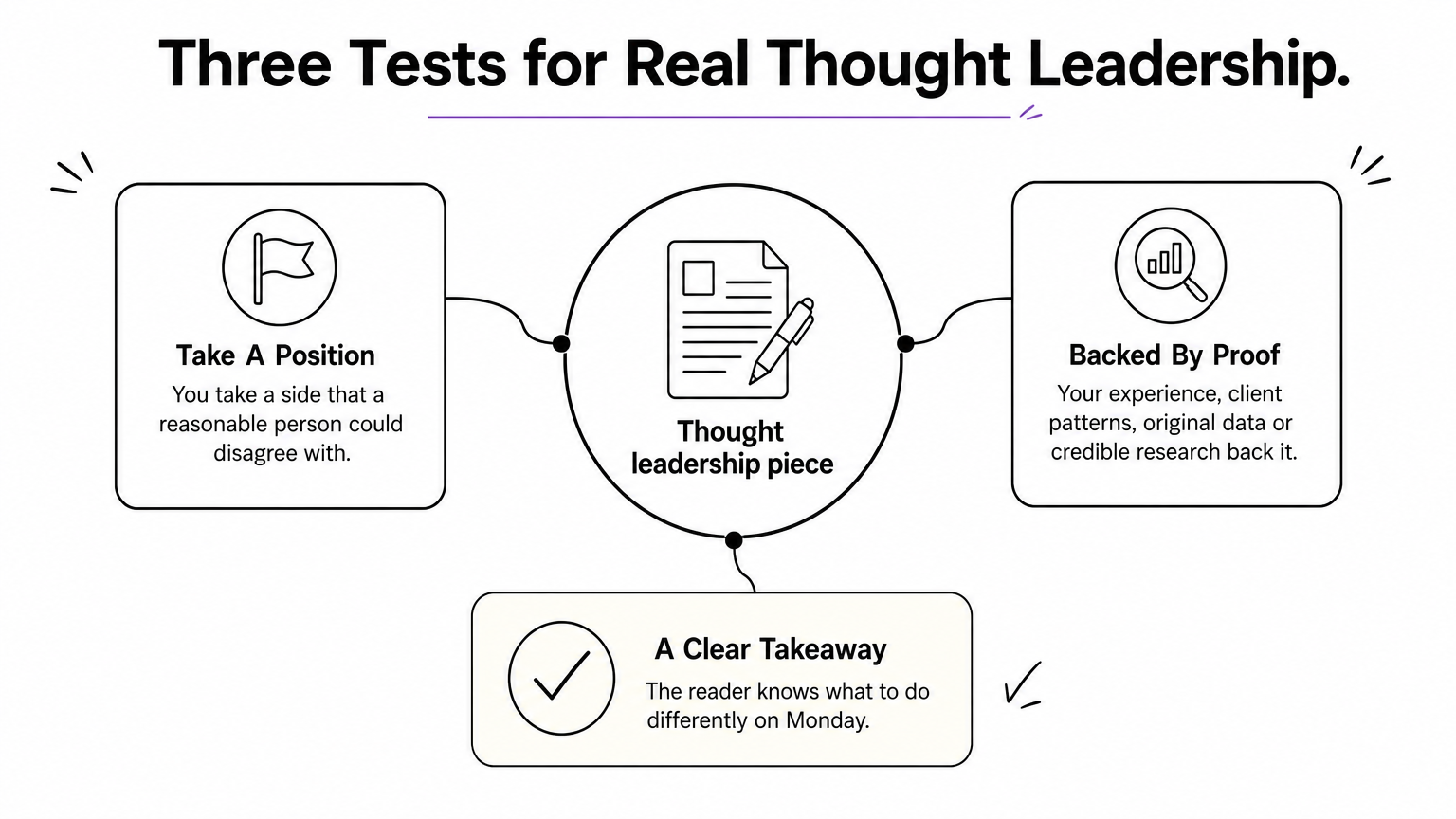
- A position. You take a side, and a reasonable person could disagree.
- Proof. You support it with your own experience, client patterns, original data or credible third-party research.
- A takeaway. The reader knows what to do differently on Monday.
Without proof, you have an opinion. Without an opinion, you have a how-to guide. Most corporate blogs fail the first test, which is why they blend together. Original input is the fastest fix. A short survey of your clients, a pattern from your own project work, or a lesson from a failure all give you something nobody else can publish.
Plan visibility before you write
Decide where each piece will appear before you start. Owned channels are your website, newsletter and executive LinkedIn profiles. Earned channels are opinion articles in trade media, expert commentary on news stories and interviews. Editors make the call on earned placement, so no honest provider can promise it. Build your owned channels in parallel so the work never depends on one editor’s yes.
Engagement is part of the strategy, not an afterthought. Put the executive’s name on the piece, reply to comments in the first day, and carry good questions from the replies into your next article. Thought leadership engagement is what turns a one-way broadcast into a conversation.
A strategy without a point of view is just a publishing schedule.
Thought leadership vs content marketing: the difference
Content marketing is the overall discipline of using content to attract, educate and convert customers. Thought leadership is one tactic inside it, with a different job: building authority rather than traffic. Think of content marketing and thought leadership as a system and one of its parts, not as rivals.
Side-by-side comparison
| Aspect | Content marketing | Thought leadership |
|---|---|---|
| Main purpose | Attract, educate and convert across the funnel | Build authority and trust in a field |
| Typical question answered | "How do I do this?" or "What is that?" | "What should our industry think or do about this?" |
| Tone | Helpful, practical, often search-driven | Opinionated, evidence-backed, signed by a named expert |
| Volume | Frequent, steady schedule | Fewer, deeper pieces |
| Success signals | Traffic, sign-ups, leads | Media requests, invitations, referrals, pre-convinced enquiries |
| Time to show results | Weeks to months | Usually months to years |
| Who writes it | Marketing team or writers | Named experts, often with writing support |
The table also explains why the two are confused. Both publish articles, both use LinkedIn and both aim to grow the business. The difference is the reader’s reaction. After good content marketing, the reader thinks "that answered my question". After good thought leadership, the reader thinks "these people see something I missed".
How the two work together
A thought leadership piece with nothing around it sits alone. Supporting content such as explainers, case studies and FAQs gives interested readers somewhere to go next. In the other direction, how-to content without a point of view is easy to replace. AI tools now produce competent generic answers in seconds, so a distinctive position is what keeps your content from being interchangeable.
Keep one boundary firm. Thought leadership is not self-promotion. A piece that spends its length praising your product is an advert, and readers treat it like one. Let your expertise carry the argument and mention your services only where they are the natural example.
Content marketing makes you findable. Thought leadership makes you worth choosing.
Formats, channels and a worked example
The best formats are the ones where an expert’s reasoning is visible: opinion articles, original research, executive LinkedIn posts, expert commentary and live speaking. Pick two or three you can sustain rather than trying all of them.
Formats and what each is good for
| Format | Best for | Effort |
|---|---|---|
| Opinion article in trade media | Reaching an audience you do not own | Medium, needs pitching, no guaranteed placement |
| Original research or survey | Giving media and prospects a citable figure | High |
| Executive LinkedIn posts | Steady visibility and discussion | Low per post, needs consistency |
| Website article | A long-form reference you control | Medium |
| Expert commentary on news | Timely media presence | Low if you respond quickly |
| Webinars, roundtables, talks | Face-to-face credibility and fresh questions | High |
| Media interviews | Being quoted as an authority | Needs preparation |
Interviews deserve special attention. A spokesperson who rambles or gets defensive can undo months of writing. Media training helps leaders stay on message, handle difficult questions and speak with clarity. Do it before your first big interview, not after.
One idea turned into eight assets
Here is a worked example for a hypothetical IT services firm. Its CEO believes mid-sized companies should rehearse incident response before buying more security tools. That one idea becomes the following:

| Asset | Channel | Count |
|---|---|---|
| Flagship article, about 1,200 words | Company website | 1 |
| Shorter opinion version for pitching | Trade publication | 1 |
| Posts on a single lesson each | CEO’s LinkedIn profile | 4 |
| Feature item | Customer newsletter | 1 |
| Quotable commentary note | Journalist contacts | 1 |
| Total | 8 |
One idea each quarter gives you four ideas and 32 assets a year. That is a pace a busy leader can keep. Repurposing keeps the message consistent without forcing you to invent something new every week.
Fewer, sharper ideas, repurposed across channels, beat a constant stream of generic posts.
How to measure it and when to get help
Measure thought leadership by authority signals first and traffic second. Bring in an agency only when time or writing skill is the bottleneck, not when you lack an idea. The ideas have to come from you.
Measure authority signals, not only traffic
Page views are a weak measure here, because a piece read by ten of the right people can outperform one read by ten thousand strangers. Track signals that show your standing is changing:
- Media requests and quotes
- Invitations to speak, join panels or appear on podcasts
- Enquiries that mention a specific article or post
- Prospects who arrive in sales calls already familiar with your view
- Comments from peers and target buyers, rather than raw likes
- Searches for your brand and your leader’s name
Ask your sales team to log how each prospect first heard of you, and review the list quarterly. Expect months, not weeks. A reasonable test is whether the signals are trending up after six to twelve months of steady publishing.
Mistakes that undo credibility
Most failures come from a short list of habits:
- Selling in disguise. The piece reads like a brochure, so readers stop trusting the author.
- Generic text with no original input. If an AI tool or a writer could have produced it without you, it adds nothing.
- Publishing once, then going silent. Authority builds through repetition.
- Claims without proof. Bold opinions need evidence behind them.
- Ghostwriting without the executive. The writer needs real time with the named expert.
When to hire a thought leadership marketing agency
Hire help when you have the expertise but not the time, or when your pieces need pitching to editors. Ask who will write, how they will capture your voice, and whether they promise coverage. A trustworthy PR provider will not guarantee earned coverage, because editorial decisions sit with journalists and editors. Purple Word Box takes the same position.
Also look for senior involvement. Thought leadership depends on judgment about which stories are strong and which media fit, and that judgment comes from experience, not templates.
Start with one idea worth defending
Thought leadership content marketing is content marketing with a sharper job. It takes a position, proves it, and gets it in front of the people who matter, so that trust is already in place when they need a supplier. It sits inside your wider content work and depends on it. It also rewards patience, because authority builds slowly and unevenly.
Begin with one narrow topic, one named expert and one idea you can back with proof. Turn it into a handful of assets, publish them consistently, and track the signals that show your standing is growing.
If you want senior help doing this, Purple Word Box runs a three-month brand visibility programme for South African businesses. It starts with an audit of your public presence and then delivers a tailored PR campaign that includes thought-leadership articles, media pitches and executive LinkedIn content. Coverage is never guaranteed, but the groundwork is built to earn it.