A good PR strategy example PDF is short. It runs one or two pages and answers five questions: what you want to achieve, who you need to reach, what you want them to believe, which tactics you will use, and how you will measure the result. Below are five worked examples, from a start-up launch to a crisis plan. A start-up needs the first, a business leader the second, a product team the third, an events team the fourth, and any company with a reputation to protect the fifth.
Most files you find online fall into two camps. Some are textbook chapters running to hundreds of pages. Others are blank templates full of prompts and no real answers. Neither shows you what a finished plan looks like. A strategy sets the approach, while a PR plan or PR campaign plan adds the dates, owners and tasks. The examples here show both in miniature.
We have no file to download, and you do not need one. Copy any table into Word or Google Docs, replace the details, and save it as a PDF. At Purple Word Box we build plans like these for South African businesses, led by Maria Joubert, who has more than 20 years of PR experience. The figures below are illustrative, so swap in your own.
1. Start-up launch plan for first media coverage
This plan suits a young company with no media history and a product that is ready to launch. The idea is to win a few credible articles rather than chase every outlet, because early coverage gives every later pitch something to point to.

The plan at a glance
Here is an illustrative 90-day plan for a South African business software start-up.
| Element | Example |
|---|---|
| Objective | Three articles in trade media within 90 days |
| Audience | Finance managers at mid-sized firms, and the trade journalists who write for them |
| Core message | "We cut invoice processing time for small finance teams" |
| Tactics | Founder story pitch, launch press release, briefings with 10 chosen journalists, one opinion article on a customer problem |
| Measures | Articles published, quality of outlets, referral visits to the website, follow-up requests from journalists |
How to adapt it
Keep the structure and change the details to match your market. A short, researched journalist list will beat a mass email every time.
- Keep: one clear goal, a short journalist list, and a story built around a customer problem.
- Change: the audience, the publications and the numbers to suit your size.
A first PR plan should aim at three good articles, not thirty mentions.
2. Thought leadership plan for a business leader
This plan suits a founder or executive who wants to be the person journalists call on one topic. It rests on a single stance, repeated in several formats, over six months.
The plan at a glance
The table below shows an illustrative six-month plan for a managing director.
| Element | Example |
|---|---|
| Objective | Be quoted as a commentator on one topic within six months |
| Audience | Customers, industry journalists, the leader’s LinkedIn network |
| Core message | "Small firms should treat cyber security as a business risk, not an IT task" |
| Tactics | One opinion article a month, two LinkedIn posts a week adapted from it, a comment bank for journalists, a media training session |
| Measures | Articles placed, requests for comment, LinkedIn engagement, inbound enquiries |
How to adapt it
Choose a topic you can defend with your own experience. Readers and journalists can tell when an opinion has no evidence behind it, so build each article around something you have seen first-hand.
- Keep: one stance, one monthly article, and a repurposing routine.
- Change: the topic, the publication targets and the posting rhythm.
One clear stance repeated for six months builds more authority than twenty unrelated posts.
3. Product announcement campaign plan
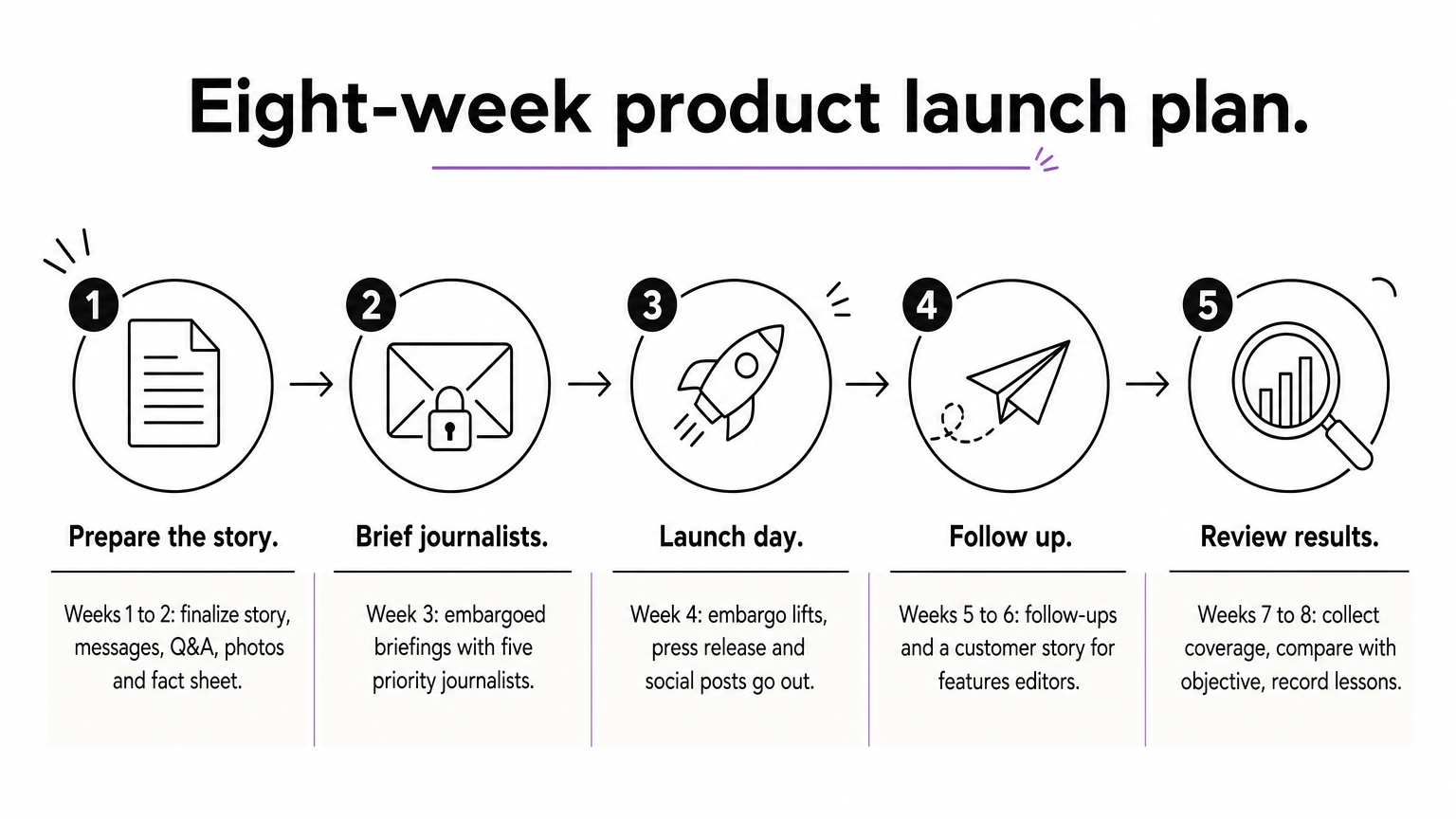
This PR campaign plan example suits a launch with a fixed date. It works backward from launch day and runs eight weeks, so every task has a place on the calendar.
The plan at a glance
The objective here is coverage in at least four relevant outlets, with the launch message repeated consistently.
| Weeks | Activity |
|---|---|
| 1 to 2 | Finalize the story, key messages, spokesperson Q&A, photos and a fact sheet |
| 3 | Embargoed briefings with five priority journalists |
| 4 | Embargo lifts, press release goes out, social posts and a customer quote go live |
| 5 to 6 | Follow-ups, a customer story pitched to features editors |
| 7 to 8 | Collect coverage, compare against the objective, record lessons |
How to adapt it
Count back from your launch date and fix the embargo time first. Journalists need a few days with the material, so a briefing the day before launch is too late.
- Keep: the briefing-before-launch order and the written Q&A.
- Change: the length of each phase to match your product’s complexity.
A campaign plan is a calendar with a goal on top, so build it backward from launch day.
4. Event PR plan from invitation to follow-up
This plan suits a conference, product showcase or client breakfast. The main lesson is that most event coverage is won before and after the day itself, so the plan has three stages.

The plan at a glance
| Stage | Activity |
|---|---|
| Four weeks before | Media invitations, pitches about the speakers, branded materials and a press kit prepared |
| Event day | A media contact on site, short spokesperson interviews, photos, live social posts |
| Within 48 hours | Press release with quotes and images sent to journalists who attended and those who did not |
| Within two weeks | Follow-up feature ideas, coverage report |
How to adapt it
Give every event one story worth telling, such as a launch, a survey result or a notable speaker. Without one, the invitation reads as an advertisement and few journalists will come.
- Keep: the 48-hour release and the named media contact.
- Change: the invitation timing and the number of spokespeople to suit the event’s size.
The event is only the middle of an event PR plan, and the coverage comes from the weeks around it.
5. Crisis and reputation readiness plan
This plan suits any company, because it is written before anything goes wrong. It decides who speaks, who approves and what gets said first, so you are not drafting under pressure.
The plan at a glance
| Element | Example |
|---|---|
| Likely issues | Data breach, service outage, staff incident, negative review spreading |
| Spokesperson | One named person and one backup, both media trained |
| Holding statement | Drafted for each issue, ready to send within one hour |
| Approval | Two people, with a 30-minute turnaround |
| Monitoring | Daily scan of media and social channels |
| Review | Updated every six months |
A holding statement is the short first message you issue while facts are still being confirmed. Draft yours in advance:
We are aware of [issue] and are investigating. Our priority is [customers/staff/safety].
We will share an update by [time]. For questions, contact [name, email, phone].
How to adapt it
List your three most likely problems honestly, then draft a statement for each. Practice once with your spokesperson by asking the hardest question you can think of.
- Keep: the named spokesperson and the approval limit.
- Change: the issue list, which should reflect your industry’s real risks.
A crisis plan is judged by how fast the first honest statement goes out.
Pick one plan and write it this week
The five examples share one shape: a single objective, a defined audience, a clear message, a short list of tactics and a way to measure results. Choose the example closest to your situation, paste it into a document, replace the details and save it as a PDF. A plan on two pages that people actually read is worth more than a polished one nobody opens.
If you would rather have an experienced practitioner write it with you, talk to Purple Word Box about your PR plan.