

The public relations function is the part of an organization that manages communication and relationships with the people who can help or hurt it: customers, journalists, employees, investors, regulators, and the community. The Public Relations Society of America defines PR as "a strategic communication process that builds mutually beneficial relationships between organizations and their publics." In plain terms, PR makes sure the right people hear the right things from you, and that you hear what they think in return.
The word "functions" matters because PR is not one task. The functions of public relations include research and counsel, media relations, content, internal communication, community and government relations, and crisis management. Most businesses already do some of these informally. The gain comes from doing them on purpose, with one message and a plan.
This guide explains why the function matters, what each core function involves, how to set it up in your own business, how it differs from marketing, who carries it out, and how to judge whether it works. Purple Word Box is a South African PR agency, so the examples come from day-to-day practice rather than theory.
Why the public relations function matters to a business
The public relations function matters because your business depends on people it does not control, and PR is the work of earning their understanding and trust on purpose. Customers, journalists, employees, investors, and regulators all form opinions about you whether you take part or not. The only question is whether you shape those opinions or leave them to chance.
A business without a PR function still has a reputation, but it has no say in how that reputation forms.
What goes wrong when nobody owns it
Silence gets filled by someone else. A journalist who cannot reach a knowledgeable spokesperson will quote a competitor, an analyst, or an unhappy customer instead. Then a review or a social media post becomes the first thing people see when they search your company name.
Internal gaps do as much damage. When staff learn about a restructure or a product change from the press, they lose confidence in leadership and repeat the rumors to clients. A working PR function closes these gaps by deciding who speaks, to whom, and when, and by making sure employees hear the news first.
Who the publics are
A public is any group with a stake in your organization, and the PR function treats each one differently. The table shows the common publics and what each expects from you, so you can see where your own message is thin.
| Public | What they want from you | Typical PR activity |
|---|---|---|
| Customers and prospects | Proof that you are credible and reliable | Case studies, expert commentary, LinkedIn content |
| Journalists and editors | Accurate, timely, relevant stories and access to people | Press releases, pitches, briefings, interviews |
| Employees | News from you first, and a way to respond | Newsletters, leadership messages, town halls |
| Investors and funders | Clarity on performance and direction | Results messaging, stakeholder updates |
| Regulators and government | Evidence that you operate responsibly | Submissions, briefings, industry body engagement |
| Local community | Signs that you contribute to the area | Sponsorships, outreach, events |
What PR earns that advertising cannot
Credibility is the main thing PR produces. When an editor runs your expert’s comment, readers know you did not buy the space, so the endorsement comes from a third party. That carries weight that your own advert or website copy cannot match.
Earned credibility is not free, though. It costs time, skill, and patient relationship building, and the result depends on editors, who decide what runs. Treat PR as a long-term asset, because each good piece of coverage makes the next pitch easier to win.
The core functions of public relations explained
The core functions of public relations are research and counsel, media relations, content and publications, internal communication, community and government relations, and crisis management. Each one serves a different public and answers a different question. A complete public relations function covers all six, even if some get more attention than others at a given time.
PR is a set of six linked jobs, and a gap in any one of them weakens the rest.
| Function | Question it answers | Typical outputs |
|---|---|---|
| Research and counsel | What do our publics think, and what should we do about it? | Media audits, sentiment checks, advice to leadership |
| Media relations | How do journalists get accurate stories and access to us? | Pitches, press releases, interviews, follow-ups |
| Content and publications | What do we say, and where do we say it? | Opinion articles, blogs, newsletters, LinkedIn posts |
| Internal communication | Do our people hear it from us first? | Staff newsletters, announcements, leadership messages |
| Community and government relations | Are we a good neighbor and a credible voice on policy? | Outreach, sponsorships, submissions, briefings |
| Crisis and issues management | What do we do when something goes wrong? | Holding statements, spokespeople, response plan |
Research, listening, and counsel
Research comes first because every other function depends on it. PR listens before it speaks: it reads what the media write about your sector, checks what customers say online, and asks staff what they hear. Listening shows you which messages your publics already believe and which they doubt.
Counsel is the part that separates PR from publicity. A good practitioner advises leadership on how a decision will land before it is announced, and says so when a plan will read as tone deaf. That advice is why the function belongs close to senior management.
Media relations and content
Media relations is the work of building steady relationships with journalists so that your organization becomes a reliable source. South African business, trade, broadcast, and online outlets each want a different angle, so the function covers:

- Finding the stories in your business that a journalist’s audience would care about
- Writing press releases, opinion articles, and expert commentary
- Pitching each story to the right journalist at the right outlet
- Handling media inquiries and arranging interviews and briefings
- Following up, then tracking what was published
Targeting matters more than volume. A short, relevant pitch to one journalist who covers your sector beats a mass email to fifty. Content also travels beyond the press, because the same opinion article can feed your website, newsletter, and LinkedIn profile.
Internal, community, and government relations
Internal communication keeps employees informed and engaged, because staff are your most credible spokespeople. Newsletters, leadership messages, and briefings before public announcements all belong here, and they work best when employees get the news before the press does.
Community and government relations look outward at the people around you. Community work covers sponsorships, outreach, and events that show you contribute to the places where you operate. Government relations, often called public affairs, covers engagement with regulators, industry bodies, and policymakers on rules that affect your sector.
Crisis and issues management
Crisis management protects your reputation when something goes wrong, and most of the work happens before anything does. Issues management spots slow-moving problems early, such as a rising number of complaints, before they become headlines. Preparation means having these basics in place:
- A named spokesperson and a backup, both with media training
- A short holding statement that you can adapt within the hour
- A clear approval chain, so legal and leadership sign off quickly
- A routine for monitoring news and social media for early warning signs
When a crisis hits, speed and honesty decide the outcome. Say what you know, say what you are doing about it, and update people as the facts change. Silence and defensiveness make a story last longer.
How to put the public relations function to work
You put the public relations function to work by setting one goal, naming the publics that decide it, writing one core message, preparing your spokespeople, and publishing on a steady rhythm. You do not need a department. For a small business, one person with a clear plan can run the function, and the plan matters more than the size of the budget.
Start with one goal and two or three publics, because a narrow plan beats a broad one nobody can sustain.
Five steps to set it up
Work through these steps in order, because each one depends on the one before it.
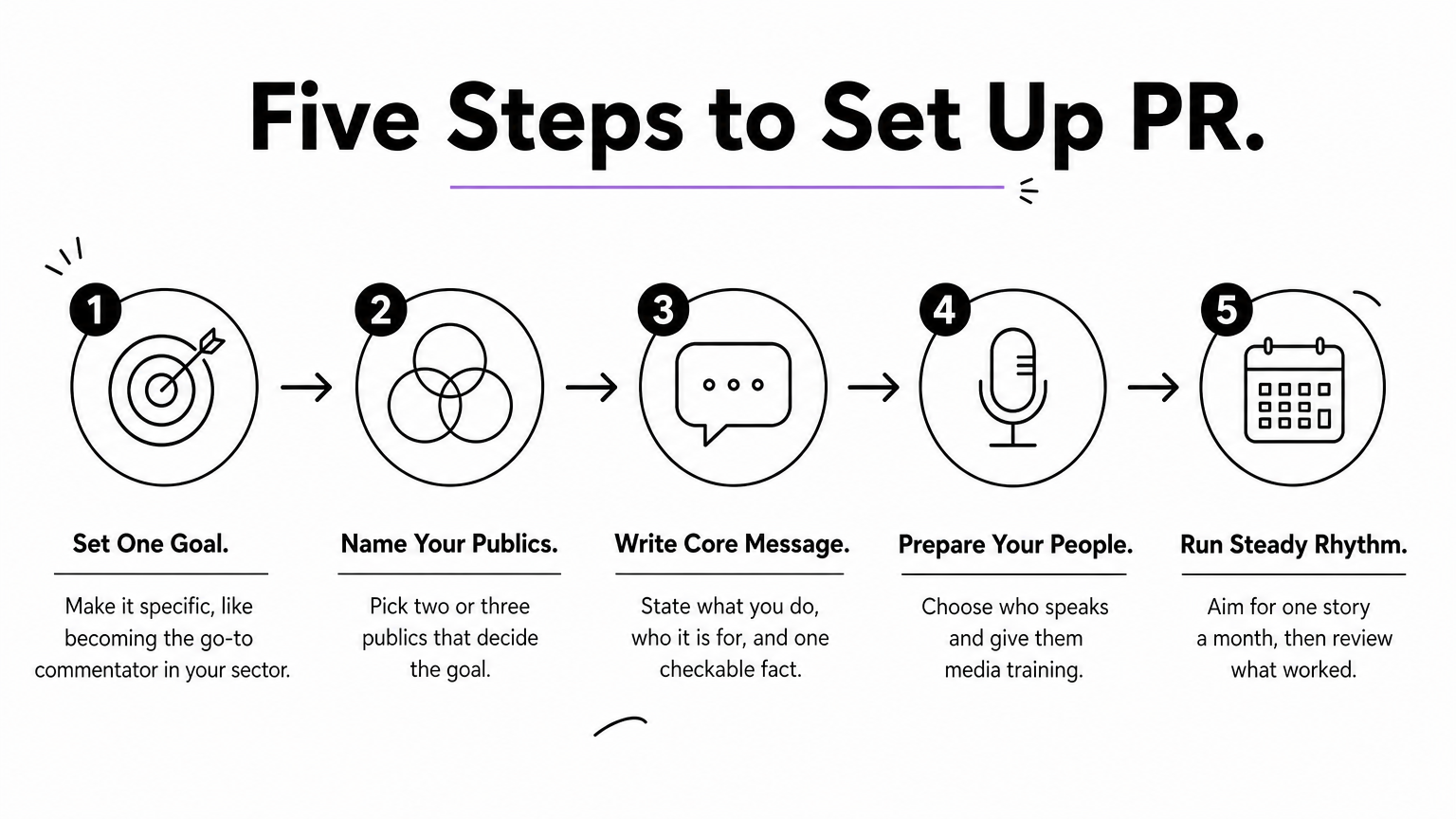
- Set one goal. Make it specific, such as becoming the go-to commentator on a topic in your sector, or attracting better job applicants.
- Name the publics that decide the goal. Pick two or three from the table earlier, not all of them.
- Write a core message. State what you do, who it is for, and one fact a journalist can check. Every channel reuses it.
- Prepare your people. Choose who speaks for the business, and give them media training so they stay on message and handle difficult questions calmly.
- Run a steady rhythm. Aim for one story a month, such as a release, an opinion article, or expert commentary, then review what worked.
Rhythm is where most plans fail. A burst of activity around a launch followed by months of silence leaves journalists with nothing to remember you by. A modest monthly story builds recognition that a single big push cannot.
A worked example: launching a new product
Imagine a 60-person South African software company launching a cyber security product for mid-sized firms. The table shows how the six functions turn into a plan, with timing that a small team can manage. The company’s own details will change the dates, not the order.
| Function | What the company does | When |
|---|---|---|
| Research and counsel | Reviews recent trade and business coverage of the topic and lists 10 journalists who write about it | Weeks 1 to 2 |
| Content | Writes a press release, an opinion article by the technical lead, and a customer case study | Weeks 2 to 4 |
| Crisis readiness | Drafts honest answers to hard questions, such as how the product handles customer data | Before launch |
| Internal communication | Briefs all staff so that they can answer questions from clients | The day before launch |
| Media relations | Offers the story to one outlet first, then pitches more widely and offers interviews | Weeks 4 to 6 |
| Review | Checks coverage, LinkedIn engagement, and inbound inquiries against the goal | Week 8 |
No plan guarantees coverage, because editors make that call. What the plan does is raise your odds by making each pitch relevant, well supported, and backed by a prepared spokesperson. It also leaves you with reusable content even when a pitch does not land.
How PR differs from marketing and advertising
PR earns trust through relationships and independent coverage, marketing creates demand for products, and advertising pays for placement. The three overlap, but they have different goals and give you different levels of control over the message.
In PR you write the pitch, but the editor decides what runs, and that independence is what makes it credible.
Side by side
The table sets the three disciplines against each other. Notice the control column, because it explains most of the trade-offs.
| Discipline | Main goal | Who controls the final message | Typical output |
|---|---|---|---|
| Public relations | Earn understanding, trust, and reputation | The company pitches, and editors decide what runs | Media coverage, expert commentary, stakeholder engagement |
| Marketing | Create demand and support sales | The company | Campaigns, collateral, newsletters, website content |
| Advertising | Promote a specific message in paid space | The company, which pays for the placement | Adverts, sponsored posts |
Crisis management, internal communication, and government relations sit with PR rather than marketing. A marketing team rarely handles a data breach statement or a regulator’s questions, while a PR team does.
How they work together
In smaller businesses, one person often handles all three, so the disciplines need to share one message and one calendar. Otherwise the press release says one thing, the campaign says another, and the sales deck says a third.
Sequence helps too. Independent coverage gives you proof that you can reuse in sales materials and on LinkedIn, with the outlet’s permission where needed. Advertising and marketing then amplify that credibility, while PR continues to build it.
Who carries out the public relations function
An in-house communications team, an outside agency, or a mix of both can carry out the public relations function. The right choice depends on how much work you have, what you can spend, and whether you already have relationships with journalists.
Whoever does the work, one senior person inside the business must own the message and approve what goes out.
In-house, agency, or both
Each setup has real strengths and limits. Most growing businesses end up with the third option.
| Option | Strengths | Limits |
|---|---|---|
| In-house | Deep knowledge of the business, fast response, always available | Limited media contacts, limited capacity, depends on one person’s skills |
| Agency | Existing media relationships, experience across industries, extra capacity | Needs a good briefing, less day-to-day immersion |
| Mix | In-house owns messaging and spokespeople, agency handles pitching and content | Needs a clear split of responsibilities |
Common PR roles
Job titles vary between organizations, but the work falls into recognizable roles. In a small business, one person often covers several of them.
- PR or communications officer: runs the day-to-day program and writes much of the content.
- Media relations manager: pitches stories, arranges interviews, and tracks coverage.
- Content writer: produces releases, articles, newsletters, and website copy.
- Social and community manager: looks after the organization’s presence on social platforms.
- Crisis communications specialist: prepares response plans and leads the response when needed.
- Head of communications: sets the strategy and advises leadership.
When an agency makes sense
An agency makes sense when you have real expertise but little public visibility, when nobody on your team has time to pitch consistently, or when you lack media relationships in your market. Purple Word Box, led by Maria Joubert, who has more than 20 years of PR experience, covers PR strategy, press releases, media pitches, thought leadership articles, interviews, and media follow-ups. Spokespeople who need more confidence can add media training.

International teams have a related need. A US or UK technology company entering Africa needs someone who knows how the South African media work and how to translate a global message for local journalists. Purple Word Box manages PR for UK and US brands that want to launch in Africa, and Maria spent 11 years working in UK agencies before returning to South Africa.
How to tell whether the PR function is working
You can tell the PR function is working by judging it against the goal you set at the start, using a few measures for each function, and reading them together. Coverage alone does not prove commercial impact, so pair it with signs of audience response, such as inquiries and engagement.
Count outcomes that serve your goal first, and treat the volume of coverage as supporting evidence only.
Measures that match each function
Different functions need different yardsticks. Pick a small set and review it on a fixed schedule, such as every quarter.
| Function | What to track |
|---|---|
| Media relations | Whether coverage appears in the right outlets, carries your message, and quotes your spokesperson, plus journalists who come back |
| Content | Reads, shares, LinkedIn engagement, and website visits from articles |
| Internal communication | Staff feedback and a drop in repeat questions |
| Community and government relations | Invitations, partnerships, and regulator or industry body engagement |
| Crisis readiness | Time to a first statement in a practice run, and how quickly approvals come |
| Overall reputation | Inbound inquiries, leads who mention coverage, and what appears when you search your company name |
A simple habit helps: ask every new client or applicant how they heard about you. The answers show which activities reach real people, which no coverage count can.
What PR cannot promise
No honest practitioner can guarantee earned media coverage, because editorial decisions sit with journalists and editors. Be wary of anyone who promises a placement in a named outlet by a fixed date. What a good PR function can promise is sound work: relevant stories, well-targeted pitches, prepared spokespeople, and consistent follow-up.
Patience matters too. Relationships with journalists and recognition among your publics build over months, not days. If the numbers show attention without the response you wanted, revisit the audience, the message, and the timing before you change everything.
Where to start with your public relations function
The public relations function comes down to one idea: manage the relationships that decide whether your business is understood and trusted. Do that through six linked jobs, which are research and counsel, media relations, content, internal communication, community and government relations, and crisis management. Start small, with one goal, a few publics, and a message you can prove.
Choose the function that is weakest today and fix that first. For many businesses it is media relations or executive visibility, because expertise exists but few people hear about it. If you want senior help setting that up, talk through your communication goals with Purple Word Box and get a quote based on the scope of your work.