

Media relations management is the ongoing work of planning, building and maintaining relationships with journalists and media outlets so that your organization earns accurate, favorable coverage. It covers which stories you tell, which outlets you approach, who speaks for you, when you release news, and how you respond when coverage turns critical. The coverage is earned, not bought, and the journalist decides what runs.
In public relations, you will also see this called media management. It is the part of PR that deals with the press, and it works best as a standing discipline instead of a string of press releases sent whenever something happens. The businesses that get quoted again and again are rarely luckier than the rest. They are more organized, more useful to reporters, and more patient.
This guide explains why media relations management matters, how to plan it, how to find stories worth pitching, and how to build relationships with journalists. It then covers the tools you need, how to prepare spokespeople and handle a crisis, and how to measure results. The examples reflect how South African businesses work with the media, and draw on the practice of Purple Word Box, a PR agency in South Africa.
Why media relations management matters for your business
Media relations management matters because coverage in a trusted publication does something your own marketing cannot: it lets a credible third party vouch for you. Managing the work as a system, instead of chasing the occasional mention, is what turns that vouching into a lasting reputation.

Coverage carries third-party credibility
When you call your company an industry leader, readers discount the claim. When a journalist at a respected title quotes you as an expert, readers take it more seriously, because the publication has put its own name behind the choice. That is third-party endorsement, and it is the core reason media relations exists.
The benefit does not stop with that outlet’s readers. Good coverage gets shared on LinkedIn, appears in search results for your company name, and gives your sales team something credible to send a prospect. Investors, partners and job candidates also tend to check what the press has said about you before they commit to a meeting.
Advertising tells people you are credible. Media relations lets someone else say so.
Where it sits inside public relations
Media management in public relations is one function of a wider discipline. PR also includes internal communication, social media, events, stakeholder engagement and reputation work. Media relations is the strand that deals with journalists, editors, producers and podcast hosts. Management is what you add on top: a plan, clear owners, shared messages and a way to measure.
In practice, the work breaks down into six jobs:
- Developing stories and angles that fit what newsrooms actually cover
- Building and maintaining a targeted media list
- Pitching, writing releases and supplying background material
- Preparing spokespeople and coordinating interviews
- Monitoring coverage and acting on it
- Handling issues and crises with the press
Why one-off efforts fail
A single release sent to a long list once a quarter rarely works. Journalists remember who was helpful, accurate and quick, and who wasted their time. A reporter who has used you as a source three times will call you first when the next related story breaks. That compounding effect cannot be created on launch day.
There is a second reason to manage the work properly. Coverage is a means to an end. You want people to buy, apply, invest, trust or change their behavior, and a feature that nobody acts on is a nice clipping, not a result. Management keeps the link between coverage and business objectives visible, which is why the next section starts there.
How to build a media relations management plan
A workable media relations plan fits on one or two pages and has five parts: objectives, audiences, key messages, a story calendar and measures. Write it before you contact a single journalist, because it decides what you pitch and what you politely skip.
Start with business objectives, not coverage targets
"Get into the newspapers" is not an objective. Start with what the business needs, then work out what kind of coverage would help. The table shows how that translation works.
| Business objective | Media goal | Signal that it worked |
|---|---|---|
| Launch a product | Trade and business press coverage in the launch month | Demo requests that mention the article |
| Win investor confidence | Business media features on results and leadership | Inbound investor enquiries |
| Recruit senior staff | Profile pieces on leaders and culture | Applications that reference the coverage |
| Build industry authority | Regular expert comment in sector titles | Journalists asking you for comment, speaking invitations |
Define audiences, messages and spokespeople
List the audiences you want to reach, such as customers, regulators, investors or future employees. Then check which outlets they read, watch or hear. A procurement manager reads different titles from a retail shopper.
Next, write no more than three key messages, each with one proof point such as a figure, a customer result or a fact. Finally, name who speaks on which topic. Your CEO may be right for strategy, while your head of engineering is better for a technical story.
Build a 90-day story calendar
A calendar stops you from pitching only when you feel like it. Here is an illustrative example for a mid-sized software company launching a product.
- Month 1, preparation: build the media list, agree messages, train two spokespeople, write the launch release and assemble the media kit.
- Month 2, launch: offer the story first to one priority outlet, send the release to trade and business media a day later, and place a leadership opinion article.
- Month 3, follow-through: pitch a data story drawn from early usage, offer a named customer result to a trade title, and review what worked.
What to run in-house and what to outsource
Keep relationships with the journalists you already know, quick comment requests and day-to-day monitoring in-house. Outsource when you lack time, story judgment or media contacts. Story development, list building, writing and crisis support are the usual candidates.
Agencies differ in what they cover. Purple Word Box, for example, offers PR strategy, press releases, media pitches, content placements and media training, and it also manages PR for UK and US brands that want to launch in Africa. Whatever you choose, ask who will actually do the work and which journalists they speak to regularly.
A media relations plan starts with what the business needs, then works backward to the coverage that would help.
How to find stories journalists want to cover
Journalists cover what is new, relevant to their audience and either useful or surprising. Your product launch rarely meets that bar on its own, so media relations management means finding the angle around it that does.

Test every idea against news values
News values are the unwritten criteria that newsrooms use to pick stories. Before you pitch, run your idea through this list and be honest about how many it meets:
- New: something readers did not know yesterday
- Surprising: it contradicts an assumption or a common belief
- Relevant: it matters to this outlet’s specific audience
- Significant: it affects many people or a lot of money
- Tension: there is a problem, a dispute or a risk in it
- Evidence: it comes with data, not adjectives
- Visual: there is a strong image, chart or demonstration
- Timely: it connects to something already in the news
Then apply the "so what?" test. "We opened a new office" is information. "We opened a new office because demand outside the metros tripled" starts to look like news. If you cannot finish the sentence "this matters to your readers because…", you do not have a pitch yet.
Story types that work for businesses
You do not need a breakthrough every month. Most business coverage comes from a handful of repeatable story types.
| Story type | Example | Suits |
|---|---|---|
| Original data | Findings from a customer survey or your own transaction trends | Business and trade media |
| Expert commentary | A same-day reaction to a regulation or market move | News desks, radio, online news |
| Named customer result | A client with a measurable outcome, quoted by name | Trade titles |
| Leadership opinion | A firm position on an industry problem | Business sites, trade titles |
| Milestones | Funding, key appointments, major contracts | Business pages |
Be honest about what is not news
Dressing up a non-story damages your credibility faster than anything else. A reporter who opens three weak pitches from you will stop opening the fourth. If the news is mild, fold it into a bigger conversation, such as a trend your data speaks to, or hold it for your own channels.
Good news alone often struggles in a newsroom, because most headline stories involve problems. The way through is to attach your good news to a problem readers already care about. Show how your solution, research or expertise answers it.
If you cannot say why a journalist’s readers should care, you do not have a pitch yet.
How to build and maintain relationships with journalists
Build relationships with journalists by being consistently useful: know what each one covers, send only relevant material, respond fast and never mislead them. Trust accumulates slowly and disappears quickly, so treat each interaction as part of a long account.
Build a targeted media list
A good media list is short and researched. Start with outlets your audiences actually use, including national and regional newspapers, business and trade titles, online news sites, radio, television, podcasts and newsletters. Then identify the specific people who cover your topic, and read or listen to their recent work before you add them.
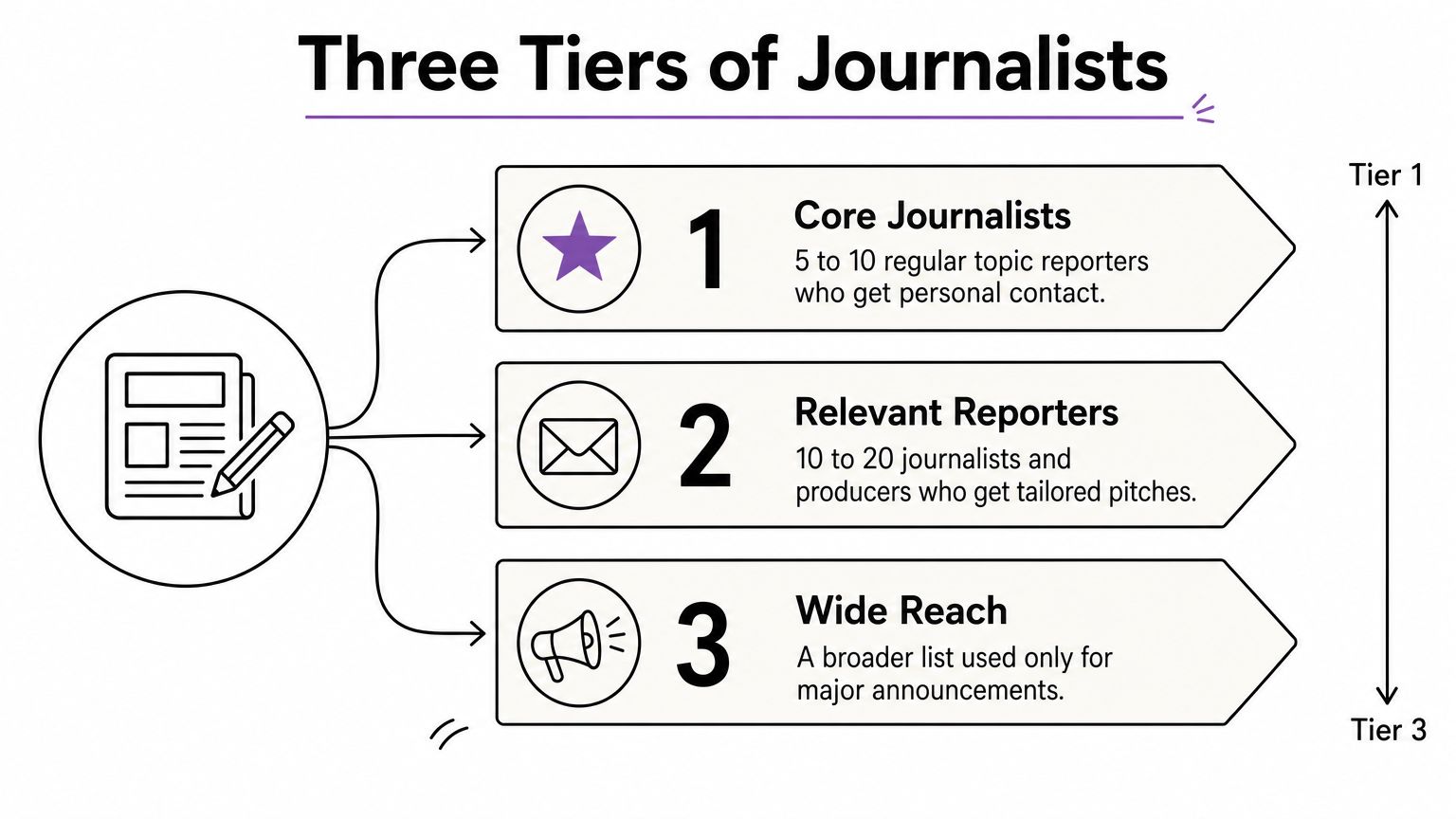
Sort the list into tiers. As a guide for a small business:
- Tier 1: 5 to 10 journalists who cover your topic regularly and could shape your reputation. These get personal, tailored contact.
- Tier 2: 10 to 20 relevant journalists and producers. These get tailored pitches when the story fits.
- Tier 3: a wider list for major announcements only.
For each name, record their beat, the last piece they wrote on your topic, their preferred channel, and their deadlines. A spreadsheet is enough.
Make first contact useful
Do not make your first message a pitch if you can avoid it. Read the journalist’s recent work and send something that helps them: a relevant data point, an introduction to a source, or a correction to a technical detail. Or simply offer a background conversation with no story attached.
Early-career journalists often need a source who will explain an unfamiliar sector patiently and accurately. Helping them get a story right, even when it has nothing to do with you, is how trusted relationships start. Many practitioners describe the role as the reporter’s friend, and the description holds up.
Keep the relationship healthy
Maintenance matters more than the first approach. These habits keep goodwill intact:
- Reply within hours when a journalist asks for something. Their deadline is not your deadline.
- Give accurate information, and say so plainly when you do not know something.
- Do not chase every release with a phone call. One short follow-up that adds something new is enough, then move on.
- Ask which channel each journalist prefers, and respect it.
- Share and credit their work when it runs, without demanding anything in return.
- Never lie to protect the company. One caught lie ends the relationship.
Journalists keep returning to the source who is accurate, quick and relevant, so be that source every time.
The core tools: press releases, pitches and media kits
Use a press release for announcements, a pitch for a tailored one-to-one approach, and a media kit for background. Each tool has its own job, and confusing them is why so many messages go unread.
Writing a press release that gets read
A press release is still worth writing. Cision’s 2024 State of the Media report found that nearly three in four journalists want to receive press releases from PR professionals, though many also want original research and exclusives. The format matters, because journalists scan for the story in seconds.
Write it in the inverted pyramid style, with the most important fact first and the least important last. The opening paragraph should answer who, what, where, when, why and how. Then follow this structure:
- Headline: specific, factual, in plain language.
- Opening paragraph: the news and why it matters.
- Supporting detail: data, context, background.
- Quote: a named person with their title, saying what the news means for the people affected. "We are delighted" tells a reader nothing.
- Boilerplate: two or three lines on the company.
- Contact details: a person who will pick up the phone.
Keep it to roughly one page, use short sentences, avoid jargon, and refer to your company as "it" or "the company", not "we".
Pitching by email: a template
A pitch is a short, personal note that sells the story to one person. Keep it under 150 words, put the angle in the subject line, and show that you have read their work. Here is a template you can copy and adapt.
Subject: [One-line finding or angle] for [journalist's readers]

Hi [First name],

I read your piece on [topic] last week, especially your point about [specific detail].

We have [new data / a spokesperson / a customer result] that adds to it: [one-sentence headline of the story, with a number if you have one].

Why it matters to your readers: [one sentence].

I can send [the full data / a summary / photos] today, and [Name, title] is available for an interview on [dates].

Thanks for your time,
[Name]
[Title, company]
[Phone number]
Building a media kit
A media kit saves a journalist from asking you for basics. Host it on a page of your website so it is easy to find, rather than sending heavy attachments. Include:
- A short company overview and your boilerplate
- A fact sheet with key figures, dates and product details
- Short biographies and good photographs of your spokespeople
- Logos in high resolution
- Links to recent coverage and relevant research
- A named media contact with a phone number and email
Keep it current. A kit with last year’s figures in it signals carelessness.
Match the tool to the job: a release announces, a pitch persuades, and a kit supports.
Managing spokespeople, interviews and timing
Choose spokespeople by topic expertise, prepare each one with three key messages, and use exclusives and embargoes sparingly. Interviews are where media relations either pays off or goes wrong, and most of the difference is made before the call.
Choose and prepare your spokespeople
The most senior person is not always the best voice. A subject expert who explains clearly often beats an executive who talks in slogans. Choose a small group, assign each a topic, and make sure they are available at short notice, because interview requests tend to arrive with tight deadlines.
Preparation is practical. Give each spokesperson a one-page sheet with the three key messages, a proof point for each, the three hardest questions they might face, and the topics the company will not discuss. Then rehearse out loud. Purple Word Box offers media training for exactly this purpose, covering leaders, executives, spokespeople and subject experts who need to stay on message.
Ground rules for interviews
Agree the basics before you start: the topic, the format, the length and who else is being interviewed. Answer the question first, then add your message. Short, concrete answers get quoted. Long, hedged ones get cut.
Treat everything as on the record unless the journalist has explicitly agreed otherwise before you say it. "Off the record" is a risk even with a journalist you trust, so use it rarely, if at all. Do not demand to approve copy, which most newsrooms will refuse. It is fine to offer to check facts and figures. Follow up the same day with any data or spellings you promised.
Exclusives and embargoes
You can control timing in three ways, and each carries a trade-off.
| Approach | What it means | Use it when | Main risk |
|---|---|---|---|
| Open release | Sent to all outlets at once | The news is broad and no outlet is the obvious lead | Nobody feels ownership, so nobody runs it |
| Exclusive | One outlet gets the story first | The story is strong and you want depth from one title | Other outlets feel passed over, and you lose control of the angle |
| Embargo | Shared early, to be published after a set time | The news is complex, data-heavy or tied to an event | A journalist may break it, or the event may change |
Use an embargo only when there is a credible reason for it, such as a speech or a report launch. If the embargo covers a speech, mark the material "check against delivery", because speeches change or are cancelled. If a journalist breaks an embargo, you can withhold future exclusives, but think twice before closing the relationship altogether.
Spokespeople win interviews before the call starts, through preparation and three clear messages.
Handling crises and negative coverage
Handle a crisis by responding quickly, factually and through one spokesperson, and never by going silent. How fairly the media treats you in a crisis depends heavily on the relationships and credibility you built before it.
Prepare before anything goes wrong
A crisis plan does not need to be long. It needs to answer who decides, who speaks, who approves and how fast. List your most likely scenarios, such as a data breach, a product fault, a service outage or a serious complaint. For each, agree a decision-maker, a legal reviewer, a trained spokesperson and a contact list that is stored somewhere you can reach it outside the office.
Draft a holding statement for each scenario in advance. You can issue it within the first hour while you gather facts.
We are aware of [brief factual description of the situation]. We are gathering the facts and will share an update by [time].

Our priority is [the people affected]. For questions, please contact [name] on [phone] or [email].
Respond when the story breaks
Work through the same steps each time:
- Confirm the basic facts before you say anything public.
- Tell your employees before or at the same time as the media. They will be asked about it.
- Issue the holding statement, then a fuller statement as facts firm up.
- Use one spokesperson, so the company says one thing.
- Commit to update times, and keep them.
- Monitor coverage and social media so you can correct errors quickly.
If your company is listed on the JSE, price-sensitive information must reach the market through the exchange’s announcement service (SENS) before it goes to the media. Confirm the rules with your legal or sponsor team before any announcement.
Correct errors and respond to criticism
Separate factual errors from unfavorable opinion. You can ask for a correction of the first. You cannot demand the removal of the second. Start with the journalist, politely and with evidence. If that fails, escalate to the editor. For publications that subscribe to the Press Council of South Africa, the Press Code and the Press Ombud offer a formal complaints route.
Avoid arguing with a journalist in public. A calm, factual response with evidence usually does more for your reputation than an angry one, and it keeps the door open for future coverage.
In a crisis, speed and honesty matter most, and the relationships you built beforehand decide how fairly you are treated.
How to measure media relations management results
Measure outcomes, not coverage counts: did the coverage change what your audience thinks or does, in line with the objectives in your plan? Counting clippings is easy. Linking them to business results takes a little more work, and that work is the difference between PR as a cost and PR as an investment.
Track inputs, outputs, outtakes and outcomes
The AMEC Integrated Evaluation Framework, widely used in the industry, separates the process into stages. The table applies it to media relations.
| Stage | What it measures | Examples |
|---|---|---|
| Inputs | Your activity | Pitches sent, interviews arranged, releases issued |
| Outputs | The coverage you secured | Articles, broadcast mentions, quotes |
| Outtakes | How audiences reacted | Message pull-through, shares, comments |
| Outcomes | What changed as a result | Enquiries, leads, applications, behavior change |
Here is a worked example. You pitch 20 journalists in a quarter. Six reply, a 30% reply rate. Three publish, a 15% placement rate. Two of the three articles carry your key message, and 14 website enquiries mention the coverage. The pitch-to-placement ratio shows how well your targeting works, and the enquiries show whether the coverage did its job.
Avoid advertising value equivalence, which multiplies the assumed ad cost of coverage by a factor. It is discredited because it says nothing about what audiences thought or did.
Build a simple monthly review
You do not need expensive software to start. Set up alerts for your company name, your spokespeople and your competitors, and Google Alerts is a free option. Then log every piece of coverage in a spreadsheet with the outlet, date, link, tone, whether your key message appeared and what action followed.
Once a quarter, review the log. Ask which angles earned coverage, which journalists responded, which outlets drove enquiries and which stories went nowhere. Then adjust the plan. The review is where media relations management becomes management rather than activity.
Use AI without hurting your relationships
AI tools can draft a press release in seconds, which means journalists now receive more competent but generic pitches. What stands out is what AI cannot invent: a real angle, original data, a named expert and evidence that you read the journalist’s work. Use AI for first drafts, for summarizing coverage, for preparing tough questions and for translation. Keep a person responsible for the facts, the tone and the final send.
Purple Word Box explores this shift in its "PR in an AI era" campaign, which you can see at purplewordbox.media.
Measure what coverage changed in your audience, not how much of it you collected.
Making media relations work for you
Media relations management comes down to a few habits: plan around business objectives, pitch stories that pass the "so what?" test, treat journalists as long-term contacts, prepare your spokespeople, and measure outcomes instead of clippings. None of it needs a large budget. It needs consistency and honest judgment about what is actually news.
If you would rather have senior help with the strategy, the pitching or the media training, talk to Purple Word Box about PR and media relations help. You will deal directly with an experienced practitioner who has more than 20 years in PR, including 11 years in UK agencies, and who can help you find the stories worth telling.