

Thought leadership is the practice of becoming a trusted source in a specific field by sharing original ideas, hands-on experience and a clear point of view that helps other people decide and act. The meaning has two halves. You publish useful insight, and your audience, peers and journalists decide whether you have earned the label. Nobody becomes a thought leader by announcing it.
This article goes beyond the bare definition. You will see why thought leadership matters, how to build it step by step, the main types for individuals and brands, and a list of ideas you can use straight away.
Purple Word Box is a South African PR and communication agency, and helping business leaders build a credible public voice is part of its daily work. Founder Maria Joubert has more than 20 years of PR experience. The advice below reflects how opinion articles, media pitches and LinkedIn content work for real businesses.
Why thought leadership matters for your business
The purpose of thought leadership
The purpose of thought leadership is to earn trust before anyone is ready to buy. People choosing a supplier, an adviser or an employer look for proof that you understand their problem. Thought leadership gives them that proof in public, before any sales conversation starts.

Done well, it delivers several things:
- Credibility with customers who have never worked with you.
- Media access, because journalists quote people with clear, defensible views.
- Warmer enquiries, since prospects arrive already knowing how you think.
- Easier hiring, because good candidates want to work with people who know their field.
- A voice in industry debates that you would not otherwise be invited into.
Thought leadership works because it proves your expertise before you ask for anything.
Thought leadership content versus ordinary content
Thought leadership content is content that changes how readers think about a problem, written by a named person who has real experience of it. Ordinary content mostly aims to be found or to explain a product. The difference shows up in a few places:
| Ordinary content | Thought leadership content | |
|---|---|---|
| Main goal | Attract clicks, explain offers | Shift how readers see a problem |
| Voice | Generic brand voice | Named expert with experience |
| Position | Neutral and safe | Clear, defensible stance |
| Proof | Claims | Data, examples, lived experience |
| Success test | Is it found? | Is it quoted, shared, remembered? |
Content marketing is the vehicle. Thought leadership is the outcome you earn when that content is original and credible enough that people repeat it.
How to build thought leadership step by step
Five steps from expertise to authority
You build thought leadership by choosing a narrow field, taking a stance, backing it with proof, and publishing consistently. Here is the sequence that works:
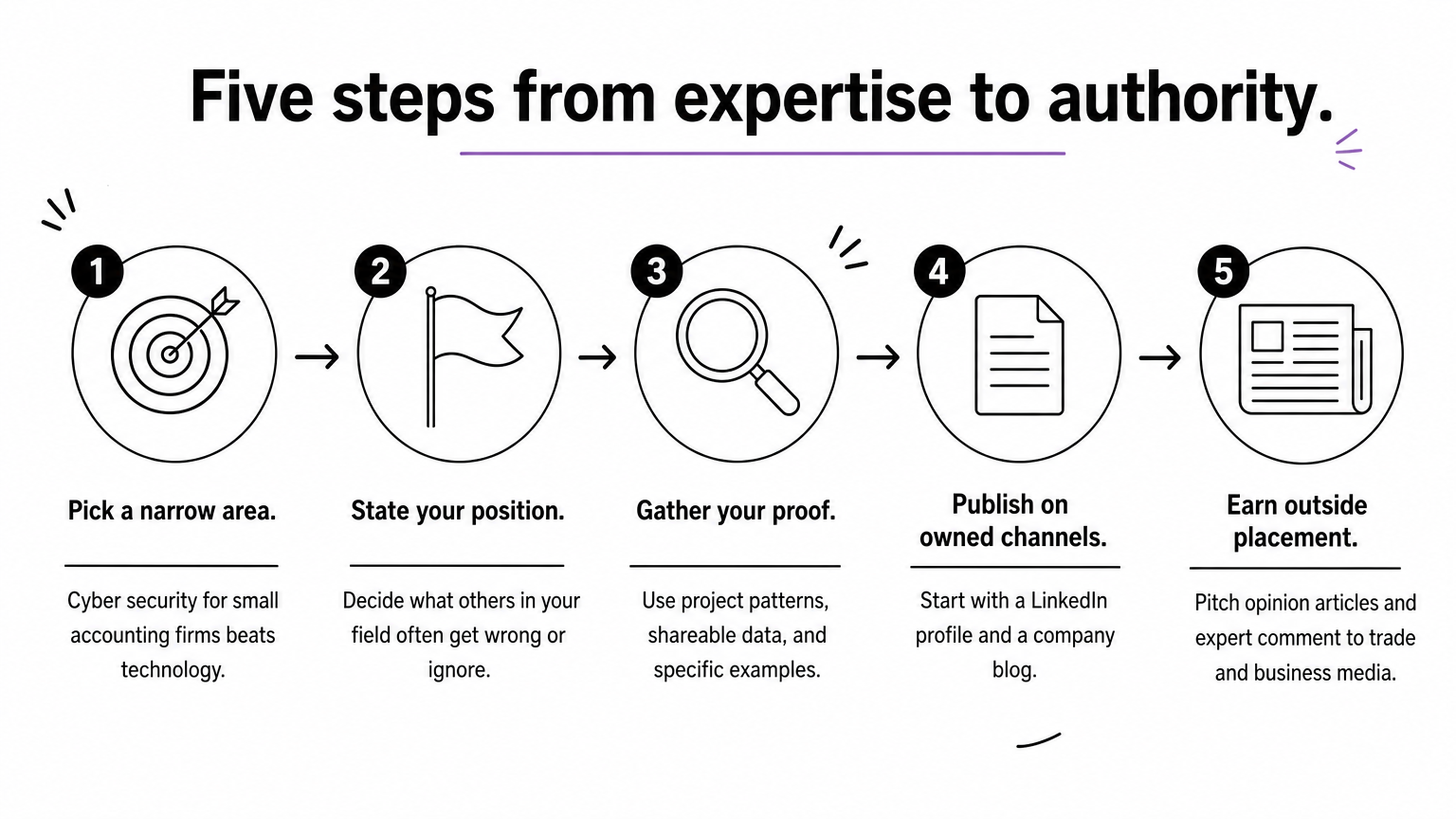
- Pick a narrow area. "Cyber security for small accounting firms" beats "technology".
- State your position. Decide what you believe that others in your field often get wrong or ignore.
- Gather proof. Use your own project patterns, data you can legally share, and specific examples.
- Publish on channels you own. A LinkedIn profile and a company blog are the usual starting points.
- Earn placement elsewhere. Pitch opinion articles and expert comment to trade and business media.
Expect months, not weeks. The signals to watch are quality ones: media requests, speaking invitations and prospects who quote your ideas back to you.
A template for your point of view
A strong stance is usually one sentence you can complete. Copy this and fill it in:
Most [audience] believe [common view].
In practice, [your view], because [evidence or experience].
That matters because [consequence for the reader].
For example: "Most small businesses believe cyber security is an IT problem. In practice it is a staff-habits problem, because so many incidents begin with a single phishing email. That matters because buying more software will not fix it." Every article, post and interview then develops that one idea.
If time is the obstacle, this is the kind of work a PR partner can take on. Purple Word Box writes thought leadership articles as part of its PR and media relations service, and thought leadership posts for LinkedIn profiles through its Social & Profile service.
A thought leader is built on one clear, defensible position repeated in many useful ways.
Types of thought leadership
Individual and corporate thought leadership
Thought leadership comes in two owners: a person or an organisation. Individual thought leadership is a founder, executive or specialist building a personal voice through bylined articles, LinkedIn posts, interviews and talks. People follow people, so this type often moves fastest.

Corporate thought leadership, sometimes called brand thought leadership, means the organisation owns a position. It usually appears as research reports, whitepapers and a steady editorial line, often with several spokespeople. The strongest approach combines both. The brand sets the theme, and its leaders give it a face. A brand position only holds when it matches what the company actually does.
Four types by content approach
Practitioners group thought leadership in different ways. A useful split is by what the content does for the reader:
| Type | What it does | Typical format |
|---|---|---|
| Visionary | Explains where the industry is heading | Annual predictions, keynote talks |
| Expert and educational | Teaches how to solve a real problem | How-to articles, explainers, webinars |
| Research-led | Offers original data or analysis | Surveys, benchmarks, whitepapers |
| Challenger | Questions accepted wisdom | Opinion articles, LinkedIn posts |
Choose one primary type rather than all four. The expert and educational type is the easiest starting point, because it needs only your experience. Research-led work needs budget and method, so add it once you have an audience.
Pick one type that fits the evidence you already have, then add others as your authority grows.
Thought leadership ideas you can use right away
Eight idea starters
The best ideas come from questions your market already asks. Use these as prompts:
- Answer the five questions clients ask you most, in full and with your own view.
- Write an opinion piece that disagrees with a common belief in your industry.
- Share a "what we got wrong" lesson from a project, with what you changed.
- Comment on a regulation change or news event while people are still discussing it.
- Make a prediction for the year ahead and show the reasoning behind it.
- Turn patterns you see across your work into a short benchmark or report, with client details removed.
- Package a complex topic into a simple framework or checklist.
- Offer yourself as a spokesperson to journalists who cover your topic.
Each idea can become a LinkedIn post, a blog article, a media pitch and a conversation starter for your sales team. Reuse one strong idea across formats rather than inventing something new every week.
Mistakes that weaken credibility
The most common mistake is turning thought leadership into a sales brochure. Readers spot a disguised pitch within a paragraph. Close behind are topics that are too broad, opinions nobody could disagree with, and bursts of posting followed by months of silence.
Another trap is generic writing with no named experience in it. If a competitor could publish your article by swapping the logo, it is not thought leadership. Add a specific example, a number you can defend or a story from your own work.
If your competitor could publish your article under their name, it is not thought leadership yet.
Pick one position and start publishing
Thought leadership means being a trusted voice with a clear point of view, earned through useful ideas shared consistently. It builds trust before the sale, whether you are a leader building a personal profile or a company building a brand position. Start with a narrow field, state one stance you can defend, back it with real evidence and publish it where your audience and the media will see it.
If you would rather have an experienced practitioner shape and place your ideas, talk to Purple Word Box about building your thought leadership. You can start with one sentence of what you believe about your industry, and take it from there.